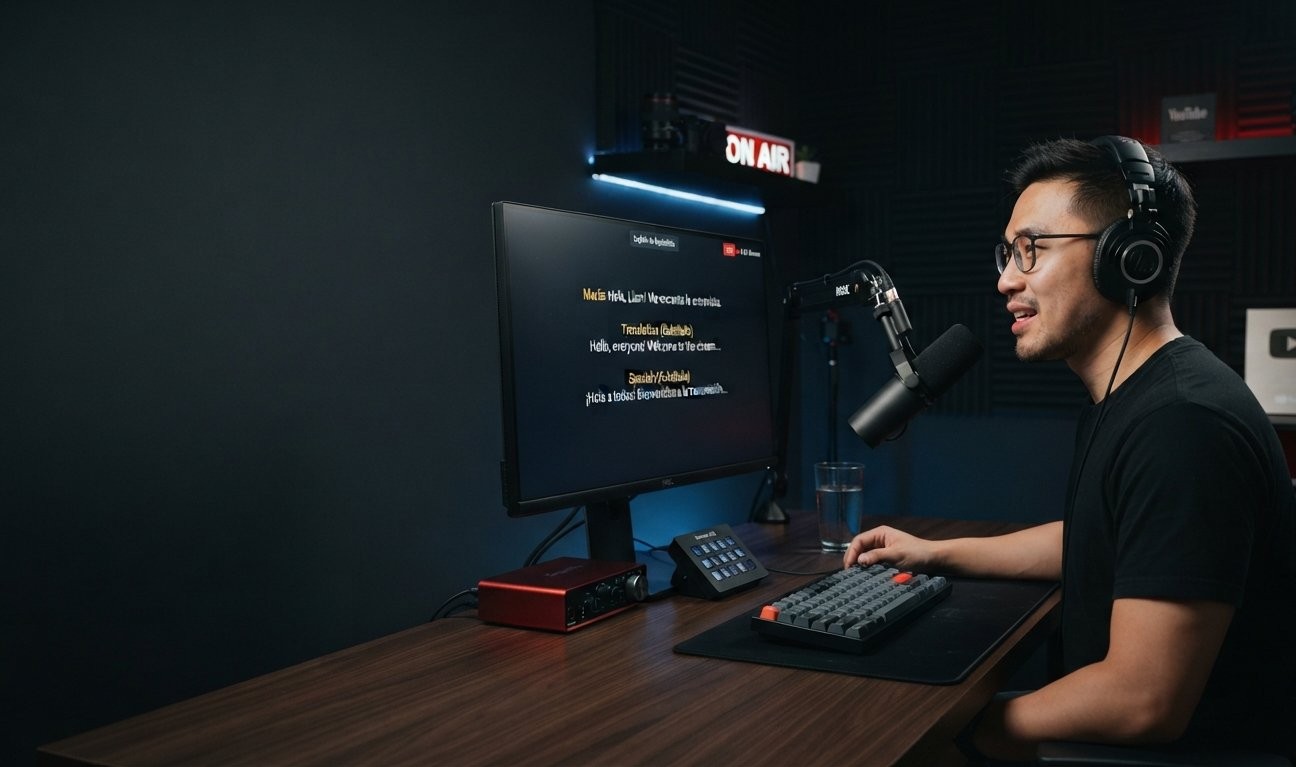

The Complete Wiki to YouTube Live Auto-Dubbing
YouTube Live auto-dubbing is an upcoming feature designed to remove one of the biggest barriers between livestreamers and international audiences: language.
YouTube announced the feature during its Made on YouTube 2026 event on September 23, with a creator-focused update published shortly afterward. The company says it plans to begin a small pilot in early 2027, initially testing real-time auto-dubbing in English and Spanish.
Unlike traditional YouTube auto-dubbing, which generates translated audio for uploaded videos, Live auto-dubbing is designed to work while a creator is broadcasting.
That means someone speaking English during a livestream could potentially have their speech translated into Spanish for viewers watching in another region, without the creator needing to manually record a second-language audio track.
YouTube says this is particularly relevant to livestreaming because more than 40% of live watch time comes from viewers outside a creator's home country.
Quick Facts
| Feature | Details |
|---|---|
| Feature | YouTube Live Auto-Dubbing |
| Announced | September 23, 2026 |
| Creator Update | September 2026 |
| Pilot | Early 2027 |
| Initial Languages | English and Spanish |
| Main Technology | Real-time speech translation |
| Primary Goal | Reach viewers across language barriers |
| Target Content | YouTube livestreams |
| Viewer Experience | Listen in a preferred language |
| Current Status | Upcoming pilot |
| Global Live Watch Time | Over 40% from outside creators' home countries, according to YouTube |
| Wider Rollout | Not yet announced |
What Is YouTube Live Auto-Dubbing?
YouTube Live auto-dubbing is an AI-powered translation system designed specifically for livestreams.
Instead of waiting for a creator to finish a broadcast and manually produce another language version, the system is intended to translate spoken language during the livestream.
YouTube describes the feature as automatically translating a creator's speech in real time so viewers can listen in their preferred language.
The concept can be simplified into:
Creator speaks → YouTube processes speech → AI translates it → Viewer hears translated audio
The feature is therefore different from:
- Live captions
- Traditional subtitles
- Manually uploaded dubbed tracks
- Human interpreters
- Post-production dubbing
The defining feature is the real-time audio translation.
The September Creator Update
YouTube's September 2026 creator update provided more context around the upcoming Live changes.
The company presented more than 30 creator and viewer updates during Made on YouTube 2026, including several new livestreaming tools. YouTube's creator-focused announcement specifically listed real-time auto-dubbing alongside Live Showdowns and expanded Watch With functionality.
The Live auto-dubbing system is still experimental.
YouTube says experimental features such as live auto-dubbing will initially be introduced through small pilot programs, allowing the company to gather feedback and make adjustments before wider availability.
This means the September announcement should not be interpreted as a full public rollout.
When Does the Live Auto-Dubbing Pilot Start?
The current official timeline is early 2027.
YouTube has not announced a specific day or month for the pilot.
The initial pilot is expected to focus on English and Spanish, giving YouTube an opportunity to test real-time translation between two widely used languages before potentially expanding the system.
The company has also not announced:
- The number of participating creators
- Exact eligibility requirements
- Whether the pilot will be invite-only
- The countries included
- Maximum stream length
- Supported streaming categories
- Whether all livestream formats will qualify
- The final list of languages for a wider release
Those details remain TBA.
How Live Auto-Dubbing Could Work
The basic experience is designed to be straightforward.
A creator starts a livestream and speaks normally.
YouTube's AI processes the creator's speech and produces a translated version for viewers who select another supported language.
For example:
English-speaking creator
↓
YouTube Live auto-dubbing
↓
Spanish-language audio
↓
Spanish-speaking viewer
The creator does not need to stop streaming and upload a separate Spanish version.
This is particularly important for live content because the value of livestreaming comes from being able to participate in the moment.
Why Real-Time Translation Matters for Livestreams
Language has always been more complicated for livestreaming than for traditional videos.
A creator can record a video, hire a translator, create subtitles, produce additional audio tracks, and publish localized versions later.
A livestream does not provide the same luxury.
If a creator is streaming for three hours, manually translating the entire broadcast afterward does not solve the problem for viewers who wanted to participate while the stream was happening.
Real-time dubbing addresses that gap.
YouTube says that over 40% of live watch time comes from viewers outside the creator's home country, highlighting the international audience already watching livestreams.
Reaching Regional Audiences
The biggest potential use case for Live auto-dubbing is regional audience expansion.
A creator who primarily broadcasts in English could potentially make the same livestream accessible to viewers in Spanish-speaking markets without creating an entirely separate channel.
This could be particularly relevant to:
- Gaming streamers
- Esports creators
- IRL streamers
- Podcasts
- Educational livestreams
- Technology channels
- Music discussions
- News and commentary creators
- Product launches
- Community events
The important point is that the feature is designed to expand the existing live audience, rather than requiring creators to build separate streams for every language.
Example: Gaming Streamers
Gaming is one of the clearest examples.
Imagine a creator streaming a new game in English.
Without live translation, Spanish-speaking viewers can still watch, but understanding rapid commentary, jokes, explanations, and live reactions may require strong English comprehension.
With Live auto-dubbing, the same broadcast could potentially be available with Spanish audio.
The creator can continue playing normally while YouTube handles the language conversion.
This could make a single international stream more accessible to multiple regional communities.
However, the actual quality of translations during fast-paced gameplay will depend on the final system's speech recognition, translation accuracy, latency, and handling of gaming terminology.
English and Spanish Are the Starting Point
YouTube's initial pilot is planned around English and Spanish.
That does not mean these will necessarily be the only languages supported in the finished product.
YouTube's existing auto-dubbing technology has already expanded substantially beyond those two languages.
In February 2026, YouTube said its standard auto-dubbing system had expanded to 27 languages, with expressive speech available across eight languages including English, French, German, Hindi, Indonesian, Italian, Portuguese, and Spanish.
However, Live auto-dubbing should not be confused with standard video auto-dubbing.
The fact that YouTube supports a language for uploaded-video dubbing does not mean that the same language is already confirmed for Live auto-dubbing.
Live Auto-Dubbing vs Regular Auto-Dubbing
| Feature | Standard Auto-Dubbing | Live Auto-Dubbing |
|---|---|---|
| Content | Uploaded videos | Livestreams |
| Timing | Post-upload | Real time |
| Translation | Generated after content processing | Generated during broadcast |
| Creator Workflow | Video is processed automatically | Creator streams normally |
| Main Challenge | Translation quality | Translation + low latency |
| Current Status | Available broadly | Early 2027 pilot |
| Initial Live Languages | N/A | English and Spanish |
| Use Case | Evergreen/global video library | International live communities |
YouTube's existing auto-dubbing system is already available broadly, while Live auto-dubbing is still being tested.
YouTube's Existing Auto-Dubbing Foundation
Live auto-dubbing is not being developed in isolation.
YouTube has already spent significant time developing automated dubbing for normal videos.
In February 2026, YouTube said auto-dubbing was available to everyone and had an expanded library of 27 languages. The company also reported that more than 6 million daily viewers watched at least 10 minutes of auto-dubbed content in December.
YouTube also introduced Expressive Speech, designed to make dubbed speech better preserve aspects of the creator's emotion and delivery.
That existing technology provides an important foundation for the move toward live translation.
Voice and Translation Quality
One of the biggest challenges for Live auto-dubbing is maintaining a natural conversation while translating speech almost instantly.
Livestreamers regularly use:
- Slang
- Memes
- Gaming terminology
- Abbreviations
- Names
- Fast speech
- Background noise
- Multiple speakers
- Jokes
- Improvised commentary
These conditions can be considerably harder for an AI translation system than carefully recorded studio speech.
YouTube has not yet published detailed performance targets for Live auto-dubbing, including a specific latency figure or accuracy rate.
Therefore, claims about exactly how quickly or accurately every livestream will be translated should be treated as unconfirmed.
Does Live Auto-Dubbing Replace Captions?
No.
The feature is designed to provide translated audio, while captions serve a different purpose.
Captions can remain useful for:
- Deaf and hard-of-hearing viewers
- Noisy environments
- Quiet viewing
- Language learning
- Checking unfamiliar words
- Situations where dubbed audio is inaccurate
Live auto-dubbing should therefore be viewed as an additional accessibility and localization layer rather than a universal replacement for captions.
Viewer Language Preferences
YouTube has already introduced greater control over language preferences for its regular auto-dubbing experience.
In February 2026, the company introduced a Preferred Language setting, allowing viewers to indicate how they want to hear multilingual content. YouTube said the setting gives viewers more control over whether they watch content in an original or preferred language.
It is not yet confirmed whether the exact same interface will be used for Live auto-dubbing.
However, viewer language selection is likely to be an important part of making real-time translated livestreams practical.
Can Creators Control Live Auto-Dubbing?
YouTube has emphasized creator control across its AI tools.
For its broader auto-dubbing system, creators can provide their own dubs or turn automatic dubbing off.
For the upcoming Live feature, YouTube has not yet published a complete control panel specification.
That means details such as:
- Opt-in settings
- Language controls
- Per-stream controls
- Audio-track controls
- Translation moderation
- Ability to disable individual languages
remain unconfirmed for the pilot.
Why Regional Audiences Matter for Creators
International viewers can already watch livestreams from creators around the world.
The challenge is converting those viewers into active participants.
A viewer may understand enough English to follow a gaming stream but struggle to:
- Follow rapid conversations
- Understand jokes
- Participate in chat
- Ask questions
- Follow technical explanations
- React to spontaneous commentary
Real-time translation could reduce that friction.
This is especially relevant to creators whose content has global appeal but a language-specific presentation.
YouTube's Earlier Multi-Language Audio Results
YouTube's existing multi-language audio program provides some evidence that localization can affect international viewing.
In September 2025, YouTube said creators who uploaded multi-language audio tracks averaged more than 25% of watch time from viewers watching in a non-primary language.
YouTube also highlighted examples of creators expanding their audiences through multilingual audio.
However, these results concern uploaded videos with multi-language audio tracks, not the upcoming Live auto-dubbing pilot.
The two systems should therefore not be treated as having identical performance.
What Live Auto-Dubbing Could Change for Streamers
If the pilot expands successfully, creators could potentially approach international audiences differently.
Instead of thinking:
One creator → One language → One regional audience
the model could become:
One creator → One livestream → Multiple language audiences
That could reduce the need to maintain separate regional channels or repeat the same broadcast in different languages.
It could also make global events easier to follow in real time.
Regional Gaming Communities
Gaming communities are particularly fragmented by language and geography.
A game launch stream might attract viewers from:
- North America
- Latin America
- Europe
- India
- Southeast Asia
- Japan
- South Korea
A creator does not necessarily have the resources to produce separate broadcasts for each market.
Live auto-dubbing could provide another way to make the same stream accessible across regions.
The actual value will depend on the languages YouTube eventually supports and the quality of translation for gaming-specific terminology.
Does Live Auto-Dubbing Mean More Viewers?
Not automatically.
The feature is designed to remove a language barrier, but it cannot guarantee that viewers will discover or watch a particular livestream.
Audience growth still depends on factors such as:
- Content topic
- Discovery
- Thumbnail and title strategy
- Existing audience
- Stream quality
- Creator personality
- Game or event popularity
- Regional demand
- Viewer retention
YouTube itself describes Live auto-dubbing as a way to help creators connect with audiences everywhere, rather than guaranteeing a specific increase in viewership.
Potential Challenges
The pilot will also have several technical challenges to solve.
Translation Errors
AI can misunderstand words, names, slang, or context.
Latency
A translated voice that arrives several seconds after the original could make live interaction difficult.
Multiple Speakers
Streams involving guests or co-hosts can make speaker recognition more complicated.
Background Noise
IRL streams may contain traffic, crowds, music, and other sounds.
Proper Names
Games, usernames, locations, and fictional characters may be translated incorrectly.
Tone
Sarcasm and humor can be difficult to translate naturally.
Moderation
Translated speech may create additional challenges for content moderation systems.
These are among the reasons YouTube is beginning with a pilot program rather than immediately launching Live auto-dubbing globally.
YouTube Live Auto-Dubbing Timeline
2023: YouTube begins expanding multi-language audio through an initial creator pilot.
September 2025: YouTube announces broader availability of multi-language audio and reports that participating creators received more than 25% of watch time from non-primary-language viewers on average.
February 2026: YouTube expands standard auto-dubbing to 27 languages and introduces additional expressive speech and viewer language controls.
September 23, 2026: YouTube announces Live auto-dubbing during Made on YouTube 2026.
September 2026: YouTube's creator update confirms that real-time auto-dubbing will begin as a small pilot, initially involving English and Spanish.
Early 2027: Planned start of the Live auto-dubbing pilot.
Later: Broader availability and additional languages remain unannounced.
Frequently Asked Questions
What is YouTube Live auto-dubbing?
It is an upcoming YouTube feature designed to translate a creator's speech in real time during a livestream, allowing viewers to listen in another supported language.
When does YouTube Live auto-dubbing launch?
YouTube plans to begin a small pilot in early 2027. A specific date has not been announced.
Which languages will the pilot support?
The initial pilot is planned for English and Spanish.
Is Live auto-dubbing available now?
No. As of September 2026, it is an upcoming experimental feature.
Is this the same as YouTube's normal auto-dubbing?
No. Normal auto-dubbing is designed primarily for uploaded videos. Live auto-dubbing is designed to translate speech during a livestream in real time.
Will YouTube Live auto-dubbing support Hindi?
Hindi is supported by YouTube's existing Expressive Speech and auto-dubbing ecosystem, but Hindi has not been confirmed for the initial Live auto-dubbing pilot.
Can creators reach regional audiences with it?
That is one of the main purposes of the feature. YouTube says the system is designed to help creators reach audiences across language barriers, while more than 40% of live watch time currently comes from viewers outside creators' home countries.
Will every YouTube streamer get Live auto-dubbing in 2027?
Not necessarily. YouTube has only announced an initial pilot program, so availability, eligibility, and the eventual rollout schedule remain to be determined.
Will the translated voice sound exactly like the creator?
YouTube has not published final Live auto-dubbing voice specifications. Its existing auto-dubbing technology includes Expressive Speech, but that does not establish the exact behavior of the upcoming live system.
Does Live auto-dubbing replace subtitles?
No. Translated audio and captions serve different accessibility and viewing needs.
Current Status
YouTube Live auto-dubbing is currently an upcoming experimental feature, not a full public rollout.
The feature was announced during Made on YouTube 2026, with YouTube confirming that a small pilot will begin in early 2027. The initial testing will focus on English and Spanish, with the system designed to translate creator speech in real time for viewers who want to follow a livestream in another language.
The feature builds on YouTube's broader investment in AI-powered auto-dubbing and multilingual audio. The company has already expanded standard auto-dubbing to 27 languages and introduced tools designed to make translated speech more natural.
For livestreamers, the biggest potential change is the ability to treat language less as a regional boundary and more as a localization layer. A single broadcast could eventually serve multiple language communities without requiring the creator to produce separate live shows.
However, the important details are still unknown. YouTube has not yet confirmed the final eligibility requirements, pilot size, exact rollout date, supported countries, latency targets, or the full language roadmap.
For now, the early 2027 English-and-Spanish pilot is the clearest confirmed step toward making YouTube Live more accessible to regional audiences around the world.
YouTube Live auto-dubbing