

Cheating in Call of Duty is no longer simply a player downloading an aimbot before jumping into a match.
Behind individual cheaters is an increasingly organized ecosystem involving cheat developers, resellers, subscription services, account sellers, boosters and hardware-spoofing tools.
In September 2026, Activision's RICOCHET Anti-Cheat team highlighted research from threat-intelligence company Intorqa estimating that cheating across 15 major games generates roughly $3.5 billion per year from cheat subscriptions alone. When related services are included, the broader cheating economy is estimated at approximately $8.5 billion annually.
The figure is an estimate rather than an audited financial total, but it illustrates the scale of the underground market surrounding competitive games.
The Call of Duty Cheating Economy
The modern cheating economy consists of several connected businesses.
At the center are developers who create unauthorized software capable of manipulating gameplay or revealing information that normal players cannot access.
Those products can then be distributed through resellers and subscription services.
The ecosystem can include:
Cheat developers
Cheat subscription providers
Resellers
Account sellers
Boosting services
Hardware spoofing services
Payment and support infrastructure
Customers purchasing unauthorized advantages
This structure means that the person selling a cheat may not necessarily be the person who created it.
Some products can also be rebranded and sold through different storefronts, creating a larger distribution network around the same underlying technology.
The $8.5 Billion Estimate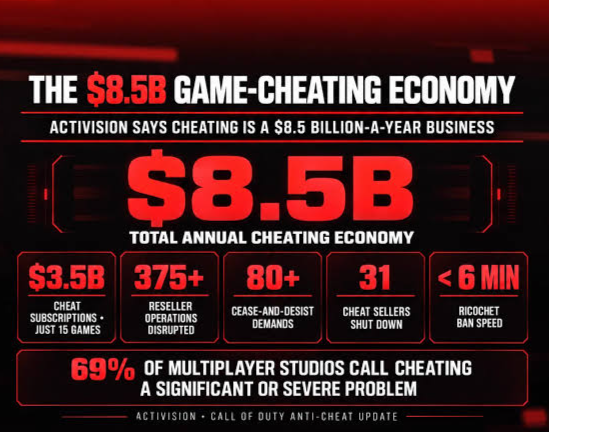
The most widely discussed number in Activision's recent anti-cheat report is $8.5 billion.
That figure represents an estimate of the broader cheating economy rather than money generated by Call of Duty alone.
The underlying research cited by Activision estimated approximately $3.5 billion in annual cheat-subscription revenue across 15 games.
The broader $8.5 billion estimate adds other services connected to cheating, including account sales, boosting and spoofing.
The distinction is important.
The figure should not be interpreted as Activision reporting that Call of Duty cheaters themselves spend $8.5 billion every year.
Instead, it describes the estimated size of a much wider market surrounding cheating across multiple games.
How Cheat Subscriptions Work?
Modern cheats increasingly operate as subscription products.
Rather than purchasing a piece of software once, customers can pay recurring fees for continued access.
Higher-end services can cost more than $100 per month, while particularly committed users may spend more than $1,000 per year on cheating-related software and services.
Subscription models give cheat developers a recurring source of revenue.
They also create an incentive to continually update their software as game developers improve anti-cheat detection.
This creates a technological arms race.
When an anti-cheat update detects a particular method, cheat developers can attempt to modify their products.
The anti-cheat team then has to identify and respond to new techniques.
Account Sales and Boosting
Cheating isn't limited to software.
The wider economy also includes illicit account sales and boosting services.
Account sellers can provide accounts with particular progression levels, unlocks or other attributes.
Boosting services operate differently.
Instead of selling software, a provider may offer to manipulate progression or competitive outcomes for a customer.
These services expand the cheating economy beyond the traditional image of somebody using an aimbot in a multiplayer match.
Spoofing and Evasion
Another part of the ecosystem involves spoofing.
Spoofing attempts to disguise information about a player's hardware or identity.
This can become relevant when anti-cheat systems use hardware-level enforcement.
Activision's current security policy specifically identifies spoofing as an attempt to hide, disguise or obfuscate the identity of hardware devices.
The existence of spoofing services demonstrates another important characteristic of the cheating economy.
The market doesn't only sell cheating tools.
It also sells products designed to help users avoid the consequences of cheating.
RICOCHET Anti-Cheat
Call of Duty's primary anti-cheat system is RICOCHET Anti-Cheat.
The system uses multiple approaches to identify suspicious behavior, including client-side and server-side detection, behavioral analysis and hardware-related checks.
Activision also uses player reports as one source of information for enforcement.
The system isn't based on one single detection mechanism.
Instead, Activision describes RICOCHET as a collection of technologies designed to identify different forms of manipulation.
That matters because modern cheating can take many forms.
Some cheats manipulate what a player sees.
Others automate actions.
Others attempt to alter game data or disguise the hardware running unauthorized software.
What Counts as Cheating?
Activision's current security policy identifies a broad range of prohibited behavior.
Examples include:
Aimbots: Unauthorized software designed to provide automated aiming advantages.
Wallhacks: Tools that reveal information players normally cannot see.
Injectors: Software designed to introduce unauthorized code or modifications.
Spoofing: Attempts to disguise hardware or player identity.
Boosting: Manipulating progression or competitive outcomes.
Unauthorized peripherals: Devices or applications used to gain prohibited advantages.
Game-data manipulation: Unauthorized modification of game files or memory.
Exploiting: Deliberately abusing unintended game behavior for an advantage.
Activision can apply penalties ranging from warnings and temporary suspensions to permanent bans and, in some circumstances, hardware bans.
The Business Model Behind Cheating
The economics explain why cheating has become such a difficult problem.
A traditional cheat might have been a simple piece of software distributed among a small community.
Today's ecosystem can function more like a subscription business.
There are developers.
There are customers.
There are resellers.
There are support channels.
There are recurring payments.
There are competing products.
And there are businesses built around avoiding detection.
That makes cheating less like an isolated form of player misconduct and more like an underground software industry.
Why the Economy Matters
The size of the estimated market helps explain why eliminating cheating is difficult.
As long as customers are willing to pay, there is a financial incentive for developers and sellers to create new tools.
This produces a continuing cycle:
New cheat → detection → countermeasure → cheat update → new detection method.
For competitive multiplayer games, the consequences extend beyond individual matches.
Cheating can affect player trust, matchmaking quality, competitive rankings and the perceived fairness of progression.
Activision's decision to publicly discuss the economics also reflects a broader shift in how game publishers describe cheating.
The problem isn't simply about detecting individual accounts.
It's about disrupting the commercial ecosystem that supplies those accounts with cheating tools.
Technology and Enforcement
Modern anti-cheat systems increasingly combine multiple layers of detection.
Activision says RICOCHET can use:
Client-side detection
Server-side detection
Behavioral models
Hardware validation
Application monitoring
Player reports
In-game mitigations
The system can also apply enforcement across devices linked to an Activision account.
Hardware bans provide another enforcement layer, preventing a banned device from accessing online gameplay while the ban remains active.
This creates a broader security model rather than relying entirely on detecting one specific cheat program.
Platforms and Availability
Call of Duty's anti-cheat systems apply across supported PC and console platforms, although the specific technologies available for detection and enforcement can differ between platforms.
RICOCHET's current security framework applies to Call of Duty titles beginning with Modern Warfare (2019) and subsequent console and PC releases.
The enforcement system can include:
Temporary account bans
Permanent account bans
Hardware bans
Leaderboard corrections
Inventory and progression corrections
Communication restrictions
Activision also warns players to be cautious with secondhand or shared hardware because an existing hardware ban can affect access to online gameplay.
What to Know at a Glance?👀
| Detail | Information |
|---|---|
| Topic | Call of Duty cheating economy |
| Publisher | Activision |
| Anti-Cheat System | RICOCHET Anti-Cheat |
| Broader Estimated Market | Approximately $8.5 billion annually |
| Cheat Subscriptions | Approximately $3.5 billion annually across 15 games |
| Research Cited | Intorqa |
| Related Services | Accounts, boosting, spoofing and other services |
| Major Enforcement | Account and hardware bans |
| Status | Ongoing anti-cheat battle |
Why It Matters?
The $8.5 billion estimate puts a number on something competitive gamers have experienced for years: cheating has developed into a substantial commercial ecosystem.
The exact size of that economy remains an estimate, not a precise financial ledger.
The underlying research includes a range around its central estimate, meaning the $8.5 billion figure should be understood as an estimate of market scale rather than an exact annual revenue total.
For Call of Duty, the significance is that anti-cheat enforcement now has to address an industry with financial incentives to keep developing new methods.
The battle therefore isn't simply Activision versus individual cheaters.
It is increasingly a contest between game security teams and an evolving commercial ecosystem.
🎮 The Bottom Line
Call of Duty's cheating problem has grown into something much larger than unauthorized software appearing in individual matches.
According to research cited by Activision, the wider cheating economy could be worth around $8.5 billion per year, with cheat subscriptions, account sales, boosting and spoofing all contributing to the market.
That doesn't mean Call of Duty itself generates or loses $8.5 billion to cheating.
It means cheating has become a substantial business ecosystem surrounding competitive gaming.
And as long as there is money to be made, RICOCHET and other anti-cheat systems will be fighting an opponent that has a financial reason to keep evolving.