
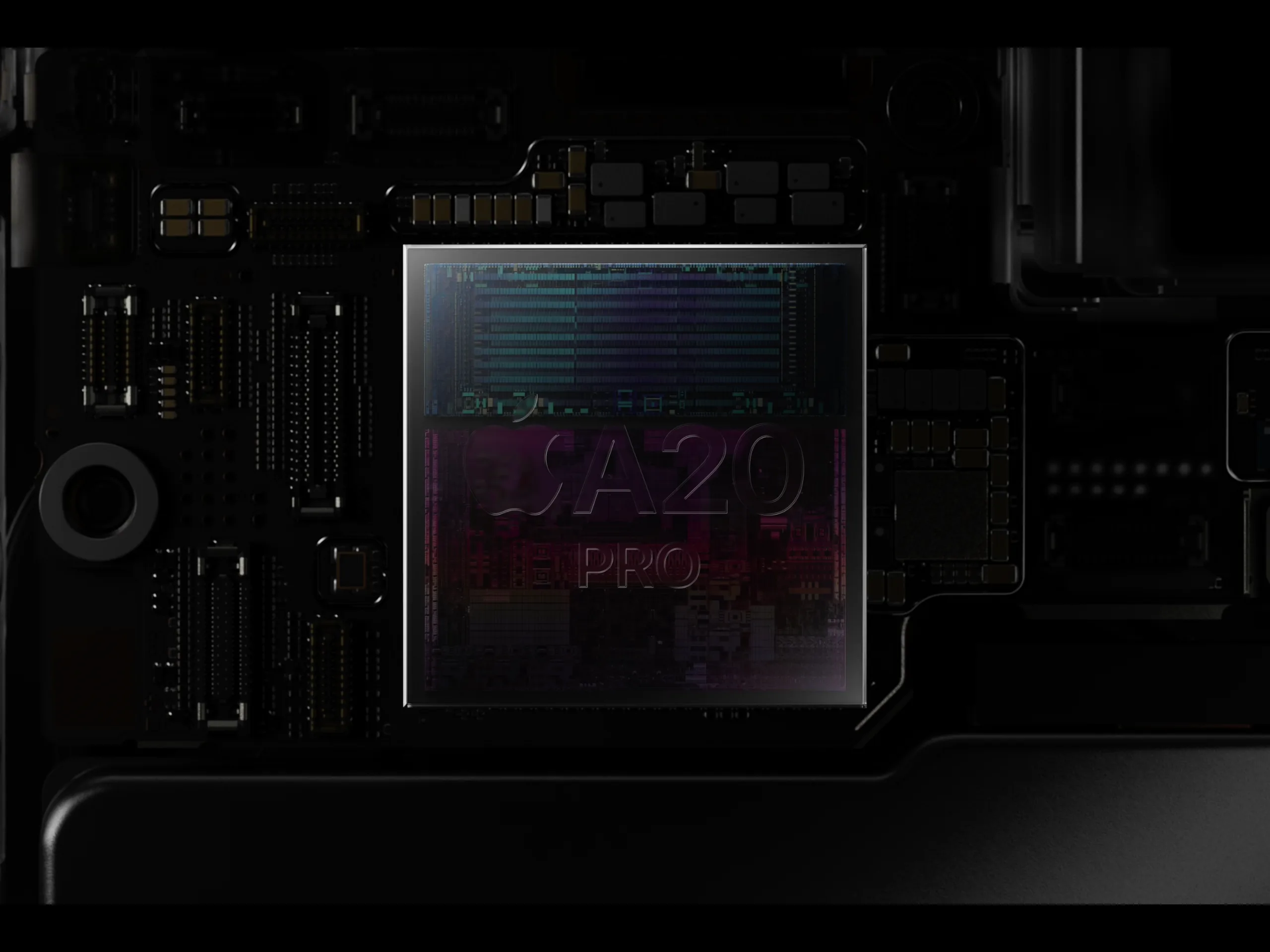
The A20 Pro is Apple's latest high-end smartphone system-on-chip (SoC), introduced with the iPhone 18 Pro and iPhone 18 Pro Max on September 9, 2026. It is Apple's first iPhone processor manufactured using 2nm process technology and combines a new 6-core CPU, 7-core GPU, integrated Neural Accelerators, and a 32-core Neural Engine.
The chip is particularly important because it brings together three major directions in Apple's silicon strategy: smaller and more efficient semiconductor manufacturing, increasingly sophisticated graphics hardware including hardware-accelerated ray tracing, and substantially greater local AI processing for Apple Intelligence.
The A20 Pro therefore represents more than a conventional annual processor upgrade. It is the hardware foundation for the next stage of Apple's approach to on-device intelligence, computational photography, gaming, and sustained smartphone performance.
What Is the A20 Pro?
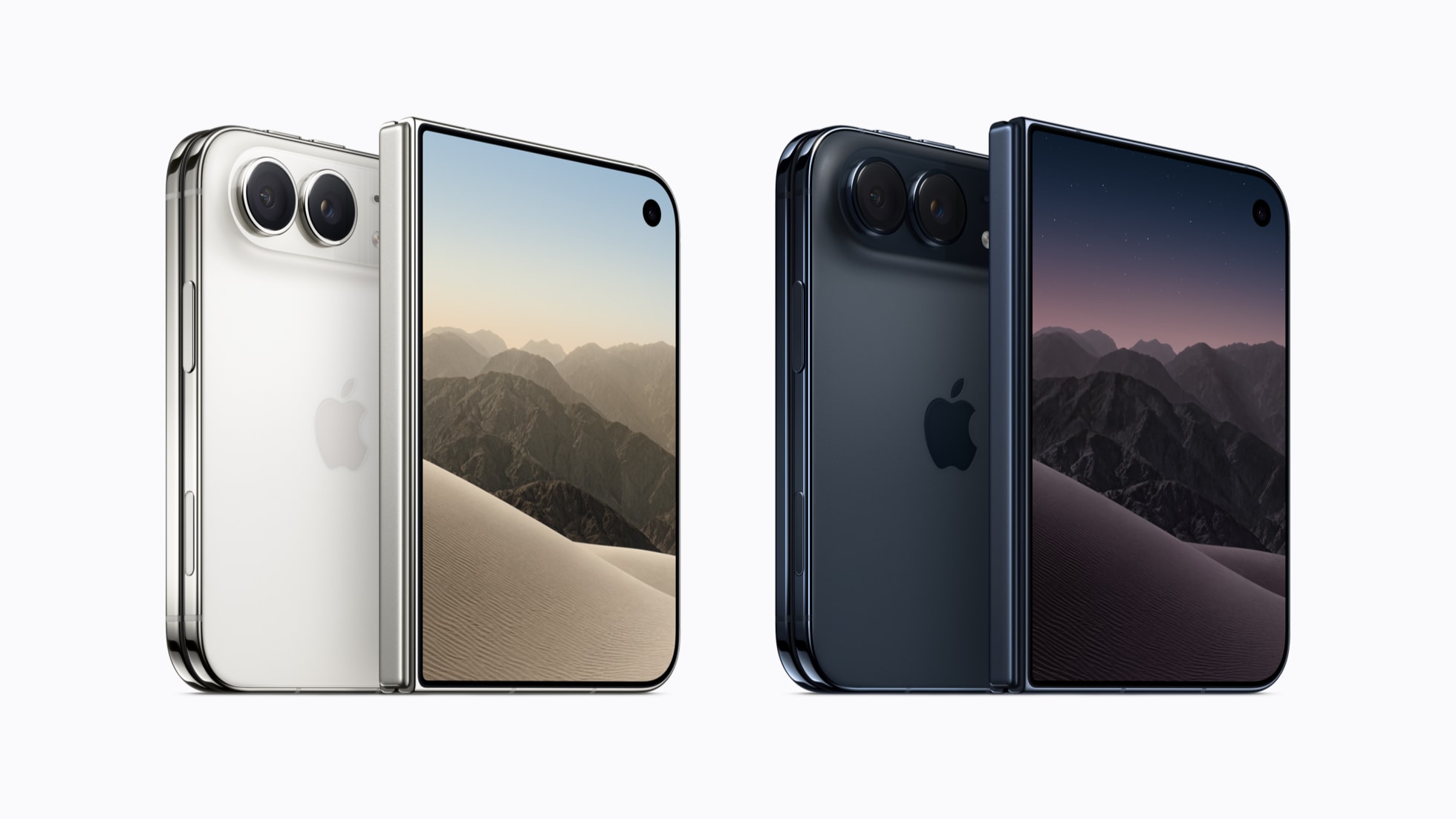
The A20 Pro is Apple's proprietary smartphone processor designed for the iPhone 18 Pro and iPhone 18 Pro Max.
Apple describes it as a major performance and AI-generation upgrade, with:
- 6-core CPU
- 7-core GPU
- Dual 16-core Neural Engine, for 32 Neural Engine cores
- Integrated Neural Accelerators
- Hardware-accelerated ray tracing
- 50% more memory bandwidth than A19 Pro
- Up to 40% faster GPU performance than A19 Pro
- Significantly greater on-device AI processing capacity
Although the processor is sometimes referred to simply as the A20, the chip officially used in the iPhone 18 Pro models is called A20 Pro.
The 2nm TSMC Manufacturing Node
One of the defining characteristics of A20 Pro is its move to 2-nanometer semiconductor manufacturing.
Apple says A20 Pro is built using the latest 2nm process technology. Industry reporting identifies the manufacturing technology as TSMC's N2 process, making A20 Pro one of the earliest major consumer smartphone processors produced on this generation of semiconductor technology.
TSMC states that its N2 technology entered volume production in the fourth quarter of 2025.
Why 2nm Matters
A smaller process node does not simply mean that a chip is physically "2nm wide." The terminology refers to a generation of semiconductor manufacturing technology that enables improvements in transistor density, power efficiency and performance.
For a smartphone processor, these improvements can be used in several ways:
- Higher performance: More computational capability can fit within a similar power envelope.
- Better efficiency: The processor can perform demanding tasks while using less energy.
- Higher transistor density: More functionality can be integrated into the SoC.
- AI scaling: Additional processing resources can be dedicated to neural and machine-learning workloads.
- Sustained performance: Efficiency improvements can help reduce the power and thermal cost of demanding workloads.
This is particularly relevant to Apple because the A20 Pro is not designed only for traditional CPU workloads. It has to simultaneously support advanced photography, gaming, generative AI, Siri AI, image processing and other computationally intensive functions.
A20 Pro CPU Architecture
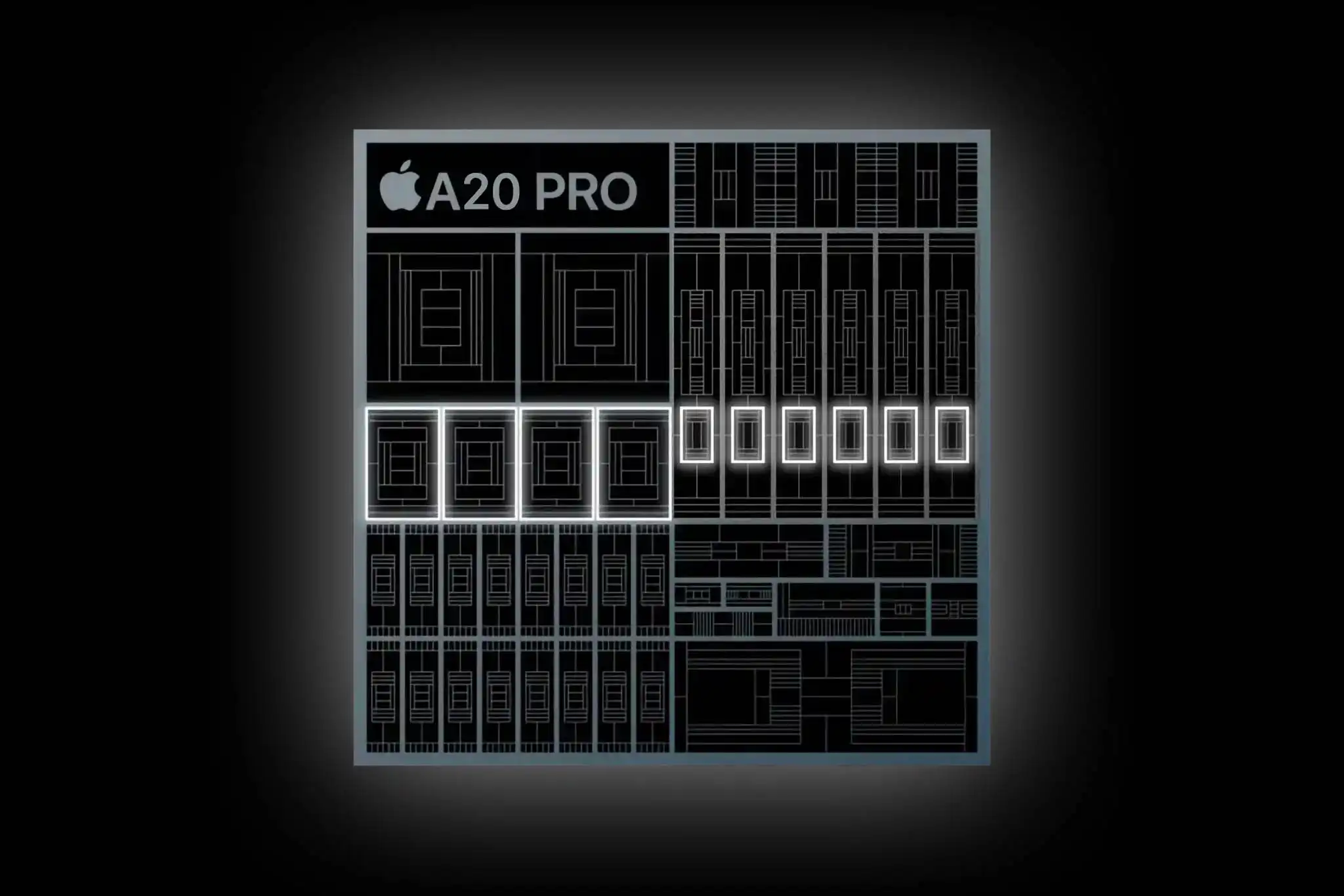
A20 Pro uses a 6-core CPU consisting of two performance-oriented cores and four efficiency cores. Apple says the CPU incorporates integrated Neural Accelerators and is designed to deliver higher performance while handling increasingly demanding workloads.
The CPU's role extends beyond conventional application performance.
It provides the general-purpose processing required for:
- iOS applications
- Multitasking
- Web browsing
- Games
- Photography pipelines
- AI-related workloads
- Background system processes
- Siri AI and other intelligent features
The inclusion of Neural Accelerators also reflects a broader shift in Apple silicon: machine-learning computation is increasingly distributed across multiple parts of the chip instead of relying on a single processor block.
A20 Pro GPU and Hardware Ray Tracing
The A20 Pro introduces a 7-core GPU that Apple says can deliver up to 40% faster graphics performance than A19 Pro.
Hardware-accelerated ray tracing is also supported.
What Is Hardware Ray Tracing?
Ray tracing is a graphics technique that simulates how light interacts with objects and environments. It can produce more realistic:
- Reflections
- Shadows
- Lighting
- Transparency
- Indirect lighting effects
Instead of relying entirely on general-purpose shader calculations, dedicated hardware can accelerate the mathematical operations involved in ray-tracing workloads.
Apple has been developing hardware ray tracing in its A-series chips for several generations. A18 Pro, for example, introduced faster hardware-accelerated ray tracing, with Apple claiming up to twice the ray-tracing performance of the previous generation.
A20 Pro builds on this direction with a substantially faster overall GPU and dedicated neural acceleration within the graphics architecture.
Why Ray Tracing Matters on iPhone
The importance of ray tracing goes beyond visual quality.
Modern mobile games increasingly target console- and PC-style rendering techniques. More capable GPU hardware allows developers to use physically based lighting and reflections without imposing the same performance penalty that software-only implementations would create.
For iPhone 18 Pro users, this makes A20 Pro relevant to:
- High-end mobile games
- Console-quality game ports
- Real-time lighting
- Advanced reflections
- Augmented and spatial experiences
- GPU-accelerated creative applications
Neural Engine and AI Processing
The A20 Pro's most important long-term change may be its AI architecture.
Apple lists a Dual 16-core Neural Engine, giving the processor 32 Neural Engine cores in total. Apple says this provides double the AI processing power of A19 Pro.
The Neural Engine is designed for machine-learning workloads rather than conventional CPU tasks. These workloads include:
- Generative AI
- Language processing
- Image generation and analysis
- Speech processing
- Computational photography
- Visual intelligence
- Personalization
- Siri AI
A20 Pro also adds integrated Neural Accelerators, allowing additional AI-related operations to be handled close to the CPU and GPU rather than sending every workload to a single neural-processing block.
A20 Pro and Apple Intelligence
The relationship between A20 Pro and Apple Intelligence is one of the chip's defining characteristics.
Apple introduced Apple Intelligence in June 2024, describing it as a personal intelligence system combining generative models with personal context. From the beginning, Apple designed the system around Apple silicon, on-device processing and privacy.
The first generation of Apple Intelligence relied heavily on capable Neural Engines and other Apple silicon resources. Apple subsequently expanded the platform, including giving developers access to its on-device foundation model in 2025.
A20 Pro represents the next hardware stage of that strategy.
From Apple Intelligence to A20 Pro
The progression can broadly be understood as:
A18/A18 Pro → Apple Intelligence becomes practical on iPhone
The A18 generation introduced the hardware foundation for Apple's first mainstream Apple Intelligence implementation, including an upgraded Neural Engine and improved memory bandwidth.
A19 generation → Apple Intelligence expands
The silicon platform continued to provide more computational headroom as Apple's AI features and models evolved.
A20 Pro → greater local AI capacity
A20 Pro increases memory bandwidth, expands Neural Engine resources and adds Neural Accelerators, giving the iPhone more hardware specifically suited to increasingly sophisticated AI workloads.
The significance is that Apple Intelligence is increasingly becoming a hardware-software system, rather than simply a collection of AI features added through software updates.
On-Device AI and Privacy
Apple Intelligence was designed around a combination of on-device processing and Private Cloud Compute.
Many AI models can run directly on an iPhone. When a request requires a larger model or more processing capacity, Private Cloud Compute can shift appropriate workloads to Apple-silicon-based servers while maintaining Apple's privacy architecture.
A20 Pro strengthens the first half of that model: more intelligence can be processed locally.
That matters because on-device processing can provide:
- Lower latency
- Reduced dependence on an internet connection
- Greater privacy for supported tasks
- Faster responses
- More efficient interaction with system sensors and apps
Apple's 2026 Apple Intelligence architecture continues this direction, with the next generation of Apple Foundation Models running both on-device and through Private Cloud Compute.
A20 Pro and Computational Photography
AI processing is also fundamental to the iPhone 18 Pro's camera system.
The A20 Pro works alongside Apple's image-processing pipeline to handle computational photography tasks such as:
- HDR processing
- Noise reduction
- Portrait processing
- Photographic Styles
- Image segmentation
- Smart scene analysis
- Computational zoom
- Image authenticity technologies
The iPhone 18 Pro also introduces a 48MP Fusion Main camera with variable aperture, making the relationship between silicon and photography even more important.
The processor is therefore not simply responsible for taking a picture. It helps transform raw sensor information into the finished photograph users see.
Memory Bandwidth and AI Workloads
A20 Pro provides 50% more memory bandwidth than A19 Pro, according to Apple.
Memory bandwidth is particularly important for AI.
Large models and neural-network operations can move enormous quantities of data between processing units and memory. Increasing bandwidth can reduce bottlenecks when several computational blocks are working simultaneously.
This benefits workloads such as:
- Generative AI
- Large language model inference
- Image processing
- Video processing
- High-resolution photography
- Gaming
- Multitasking
In practical terms, A20 Pro's performance is therefore not defined by CPU clock speed alone. Its overall architecture is designed to move data efficiently between different specialized processors.
A20 Pro for Gaming
Gaming is another major beneficiary of the new chip.
The combination of a faster 7-core GPU, hardware ray tracing and greater memory bandwidth gives iPhone 18 Pro a stronger graphics foundation for demanding games. Apple specifically positions A20 Pro as capable of handling demanding games alongside advanced AI workloads.
Key gaming technologies include:
- Hardware-accelerated ray tracing
- Faster GPU rendering
- Higher memory bandwidth
- Improved sustained performance
- Advanced thermal management
- Neural processing for selected game and graphics workloads
The iPhone 18 Pro also uses a new-generation vapor chamber, with Apple describing the combination of A20 Pro and the thermal system as enabling the highest sustained performance in iPhone history.
A20 Pro and Sustained Performance
Peak benchmark performance is only one part of smartphone performance.
A chip can reach a high maximum performance level but reduce its speed if sustained workloads cause excessive heat.
Apple addresses this in the iPhone 18 Pro with a next-generation vapor chamber alongside A20 Pro. The objective is to maintain high performance for longer during demanding workloads such as gaming, video processing and AI inference.
This is particularly important for A20 Pro because AI and ray tracing can generate sustained computational loads rather than short bursts of activity.
A20 Pro Compared With A19 Pro
| Feature | A19 Pro | A20 Pro |
|---|---|---|
| Manufacturing | Previous-generation process | 2nm |
| CPU | Previous generation | 6-core CPU |
| GPU | Previous generation | 7-core GPU |
| GPU performance | Baseline | Up to 40% faster |
| Memory bandwidth | Baseline | 50% higher |
| Neural Engine | Previous generation | Dual 16-core design |
| Neural Engine cores | 16-core generation | 32 total cores |
| Neural Accelerators | Previous generation | Integrated |
| Ray tracing | Hardware accelerated | Hardware accelerated |
| Apple Intelligence | Supported | Expanded AI capability |
Apple's official comparison identifies the major generational gains as increased memory bandwidth, a faster GPU, integrated Neural Accelerators and twice the AI processing capability of A19 Pro.
How A20 Pro Expands Apple's Silicon Strategy
A20 Pro is best understood as the continuation of several technology trends rather than an isolated processor upgrade.
Apple's silicon strategy has increasingly moved toward specialized processing.
The CPU handles general-purpose workloads. The GPU handles graphics and parallel computation. The Neural Engine and Neural Accelerators handle AI-oriented operations. Dedicated image-processing capabilities handle photography, while specialized connectivity components handle networking.
This architecture allows Apple to increase capability without expecting a single processor to perform every task.
The move to 2nm provides additional transistor and efficiency headroom, while the expanded AI hardware gives Apple more capacity to run increasingly sophisticated models locally.
iPhone 18 Pro Platforms and Availability
The A20 Pro is available in:
- iPhone 18 Pro
- iPhone 18 Pro Max
Apple announced the phones on September 9, 2026. Preorders begin September 12, with availability beginning September 18.
In India, the iPhone 18 Pro starts at ₹1,64,900, while the iPhone 18 Pro Max starts at ₹1,79,900. Sales begin September 18, 2026.
For complete hardware specifications, Apple's official shows that Apple Intelligence is no longer simply a software feature layered onto the iPhone. Apple has been building a hardware foundation for it since the A18 generation, when Apple explicitly positioned A18 and A18 Pro as processors designed to accelerate Apple Intelligence. specification page lists the A20 Pro CPU, GPU, Neural Engine, ray tracing and Apple Intelligence capabilities.
Why It Matters
A20 Pro matters because it brings together three developments that increasingly define modern smartphones.
First, the transition to 2nm manufacturing represents a major step in semiconductor scaling. Second, increasingly powerful GPU hardware and ray tracing push smartphones closer to traditional gaming platforms. Third, the expanded Neural Engine and Neural Accelerators provide the processing capacity needed for Apple's long-term on-device AI strategy.
Most importantly, A20 Pro shows that Apple Intelligence is no longer simply a software feature layered onto the iPhone. Apple has been building a hardware foundation for it since the A18 generation, when Apple explicitly positioned A18 and A18 Pro as processors designed to accelerate Apple Intelligence.
By the A20 Pro generation, that foundation has expanded into a broader architecture involving CPU, GPU, Neural Engine, Neural Accelerators, memory bandwidth and Apple's private cloud infrastructure.
That combination is what makes A20 Pro significant beyond its raw performance numbers.
Quick Facts
| Detail | Information |
|---|---|
| Chip | A20 Pro |
| Manufacturer | Apple |
| Manufacturing | 2nm process technology |
| Foundry process | TSMC N2 |
| CPU | 6-core |
| GPU | 7-core |
| Neural Engine | Dual 16-core / 32 cores total |
| Ray Tracing | Hardware accelerated |
| Memory Bandwidth | 50% higher than A19 Pro |
| GPU Improvement | Up to 40% over A19 Pro |
| AI Processing | Up to 2× A19 Pro |
| Devices | iPhone 18 Pro, iPhone 18 Pro Max |
| Announcement | September 9, 2026 |
| Preorders | September 12, 2026 |
| Availability | September 18, 2026 |
| Operating System | iOS 27 |
Apple's official specifications confirm the A20 Pro architecture, hardware ray tracing and Apple Intelligence integration.
The Bottom Line
The A20 Pro brings Apple's next major silicon generation to the iPhone 18 Pro, combining a 2nm manufacturing process, faster graphics, hardware-accelerated ray tracing and a substantially expanded AI architecture.
Its biggest significance is not any single specification. A20 Pro represents the convergence of Apple's semiconductor scaling and its multi-year Apple Intelligence strategy: more powerful local processing, more capable generative AI, advanced computational photography and increasingly sophisticated graphics in a single mobile platform.
For anyone interested in where high-end smartphones are heading, the A20 Pro is important because it demonstrates how AI, graphics and semiconductor efficiency are becoming inseparable parts of modern mobile chip design.