

Snapchat's 2026 privacy update reflects a broader shift toward stronger protections against the misuse of private and intimate content.
The updated framework focuses heavily on non-consensual intimate imagery (NCII), unauthorized sharing of private material, harassment and faster responses to reported violations.
One important distinction is that Snapchat's documented policies clearly establish stronger rules around NCII and private imagery, while claims about a universal new screen-record blocking API should be treated separately unless Snapchat officially confirms the technical feature.
Story / Overview: What Changed in 2026?
The 2026 changes are best understood as an expansion of Snapchat's approach to privacy enforcement and safety, rather than simply a new screenshot feature.
Snapchat prohibits creating, sharing or threatening to distribute non-consensual intimate imagery.
The rules cover intimate photographs and videos shared without permission, sexually explicit material distributed without consent and threats involving intimate content.
The policy also addresses newer forms of abuse involving artificial intelligence.
AI-generated sexual content, including services designed to create fake nude imagery, falls under Snapchat's prohibited sexual-content rules.
The broader privacy framework also covers the unauthorized sharing of private information and imagery.
Setting / Background
Snapchat's identity has always been closely connected to temporary communication.
Snaps can disappear.
Stories can expire.
Messages can be removed.
But disappearing content has never meant that it is impossible to preserve.
A recipient may be able to use screenshots, screen recording, another device or other capture methods.
That creates a fundamental privacy challenge.
A platform can control its own interface, but it cannot guarantee that another person will never reproduce what appears on a screen.
Snapchat's privacy approach therefore combines product-level safety measures with reporting and enforcement.
The result is a system where technical protections are only one part of the overall privacy strategy.
Key People and Organizations
Snap Inc.
Snap Inc. operates Snapchat and establishes the platform's Community Guidelines, privacy policies and safety systems.
The company is responsible for determining how violations are handled and what enforcement measures are applied.
Snapchat Safety Teams
Snapchat's safety teams review reports and determine whether reported material violates its rules.
For serious privacy violations, users can submit reports through Snapchat's reporting systems and receive information about the outcome of the review.
Users and Victims
Users affected by non-consensual intimate imagery can report the material directly to Snapchat.
The reporting process is particularly important because harmful material can spread beyond its original audience once it has been captured or reposted.
Features / Major Details
NCII Protection: Snapchat prohibits creating, sharing or threatening to share intimate imagery without the depicted person's consent.
Private-Content Protection: Sharing another person's private information, images or other material without permission can violate Snapchat's harassment and privacy rules.
AI-Generated Sexual Content: Snapchat's rules also address AI-generated sexual imagery and services designed to create fake nude content.
Reactive Enforcement: Reported material can be reviewed by Snapchat's safety teams, with enforcement actions applied when content violates the platform's rules.
Dedicated Reporting: Users have reporting options for abusive material, including specific pathways for non-consensual intimate imagery.
Screen Capture Protections: Snapchat uses product-level safety measures around privacy and content capture, although the exact scope of any new screen-recording technology should not be confused with a publicly documented universal developer API.
Technology / Development
The technology behind Snapchat's privacy system involves more than simply blocking screenshots.
Modern social platforms use a combination of automated detection, user reports, moderation systems and product-level safety controls to identify and respond to harmful content.
Screen recording presents a particularly difficult technical challenge.
A platform can potentially restrict recording functionality on supported devices or detect certain capture methods.
However, it cannot completely prevent someone from using another physical device to photograph or record a screen.
This means that screen-recording restrictions are best viewed as one layer of privacy protection, rather than a complete solution.
The distinction is also important for developers.
A platform's internal safety technology does not automatically mean that an equivalent public API exists for third-party applications.
Claims about a new Snapchat screen-record blocking API therefore need to be distinguished from Snapchat's documented user-facing privacy and safety features.
Reactive Enforcement
One of the most important elements of Snapchat's privacy approach is what happens after harmful content is reported.
Users can report content they believe violates Snapchat's rules.
Depending on the situation, enforcement can include:
Content removal
Account warnings
Restrictions
Reduced access to features
Account termination
Further action where appropriate
This reactive model is especially important for intimate-image violations.
A technical system may not recognize every harmful image automatically.
A user report can provide additional context and identify material that automated systems may not immediately detect.
Screen Recording and Privacy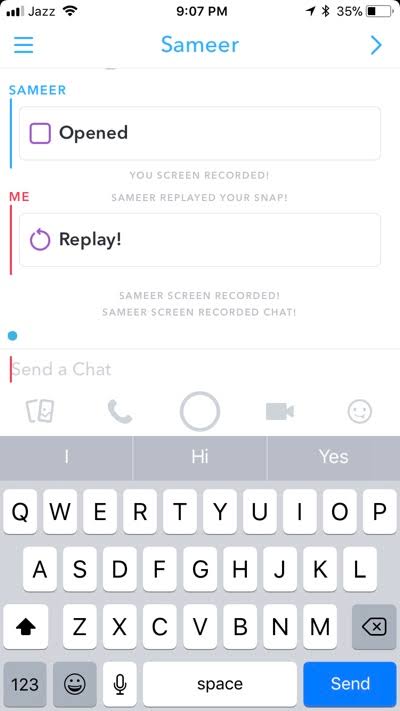
Screen recording is one of the most misunderstood parts of Snapchat's privacy model.
A restriction on screen capture can make unauthorized copying more difficult.
It does not make copying impossible.
Someone could still use:
Another smartphone
A camera
A second device
External recording hardware
That's why users should never treat disappearing content as completely permanent-proof.
The strongest privacy model combines technical restrictions, responsible sharing, reporting tools and consent.
Platforms and Availability
The 2026 privacy framework applies to Snapchat and A platform-level restriction on screen capture is not necessarily the same thing as a publicly available developer its supported services.
Platform: Snapchat
Developer: Snap Inc.
Availability: Snapchat-supported markets
Policy area: Privacy, safety and content enforcement
Key focus: NCII, harassment, private imagery and harmful content
Reporting: Available through Snapchat's reporting systems
The exact features available to users can vary by device, operating system, country and Snapchat product version.
Why It Matters
The importance of Snapchat's 2026 privacy update goes beyond screenshots.
The bigger issue is the intersection of privacy, moderation, AI-generated content and digital permanence.
A private image can move from one conversation to a public platform within minutes.
AI tools can also make it easier to manipulate or fabricate sexual imagery.
That means platforms increasingly have to address both traditional forms of abuse and newer forms of digitally generated content.
For users, the practical lesson is straightforward:
Private or disappearing content should never be assumed to be impossible to copy.
At the same time, unauthorized distribution of intimate material can violate platform rules and may also have legal consequences depending on the circumstances and jurisdiction.
🎮 The Bottom Line
Snapchat's 2026 privacy framework puts stronger emphasis on non-consensual intimate imagery, private-content abuse, harassment and reactive enforcement.
The most significant part of the update isn't a single privacy button.
It's the broader combination of reporting systems, moderation, product safety measures and stronger rules around intimate imagery.
The frequently discussed screen-record blocking API should be treated more carefully, however. A platform-level restriction on screen capture is not necessarily the same thing as a publicly available developer API.
For Snapchat users and creators, the key takeaway is simple:
Temporary content isn't necessarily permanent-proof, and privacy protection increasingly depends on both technology and responsible content sharing.