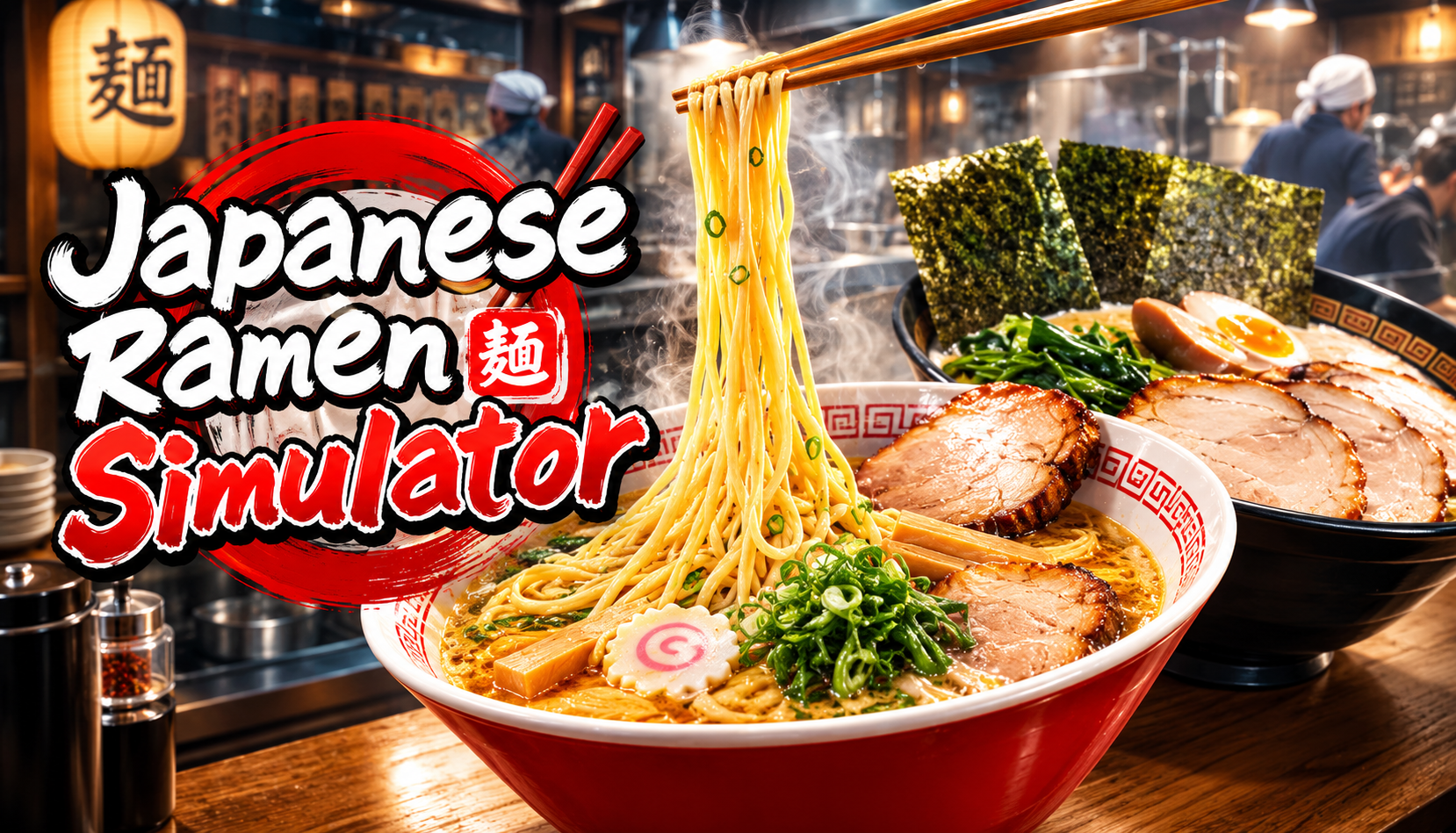


Japanese Ramen Simulator is a cooking and restaurant-management simulation game developed and published by Wild Dog. Released on Steam in September 2026, the game lets players build and operate their own ramen restaurant while preparing dishes, developing recipes, customizing their kitchen, and serving customers.
The game can be played alone or with up to six players in online co-op, making teamwork an important part of running a busy restaurant.
Here's everything you need to know about its cooking mechanics, restaurant customization, progression, and multiplayer systems.
Story and Overview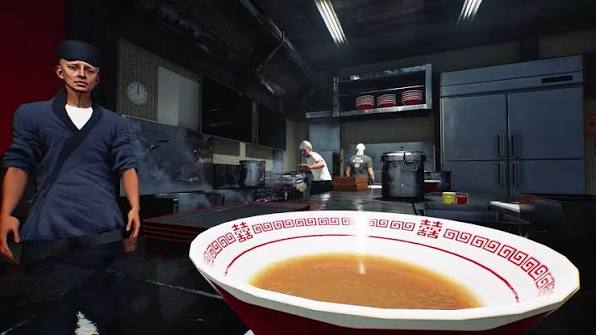
Unlike a traditional story-driven game, Japanese Ramen Simulator focuses on the experience of running a ramen restaurant.
Players take responsibility for different parts of the business, from preparing ingredients and cooking ramen to serving customers, cleaning the restaurant, and improving the shop.
The main gameplay loop revolves around operating the restaurant successfully and using the money earned from customers to improve the business.
Players can also switch between first-person and third-person perspectives, allowing them to experience the restaurant from different viewpoints.
Setting: Your Own Ramen Restaurant
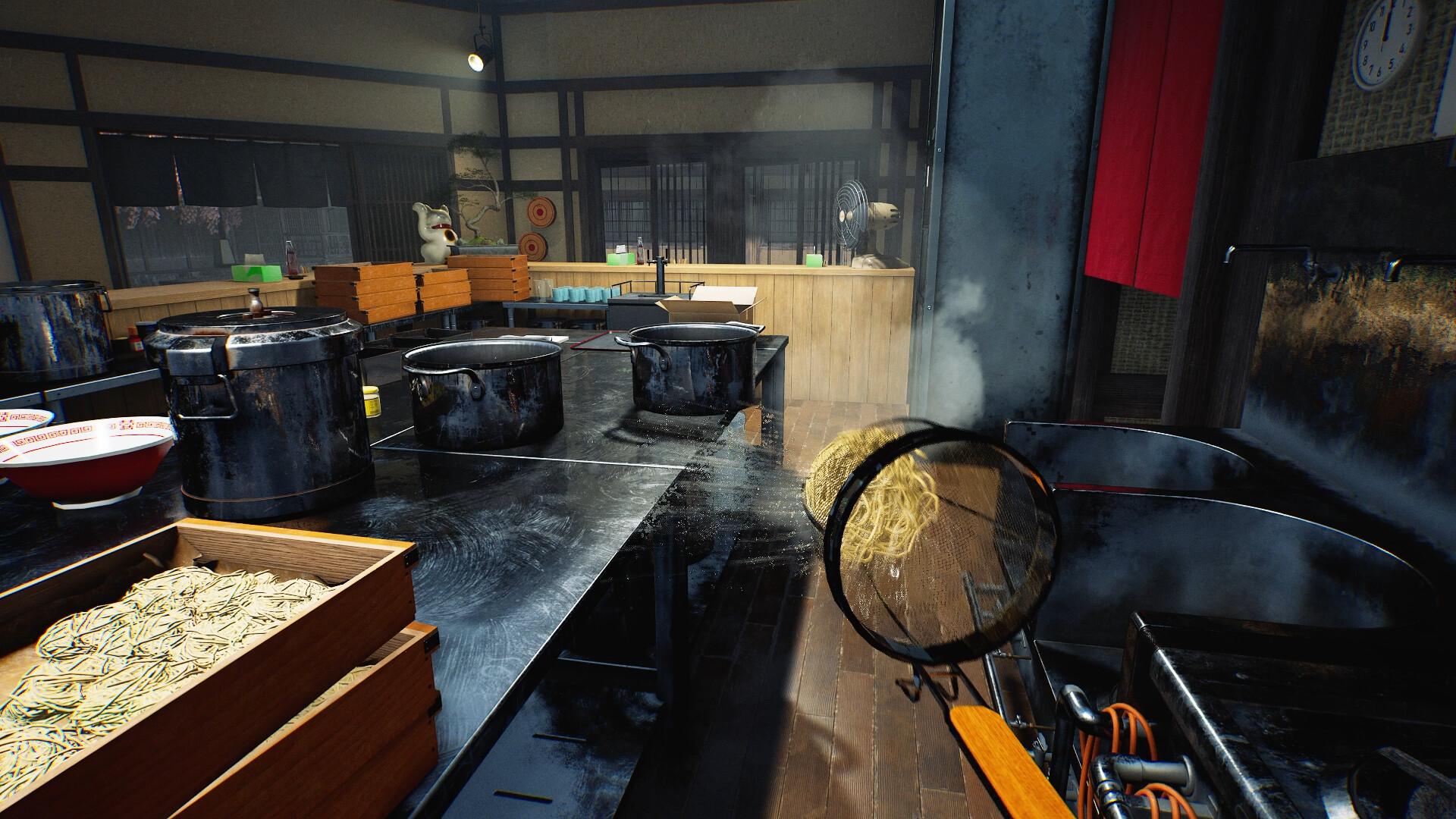
The game takes place primarily inside a customizable Japanese ramen restaurant.
Instead of forcing every player to use the same kitchen arrangement, the game allows furniture, cooking equipment, storage, and decorations to be moved around.
This means players can create layouts based on their preferred style of play.
A compact kitchen can focus on efficiency, while a larger design can prioritize aesthetics and customer space.
Players can also customize visual elements such as shop signs and noren curtains.
Characters and Customers
The Player
The player becomes the owner and operator of the ramen restaurant.
Depending on whether they're playing alone or with others, they may handle everything from preparing ingredients to serving customers.
Co-Op Players
In multiplayer, up to six players can work inside the same restaurant.
Each player can take responsibility for different tasks, allowing the group to divide the workload.
One player might prepare ingredients while another handles cooking and someone else focuses on serving customers.
Customers
Customers are the main source of orders and income.
Their requests determine which dishes need to be prepared, creating the time-management element of the game.
Ramen Critics
Special customers can also visit the restaurant and evaluate the food.
Their reactions encourage players to experiment with ingredients and focus on the quality of their dishes rather than simply producing food as quickly as possible.
Gameplay and Mechanics
Recipe Crafting
Recipe creation is one of the central mechanics.
Players prepare soup, cook noodles, and add toppings to create individual bowls of ramen.
Soup can be produced by combining different ingredients, while toppings are physically arranged on the finished dish.
The quality of a bowl can depend on several factors, including:
- Noodle texture
- Soup temperature
- Aroma
- Umami
- Toppings
- Serving time
This makes recipe creation more involved than simply selecting a predefined dish.
Menu Creation
Ramen isn't the only food available.
Players can expand their restaurant menu with additional dishes, including:
- Gyoza
- Rice bowls
- Ramen
- Beer
Different dishes require different preparation methods, giving players more responsibilities as the restaurant develops.
Kitchen Layout Customization
Kitchen customization is both a creative and practical feature.
Players can move:
- Cooking equipment
- Furniture
- Storage
- Decorations
- Restaurant fixtures
The ability to rearrange the kitchen allows players to create layouts that fit their preferred workflow.
Frequently used equipment can be placed closer together, while decorative elements can be arranged around the dining area.
Players can also personalize signs and noren curtains, giving their restaurant a more individual identity.
Shop Progression
Running the restaurant successfully generates money that can be invested back into the business.
As the restaurant's Shop Level increases, players can unlock additional ingredients and equipment.
The progression system creates a straightforward gameplay loop:
Cook → Serve → Earn → Upgrade → Expand
As the restaurant grows, players have more tools and ingredients available for creating new dishes.
Six-Player Co-Op
One of the game's defining features is online co-op for up to six players.
Instead of requiring one person to manage the entire restaurant, players can divide responsibilities.
A typical team might have:
- One player preparing ingredients
- One player cooking noodles
- One player preparing toppings
- One player serving customers
- One player managing dishes
- One player cleaning and organizing the restaurant
The exact division is up to the players.
That flexibility makes communication particularly important during busy restaurant shifts.
Solo players can also hire NPC staff, allowing the restaurant to operate without needing a full multiplayer group.
Multiplayer and Network Stability
Six-player cooking places considerable importance on reliable multiplayer performance.
When several players are simultaneously preparing food, moving around the kitchen, serving customers, and interacting with equipment, network problems can become especially noticeable.
The game supports online co-op for up to six players and includes spatial voice chat.
Spatial voice chat means players can hear teammates differently depending on their position in the restaurant, making communication feel more connected to the physical kitchen.
Because Japanese Ramen Simulator launched in Early Access, multiplayer performance and network stability are also areas that can evolve through future updates.
Technology and Development
Japanese Ramen Simulator is developed and published by Wild Dog.
The game focuses heavily on interactive simulation.
Rather than completing recipes entirely through menus, players physically interact with kitchen equipment, ingredients, and dishes.
The game also features:
- First-person and third-person perspectives
- Physics-based food placement
- Customizable restaurant layouts
- Online multiplayer
- Spatial voice chat
- Customizable restaurant decorations
- Progression through Shop Levels
The Early Access format allows the developers to continue refining these systems and expanding the game over time.
Platforms and Availability
Japanese Ramen Simulator is available on PC through Steam.
- Platform: PC
- Store: Steam
- Release: September 2026
- Format: Early Access
- Players: 1–6
- Multiplayer: Online co-op
- Perspective: First-person and third-person
-
Genre: Cooking / Restaurant Management Simulation
Quick Facts
| Detail | Information |
|---|---|
| Developer | Wild Dog |
| Publisher | Wild Dog |
| Genre | Cooking / Restaurant Management Simulation |
| Platform | PC |
| Store | Steam |
| Release | September 2026 |
| Format | Early Access |
| Players | 1–6 |
| Multiplayer | Online Co-op |
| Perspective | First-person / Third-person |
| Main Focus | Ramen cooking and restaurant management |
Why It Matters
Japanese Ramen Simulator combines several gameplay systems that are usually found in separate simulation games.
It isn't simply a cooking game.
It also incorporates restaurant management, recipe experimentation, customization, progression, and multiplayer cooperation.
The six-player system is particularly important because it allows an entire group to share the responsibilities of operating the restaurant.
The kitchen therefore becomes more than a place where players prepare food. It becomes a shared workspace where everyone needs to coordinate.
The Early Access model also gives the game room to expand. Future updates can potentially introduce additional recipes, equipment, customization options, challenges, and multiplayer improvements.
For players interested in social simulation games, the combination of restaurant management and large-scale co-op gives Japanese Ramen Simulator a distinct identity.
🎮 The Bottom Line
Japanese Ramen Simulator brings ramen cooking, restaurant management, customization, and six-player online co-op together in one simulation.
Its core systems revolve around creating recipes, preparing food, managing the kitchen, customizing the restaurant, earning money, and expanding the business.
With its September 2026 Steam launch and Early Access development model, the game provides a foundation that can continue evolving through new content and community feedback.
For fans of cooking games, management simulations, and chaotic multiplayer experiences, the six-player restaurant system is the feature to watch as the game continues to develop.