
🧠 What Exactly Is Project AVA?
Think of AVA as a combination of AI assistant, gaming companion, desktop character and smart display.
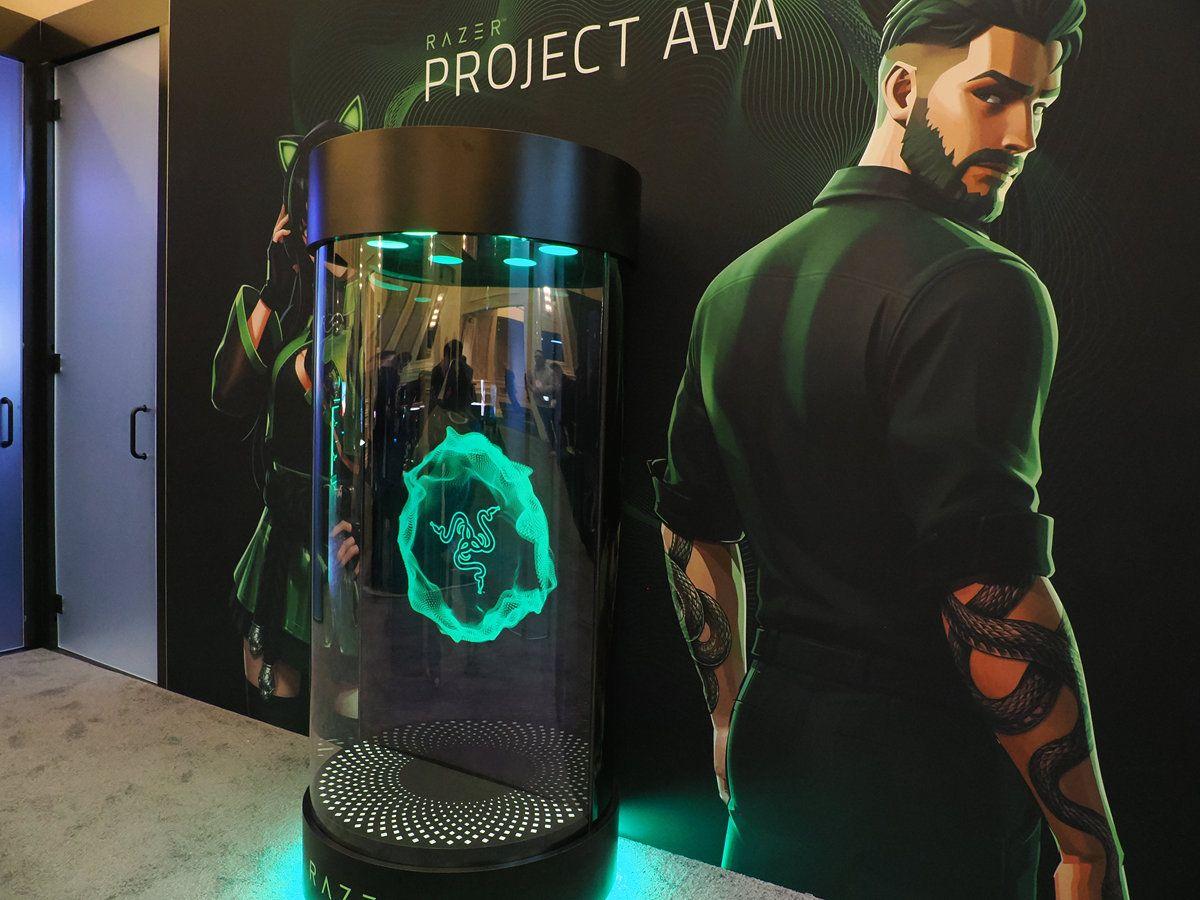
The hardware uses an animated 5.5 inch 3D holographic display alongside cameras, microphones and a speaker. This allows AVA to see, hear and respond to its surroundings rather than simply displaying text inside a browser window.
The bigger idea is persistence.
AVA is designed to remain part of your desktop environment instead of appearing only when you open an application.
📦 QUICK FLOW
YOUR VOICE / SCREEN / CONTEXT → AVA AI ENGINE → UNDERSTANDS INTENT → RESPONDS OR TAKES ACTION → HOLOGRAPHIC COMPANION
This is the core philosophy behind AVA: AI that feels present rather than hidden.
✨ The Holographic Hardware
The physical device is what separates AVA from conventional AI assistants.
Its animated holographic character can display facial expressions, movement and lip synchronization, making conversations feel closer to interacting with a character than operating a software utility.
Hardware at a Glance
| Component | Purpose |
|---|---|
| 5.5 inch 3D holographic display | Displays the animated companion |
| HD camera | Visual awareness and PC Vision features |
| Dual far field microphones | Voice input from across the desk |
| Full range speaker | Voice and audio responses |
| Chroma RGB | Desktop lighting customization |
| Showcase LEDs | Visual effects and personalization |
| USB Type C | Power and data connection |
| Physical controls | Volume and power or mute |
Razer also describes swappable holographic avatars, meaning the visual identity of the companion is not necessarily locked to a single character.
👁️ PC Vision Makes AVA Different
One of AVA's most interesting capabilities is PC Vision Mode.
Instead of relying exclusively on what you tell it, AVA can interpret what is happening on your screen and use that information to provide contextual assistance.
For gaming, that could mean asking for help while keeping your attention on the game.
For productivity, AVA can potentially understand documents, spreadsheets and other information visible on your display.
The concept is simple:
See → Understand → Respond
rather than:
Ask → Search → Read
🤖 From AI Assistant to Agentic Companion
This is where the 2026 version of AVA becomes substantially more ambitious.
At GDC 2026, Razer introduced agentic capabilities, allowing AVA to interpret a goal, break it into multiple steps and work across connected applications and services.
That changes the role of AVA.
A traditional assistant might tell you how to perform a task.
An agentic AVA is being designed to help perform the task itself.
For example, Razer describes capabilities involving application launching, scheduling, task management and coordination across connected services.
🎮 AVA as Your Gaming Wingman
Gaming remains a major part of the concept.
AVA can provide real time strategy assistance, help with puzzles, explain game information and offer guidance without forcing you to constantly leave the game.
The original 2025 Project AVA concept was even more focused on esports coaching, including gameplay analysis, post match feedback and PC optimization.
The evolution is therefore pretty clear:
Esports Coach → Gaming Copilot → Holographic Companion → Agentic AI Assistant
🎥 Twitch and Streaming Integration
For streamers, the interesting part is AVA's potential role as an interactive on desk streaming companion.
Razer has already demonstrated integrations between its streaming ecosystem and Twitch, including Twitch chat triggered reactions on devices such as the Razer Emote Display.
However, there is an important distinction: Razer's current official AVA documentation does not explicitly confirm a dedicated Twitch chat integration as a finalized AVA feature.
What is confirmed is that AVA can work with supported applications, services and chat platforms through its expanding agentic ecosystem.
That makes Twitch an obvious direction for future development, but it should not be presented as a fully confirmed launch feature yet.
🎭 Choose Your AI Personality
AVA is not designed to be just one personality.
Razer has shown multiple companion identities, including AVA, Kira and Zane, alongside collaborations featuring esports and entertainment personalities.
Users can potentially customize more than appearance.
Razer's concept includes personalities ranging from calm and reliable to energetic and gaming focused, with the AI adapting through interactions and remembered preferences.
Customization Layers
Avatar
Choose how your companion looks.
Personality
Choose the type of interaction you prefer.
Lighting
Customize the physical device through Razer Chroma RGB and showcase lighting.
AI Model
Razer has described AVA as an open, future ready platform intended to support multiple AI models rather than permanently locking the experience to one model.
Memory
AVA is designed to remember preferences and become more personalized through continued interaction.
🧩 What Can AVA Actually Help With?
| Area | Example |
|---|---|
| Gaming | Strategy, puzzles, game information |
| Productivity | Documents, spreadsheets and brainstorming |
| Organization | Scheduling and daily planning |
| Streaming | Potential workflow and service coordination |
| Communication | Voice based interaction and supported chat platforms |
| Research | Information synthesis and contextual assistance |
| Creative work | Brainstorming and problem solving |
| Entertainment | Personalized companion interactions |
🔮 Why Project AVA Matters
The interesting part of AVA isn't simply the hologram.
The hologram is the interface.
The bigger experiment is whether people want AI to become a persistent physical presence in their workspace.
Razer is effectively combining three ideas:
AI intelligence + physical hardware + character personality
That creates something very different from opening ChatGPT in another browser tab.
⚠️ EDITOR'S NOTE
Project AVA is still an evolving platform. Razer's own material shows a clear transition from the original 2025 concept toward the 2026 holographic and agentic versions, so individual features, avatars and integrations can change before wider availability. Razer currently describes AVA as expected to launch in the second half of 2026.
The safest way to understand AVA today is as an evolving AI hardware platform, rather than a completely finalized product specification.
🏁 The Bottom Line
Razer Project AVA is essentially Razer's attempt to give AI a face, body and permanent place on your desk.
Its 3D holographic display provides the visual identity. Cameras and microphones provide environmental awareness. AI provides reasoning and personalization. Agentic capabilities push it toward actually completing tasks.
And for gamers and creators, the most exciting possibility may be what happens when that companion starts interacting with games, streaming tools, chat platforms and the rest of the desktop ecosystem.
Project AVA isn't trying to be another monitor. It's trying to become the character living inside your setup.
Comments
Sign in to join the conversation
Sign inNo comments yet
Be the first to share your thoughts!