
🖥️ The Samsung Odyssey OLED G9 (2026 Edition)
Samsung's Odyssey OLED G9 has spent the past few years cementing itself as one of the most talked about super ultrawide gaming monitors on the market. Heading into 2026, the lineup remains built around the same core promise: a massive 49 inch QD-OLED panel that tries to replace a full dual monitor setup with a single, curved screen.
🧬 Panel and Core Specs
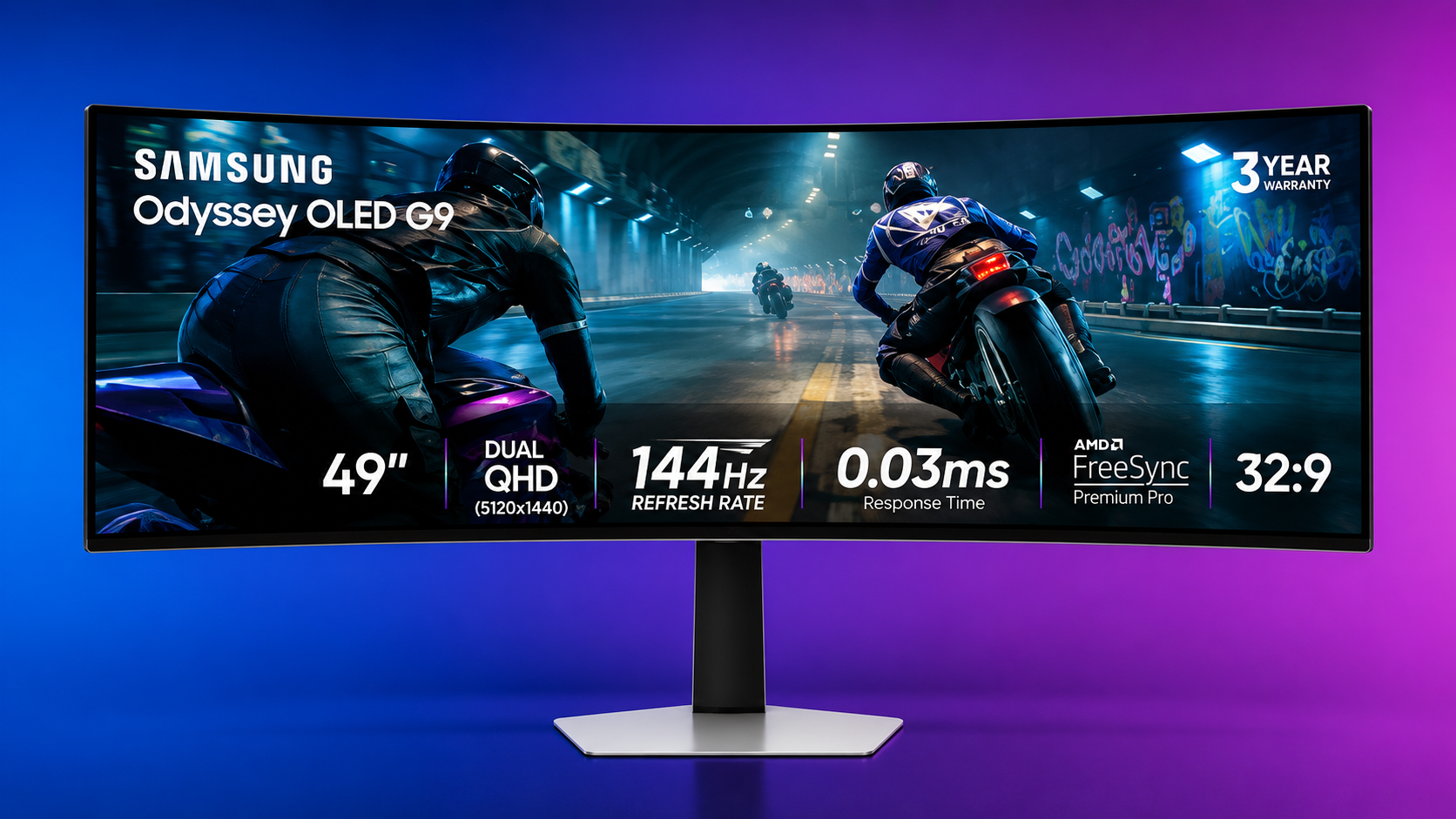
The Odyssey OLED G9 uses a 49 inch second generation QD-OLED panel with a 32:9 aspect ratio and a 1800R curve, running at a 5120 by 1440 Dual QHD resolution. That resolution effectively mimics two 27 inch QHD monitors placed side by side, which is the entire premise behind the "replace your dual monitor setup" pitch.
🖥️ 1. Panel Type → 49" QD-OLED, Gen 2, 32:9, 1800R curve
      ↓
📐 2. Resolution → 5120 x 1440 Dual QHD, ~110 PPI
      ↓
⚡ 3. Refresh Rate → 240Hz with 0.03ms response time (GtG)
      ↓
🎨 4. Color Coverage → 99% DCI-P3, wide color gamut
Peak SDR brightness sits around 250 nits, while HDR brightness reaches roughly 400 to 418 nits depending on the specific test conditions, backed by VESA DisplayHDR True Black 400 and HDR10+ certification.
⚡ Performance for Competitive Gaming
The headline gaming specs remain genuinely elite for a monitor this large. A 240Hz refresh rate paired with a 0.03ms gray to gray response time puts the Odyssey OLED G9 firmly in esports territory, not just casual immersive gaming.
At 240Hz, a new frame is produced roughly every 4.2 milliseconds, and the extremely fast pixel response keeps fast moving objects sharp rather than smeared, which matters far more in competitive shooters than the size or curve of the panel itself.
VRR support spans a 48 to 240Hz range over both DisplayPort and HDMI, with FreeSync Premium Pro and G-Sync compatibility covering both AMD and Nvidia GPU setups. Input lag measures in at roughly 3ms, low enough that there's no perceptible delay between an action and its result on screen.
🌈 OLED Picture Quality
Since it's a true OLED panel combined with quantum dot technology, individual pixels can turn fully off, producing genuinely infinite contrast and true black levels rather than the "almost black" of LED backlit alternatives. Shadow detail holds up well in dark scenes, a common weak point for non OLED monitors at this size.
Color performance is similarly strong, covering approximately 98% of the DCI-P3 gamut and 96% of Adobe RGB, putting it in the same conversation as dedicated color accurate professional displays, despite being built primarily as a gaming monitor.
📺 Smart Features and Software
Depending on the specific model tier, the Odyssey OLED G9 line includes Samsung's Tizen based Smart Hub, bringing native apps like Netflix, Spotify, Xbox Cloud Gaming, and GeForce Now directly to the monitor without a PC connected. It's worth noting that most of these apps don't natively support the monitor's 32:9 aspect ratio, so they typically run in a letterboxed or split view rather than filling the full screen.
Additional software features include:
- CoreSync and Core Lighting+, which project on screen colors onto the surrounding desk area for an ambient lighting effect
- Black Equalizer, designed to boost visibility in dark scene areas without blowing out highlights
- SmartThings integration, letting the monitor tie into a broader Samsung smart device ecosystem
💰 Pricing and Model Tiers
The Odyssey OLED G9 line splits into a few tiers depending on features rather than core panel performance, which stays consistent across the range.
| Model | Key Difference | Typical Price (2026) |
|---|---|---|
| G91SD | Base tier, no Smart features | $1,099 to $1,299 |
| G93SD | Adds glare free coating, refined calibration | $1,199 to $1,349 |
| G95SD | Full Smart TV features, Tizen apps | $1,197 to $1,899 |
The line originally launched at $1,799, and pricing has fluctuated significantly since, with refurbished and open box units occasionally dropping well below $1,000. Buyers comparing tiers should weigh the Smart Hub features specifically, since the underlying OLED panel, refresh rate, and response time stay identical across the range.
🆚 OLED G9 vs Neo G9: Which One to Buy
Samsung also sells a separate Neo G9 line using Mini LED rather than OLED, and the two are aimed at different priorities entirely.
Choose the OLED G9 if contrast, motion clarity, and immersive gaming in a controlled lighting room matter most. Choose the Neo G9 instead if sustained brightness above 1,000 nits is a requirement, such as gaming or working in a consistently bright room, since Mini LED panels don't carry OLED's burn in risk and can sustain far higher full screen brightness over time.
❓ FAQ
Is the Samsung Odyssey OLED G9 worth it for productivity work, not just gaming?
It can work well for productivity given its dual monitor style resolution, though its curved 32:9 shape and OLED subpixel structure mean some text heavy or color critical professional work may still be better suited to a flat IPS panel.
Does the Odyssey OLED G9 have burn in risk?
As with any OLED display, static content left on screen for extended periods carries some burn in risk, though Samsung's OLED Safeguard feature is specifically designed to reduce heat buildup and mitigate this over time.
What's the real difference between the G91SD, G93SD, and G95SD models?
The core OLED panel, resolution, refresh rate, and response time are identical across all three. The differences come down to glare coating, calibration, and whether Samsung's Smart Hub and Tizen apps are included.
The Samsung Odyssey OLED G9 remains one of the most complete super ultrawide gaming monitors available in 2026, combining genuine competitive grade performance with OLED picture quality few rivals can match at this screen size. The real decision for most buyers isn't whether the panel itself is good, it clearly is, but which tier's extra features, and which price point, actually make sense for their setup.
For deeper technical benchmarks and further model comparisons, see DisplayNinja's full Odyssey OLED G9 review and TFTCentral's coverage of the G95SD and G93SD launch.
Comments
Sign in to join the conversation
Sign inNo comments yet
Be the first to share your thoughts!