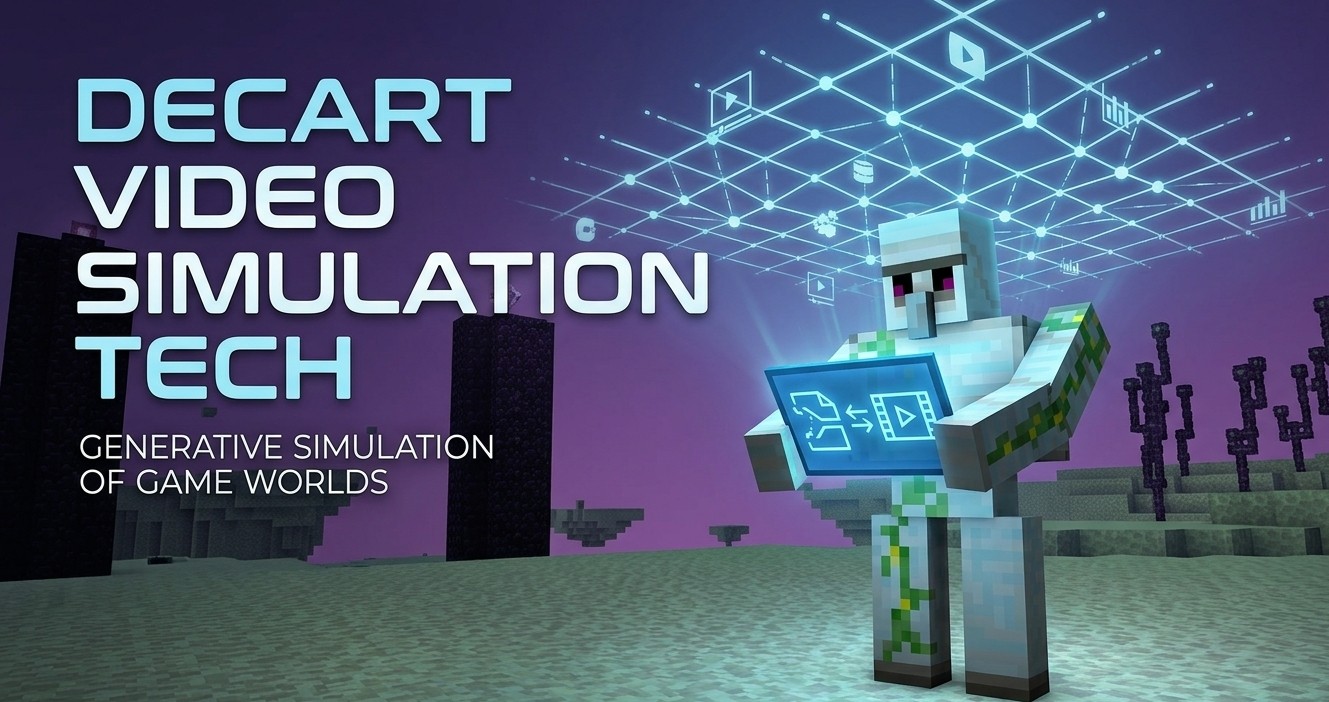

The Complete Wiki to Decart Video Simulation Tech
Decart is an Israel-based AI research company developing technology designed to make generative AI operate in real time.
Instead of focusing only on conventional text-to-image or text-to-video generation, Decart is building world models, real-time video systems, and the infrastructure required to generate or transform visual environments with very low latency. Its technology now spans gaming, live streaming, video editing, robotics, physical AI, and interactive digital experiences.
Quick Facts
| Detail | Information |
|---|---|
| Company | Decart |
| Country | Israel |
| Founded | 2023 |
| Founders | Dean Leitersdorf and Moshe Shalev |
| Major 2026 funding | $300 million Series B |
| Lead investor | Radical Ventures |
| Reported valuation | $4 billion |
| Total funding after round | More than $450 million |
| Core technology | Real-time AI, world models, video generation, AI infrastructure |
| Major models | Lucy and Oasis |
| Infrastructure | Decart Optimization Stack, or DOS |
| Gaming connection | AI-generated worlds, real-time world editing and interactive experiences |
| Original gaming breakthrough | Oasis, a playable real-time AI-generated world |
What Is Decart?
Decart is an AI research and infrastructure company founded in 2023 by Dean Leitersdorf and Moshe Shalev.
The company's goal is to make AI systems operate closer to the speed of real-world interaction. Instead of generating an image or video and waiting for a traditional rendering process to finish, Decart's systems are designed to continuously generate or modify visual information while a user is interacting with it.
This approach is particularly relevant to gaming.
Traditional games rely heavily on pre-built assets, game engines, textures, animations, lighting systems and scripted environments. Decart's world-model approach explores a different possibility: generating or modifying parts of the visual world dynamically.
The $300 Million Funding Round
In May 2026, Decart announced a $300 million funding round led by Radical Ventures.
The company said the investment would accelerate its work on infrastructure for low-latency AI systems, alongside new generations of its Lucy and Oasis models. Decart's own timeline states that the round brought its total funding to more than $450 million.
Radical Ventures lists the round as a Series B completed in 2026 and gives Decart a reported valuation of approximately $4 billion.
The funding is important because real-time generative AI is extremely computationally demanding.
Generating every frame of an interactive environment requires substantially different infrastructure from generating a single image.
What Is Decart's Optimization Stack?
One of Decart's most important technologies is the Decart Optimization Stack, commonly abbreviated as DOS.
DOS is designed to optimize AI workloads across the computational stack, including hardware and inference systems.
Decart says DOS works across hardware platforms including NVIDIA, AWS Trainium and Google TPU, with the goal of making AI workloads faster and more efficient.
This infrastructure is particularly important for Decart because its models need to generate results continuously rather than producing a single output after a long rendering process.
Lucy: Decart's Real-Time World Editing Model
Lucy is Decart's real-time video and world-editing technology.
Rather than simply creating a video from a prompt, Lucy can modify an existing live video stream.
According to Decart, Lucy can perform operations such as:
- Character swapping
- Object addition
- Object removal
- Background changes
- Style changes
- Visual effects
- Attribute changes
The company says Lucy can perform these transformations while video is being created, streamed or consumed.
Why Lucy Matters for Gaming
Gaming is one of the industries Decart specifically identifies for Lucy.
The company's platform describes Lucy as capable of editing the world it sees in real time, potentially enabling new types of interactive gaming experiences.
This could mean a game environment where visual elements are not permanently fixed.
For example, an AI system could potentially transform:
Environment → Character → Object → Lighting → Visual Style
while the player is interacting with the world.
This is different from traditional game development, where most of these elements are prepared before the player launches the game.
Does Decart Generate Game Assets?
This point needs some clarification.
Decart's current technology can generate and transform images, video, environments, characters, objects and visual effects, and its platform explicitly targets gaming.
However, it would be inaccurate to describe Decart as simply an AI 3D asset generator comparable to a conventional tool for exporting ready-to-use game meshes, textures or animation files.
Its bigger idea is real-time world generation and world editing.
Decart's technology can therefore be relevant to game assets because objects and environments can be generated or transformed dynamically, but the company's broader ambition goes beyond individual downloadable assets.
Oasis: The World Generation Side
While Lucy focuses heavily on world editing, Oasis represents Decart's world-generation technology.
Decart originally demonstrated Oasis as a playable, real-time AI-generated game world.
In 2024, TechCrunch reported that Oasis generated a Minecraft-like environment dynamically from gameplay inputs. The model was trained on Minecraft gameplay videos and used keyboard and mouse inputs to generate frames while simulating aspects of the game's physics, rules and graphics.
This was one of the clearest demonstrations of Decart's gaming ambitions.
Oasis and AI-Generated Games
The original Oasis experiment suggested a radically different approach to game creation.
Instead of:
Game Engine → Assets → Rendering → Final Frame
an AI world model can attempt something closer to:
Player Input → World Model → Generated Frame
The difference is significant.
A traditional game engine uses predetermined assets and rules to render the world.
A world model attempts to learn how the world should behave visually and generate what comes next.
From Minecraft-Like Worlds to Physical AI
Decart's newer Oasis technology has expanded beyond gaming.
In June 2026, Decart introduced Oasis 3, an interactive world model designed initially for applications such as autonomous-vehicle simulation and other physical-AI workloads. TechCrunch reported that Oasis 3 could generate photorealistic driving environments in real time and was available through an API.
Decart describes Oasis as its world model for physical AI, while Lucy is positioned around immersive experiences and world editing.
Why World Models Are Important
A conventional generative AI model might create a picture of a fantasy castle.
A world model aims to go further.
It attempts to understand how an environment changes when something happens inside it.
For gaming, that could eventually mean:
- A character walks through a door
- The environment changes accordingly
- Objects react to the character
- Lighting changes
- New visual details appear
- The world continues generating around the player's actions
The goal is not simply generating an image.
It is generating a responsive environment.
Decart's Gaming Timeline
| Year | Development |
|---|---|
| 2024 | Decart emerges from stealth with $21M seed funding |
| 2024 | Oasis demonstrates a playable real-time AI-generated game world |
| 2025 | Decart expands its real-time video and generative AI technology |
| 2026 | Lucy and Oasis become central parts of Decart's world-model strategy |
| May 2026 | Decart announces $300M funding round |
| June 2026 | Oasis 3 launches for interactive world-model applications |
| July 2026 | Lucy 2.5 launches with higher-quality real-time transformations |
Decart's own company timeline identifies Oasis, Lucy, its funding rounds and DOS as major stages in the company's development.
Lucy 2.5 and Real-Time Generation
In July 2026, Decart announced Lucy 2.5, describing it as an improved real-time video model.
The company highlighted:
- Higher-quality edits
- Improved temporal consistency
- Physically aware visual effects
- Lower latency
- Real-time generation at 30 FPS
Decart positions Lucy 2.5 as infrastructure for live AI experiences rather than simply another offline video-generation model.
The Importance of Low Latency
Latency is one of the biggest challenges for AI-generated gaming.
If a player presses a button and waits several seconds for the AI to generate the next frame, the experience stops feeling interactive.
Decart's platform therefore focuses heavily on real-time inference.
Its Lucy platform currently advertises sub-40ms latency for certain experiences and continuous generation capabilities, although actual performance depends on the model, resolution, hardware and application.
Could AI Eventually Replace Traditional Game Assets?
Decart's technology points toward a possible future where some visual content is generated dynamically rather than stored entirely as traditional assets.
A future game could potentially use AI to generate:
Characters
Buildings
Props
Environments
Visual effects
Backgrounds
World variations
Instead of requiring developers to manually create every possible variation, the AI could generate variations as players encounter them.
However, this remains an evolving technology.
Today's systems still have challenges involving consistency, control, latency, compute costs, game logic and persistence.
The Consistency Problem
One of the biggest challenges with generative game worlds is maintaining consistency.
A traditional game engine knows exactly where every object exists.
An AI-generated environment can potentially have difficulty maintaining perfect continuity.
This was visible in early Oasis demonstrations. TechCrunch reported that the system could lose track of the level layout and rearrange parts of the environment when the player turned around.
For a game, this is a major technical challenge.
Players expect:
The same door to remain the same door.
The same building to remain in the same location.
The same character to retain the same appearance.
The same world state to persist.
AI world models need to solve these problems before they can fully replace conventional game-engine workflows.
Decart's Developer Platform
Decart is also moving toward making its technology accessible to developers.
The company provides a developer SDK and APIs for its models, including real-time video transformation. Its official JavaScript SDK supports connections to Decart's real-time models, while its broader developer ecosystem provides access to image and video generation models.
This is important because Decart's long-term strategy is not limited to building demonstrations.
The company wants developers and businesses to build applications on top of its models.
What Makes Decart Different?
Decart's strategy combines three layers:
1. Infrastructure
DOS optimizes the underlying AI computation.
2. World Models
Lucy and Oasis provide generative and editing capabilities.
3. Applications
These models can be applied to:
- Gaming
- Live streaming
- Advertising
- Social media
- Virtual try-on
- Robotics
- Autonomous vehicles
- Simulation
Decart describes this as a stack that extends from hardware optimization to world models and applications.
Decart vs Traditional Game Development
| Traditional Game Development | Decart-Style World Models |
|---|---|
| Assets created ahead of time | Visual content can be generated dynamically |
| Fixed environments | Potentially adaptive environments |
| Conventional game engine rendering | AI-generated frames or transformations |
| Assets stored locally | AI model generates visual content |
| Highly deterministic | Potentially probabilistic |
| Large manual content pipeline | AI-assisted generation |
| Predictable performance | Dependent on AI inference |
This does not mean world models are replacing game engines today.
Instead, they represent a different layer of technology that could eventually work alongside traditional engines.
The $300M Funding and Gaming
The $300 million investment gives Decart significantly more resources to develop this technology.
The funding announcement specifically connected the company to DOS, Lucy and Oasis, rather than describing the round as a gaming-only investment.
That distinction is important.
Gaming is one of Decart's applications, but its ambitions also include physical AI, robotics, simulation and real-time video.
The broader strategy is essentially to make AI capable of understanding and generating environments quickly enough for people and machines to interact with them.
What Could Decart Mean for Game Developers?
If world models continue improving, developers could eventually use AI for parts of the content pipeline that currently require substantial manual work.
Potential applications include:
- Rapid environment prototyping
- Procedural visual generation
- Dynamic NPC appearances
- Real-time world transformations
- AI-generated background environments
- Interactive visual effects
- Player-specific environments
- Live game-world modifications
The biggest potential change is that the game could become less dependent on a fixed set of visual possibilities.
Current Limitations
Despite the impressive demonstrations, Decart's technology still has significant limitations.
Consistency
AI-generated worlds need to preserve locations, objects and characters over time.
Latency
Interactive applications require extremely fast generation.
Compute
Generating frames through AI requires significant computational resources.
Control
Game developers need precise control over what happens inside their worlds.
Game Logic
Generating a visually convincing environment is different from creating a complete game with robust mechanics, networking, progression and rules.
Persistence
A real game world needs to remember changes made by the player.
These challenges mean AI-generated worlds are currently better viewed as an emerging technology than a complete replacement for traditional game development.
FAQ
What is Decart?
Decart is an Israel-based AI company developing real-time AI infrastructure and world models for video, gaming, physical AI and other interactive applications.
How much funding did Decart raise?
Decart announced a $300 million funding round in May 2026, led by Radical Ventures. The company said its total funding surpassed $450 million.
What is Lucy?
Lucy is Decart's real-time video and world-editing model capable of transforming people, objects, environments, styles and visual effects while video is being generated or streamed.
What is Oasis?
Oasis is Decart's world-generation technology. Its early version demonstrated a playable AI-generated game environment, while later versions have expanded toward physical-AI and simulation applications.
Does Decart generate game assets?
Decart's technology can generate and transform visual content, objects, environments and effects, with gaming listed as an application. However, it is more accurate to describe Decart as a real-time world-generation and world-editing platform than simply a traditional 3D game-asset generator.
Can Decart replace Unreal Engine or Unity?
There is currently no basis for saying Decart has replaced traditional game engines. Its technology represents a different approach to generating and modifying interactive visual environments.
Why is real-time AI important for games?
Games require immediate responses to player input. Generating visual content with extremely low latency could allow AI systems to participate directly in the rendering or transformation of interactive worlds.
What is DOS?
DOS, or Decart Optimization Stack, is Decart's infrastructure layer designed to improve AI training and inference efficiency across different hardware platforms