
Twitch's AI Training Opt-Out: Why Your Old Streams Might Already Be Training Amazon's AI
Somewhere in Amazon's AI training pipeline, there's a real chance your old Twitch broadcasts are already in it.
Not because you agreed to it. Because you didn't turn it off in time.
That's the uncomfortable reality behind one of 2026's most controversial Twitch policy changes, and unlike a lot of platform drama, this one didn't need a scandal to spark backlash. The setting itself was the scandal.
What Happened
On August 12, 2026, Twitch quietly added a new toggle to account settings called Generative AI Training.
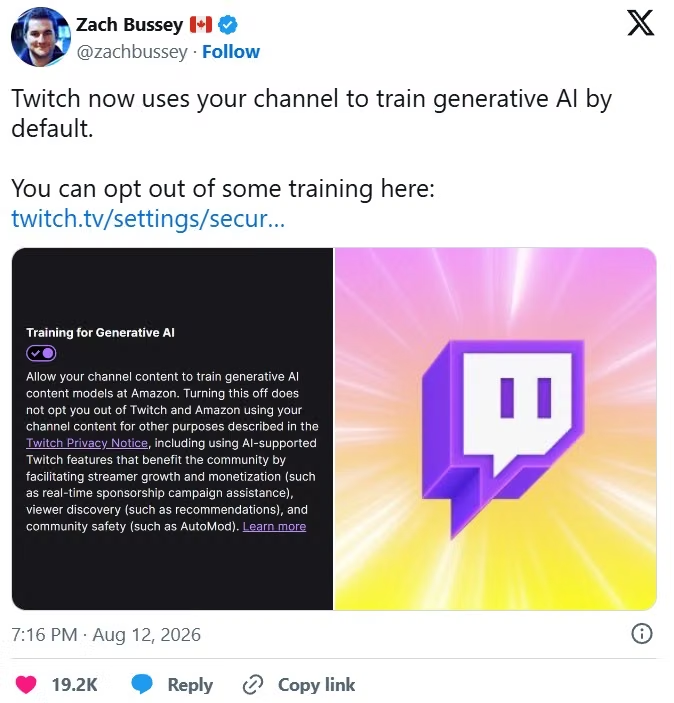
Note: The setting was enabled by default for every user. Streamers had to manually find it and switch it off, under Settings → Security and Privacy, or their past and future content became eligible for Amazon's AI training pipeline automatically.
The core details of the policy:
- Amazon can collect streams, clips, images, chats, and channel content for AI training purposes
- The setting applies retroactively, meaning past broadcasts were already eligible the moment the toggle went live
- Twitch's own team admitted it doesn't know whether any specific streamer's content had already been used for training before creators had a chance to opt out
- The backlash was immediate: within hours, a support forum post demanding an opt-in model instead had gathered close to 14,000 upvotes, according to Engadget's coverage of the rollout
The justification from Twitch's leadership became a flashpoint on its own. Chief Product Officer Mike Minton defended the default-on approach directly, according to CBC News's report on the policy, arguing that an opt-in model simply wouldn't have gotten adoption, since most users wouldn't choose to join voluntarily.
That admission became the story almost as much as the policy itself.
Why the "Default-On" Design Made This Worse
Twitch could have shipped the exact same underlying policy and gotten a very different reaction, if it had launched as opt-in instead of opt-out.
| Approach | What It Would Mean | Creator Reaction |
|---|---|---|
| Opt-in (not used) | No content used unless a streamer actively agrees | Likely low adoption, but minimal backlash |
| Opt-out (what shipped) | All content used automatically unless a streamer finds and disables it | Mass backlash, over 16,000 formal objections |
| No AI training option at all | Content stays fully outside AI training pipelines | Not offered as a choice |
The design choice shifted the burden of consent from Twitch onto individual streamers. Instead of asking permission, the platform asked forgiveness, and gave people a settings menu to quietly walk it back if they found it in time.
According to a detailed breakdown of the controversy, that framing decision, describing the update as simply "adding a setting that lets you opt out," rather than disclosing that AI training was starting by default, is what many creators felt sanitized a significant shift in how their content could be used (source).
It's a familiar pattern in tech more broadly, but seeing it applied to years of personal, unscripted livestream footage hit differently for a lot of creators than it does with, say, a cookie-consent banner.
Why Twitch's Content Specifically Matters Here
This isn't a generic "platform trains AI on user data" story. The type of data matters, and Twitch's archive is unusually valuable for a specific reason.
Twitch represents thousands of hours of long-form, unscripted audio and video, a dataset that's difficult to replicate through any other source, since it captures natural speech and behavior across countless hours of live, unedited broadcasting.
That's a meaningfully different category of training data than scripted video, produced content, or short clips. It's raw, extended, real human conversation and reaction, exactly the kind of data that's become harder for AI companies to source as more platforms lock down access.
Understanding why Amazon specifically wanted this data helps explain the timing:
- Twitch's archive offers scale that's hard to match, thousands of hours of continuous content
- The content is unscripted, capturing natural speech patterns AI models struggle to learn from produced media
- Amazon owns Twitch outright, removing the licensing negotiations other companies face when sourcing training data
- The data includes chat interactions alongside audio and video, giving models a paired view of content and real-time audience reaction
What Opting Out Actually Does, and Doesn't, Stop
For creators who did find the setting and disable it, there's an important limitation worth understanding.
Turning off Generative AI Training going forward doesn't necessarily undo what may have already happened during the window between the policy's launch and a creator discovering the toggle. Twitch itself has acknowledged it can't confirm whether specific past content was already swept into training data before someone opted out.
That gap, between policy launch and individual discovery, is where most of the lingering frustration sits. It's not just about future content. It's about not knowing what already happened to years of past broadcasts during the time before the setting was found.
What Happens Next?
A few things worth watching as this story continues to develop:
- Whether sustained creator pressure, now numbering well over 16,000 formal objections, pushes Twitch toward an opt-in model instead
- Whether regulators in regions with stronger data consent laws, particularly the EU, scrutinize the default-on design specifically
- Whether other Amazon-owned or Amazon-adjacent platforms adopt similar default-on AI training policies, now that Twitch has tested the model and absorbed the backlash
- Whether Twitch offers any clarity on exactly what content, from which time window, was used for training before individual creators opted out
The Bottom Line
This wasn't a policy that required a scandal to become controversial. The mechanism itself, opting millions of creators into AI training by default and asking them to find the switch themselves, was the controversy.
Twitch's own product leadership was candid about why: an honest opt-in request likely wouldn't have gotten the adoption Amazon wanted. That kind of transparency about the reasoning didn't calm the backlash. If anything, it confirmed exactly what creators suspected, that the default setting wasn't an oversight. It was the plan.
FAQ
When did Twitch's Generative AI Training policy go live?
The setting was added to Twitch account settings on August 12, 2026, and was enabled by default for all users.
How do I check or change this setting on my own account?
Go to your Twitch profile picture, then Settings, then Security and Privacy, and look for the Generative AI Training toggle to disable it.
Does opting out remove content that was already used for training?
Not necessarily. Twitch has said it doesn't know whether specific content was already used for training before a creator found and disabled the setting, so opting out mainly affects future eligibility.
Why did Twitch make this opt-out instead of opt-in?
Twitch's Chief Product Officer stated publicly that an opt-in model likely wouldn't have gotten meaningful adoption, since most users would not voluntarily choose to join.
What kind of content does this policy affect?
The policy covers streams, clips, images, chat logs, and general channel content, applied both retroactively to past broadcasts and to future content until a creator opts out.