
💾 PCIe 5.0 DirectStorage in 2026: Are High-Speed SSDs Finally Eliminating Open-World Stutter?
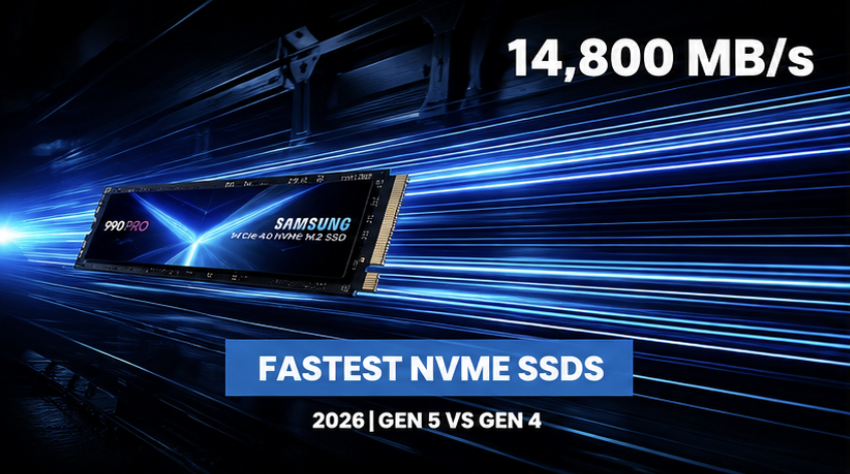
For years, PC gamers have been sold the same promise: buy a faster SSD, and your games will load quicker, stream smoother, and stutter less. PCIe 5.0 drives now push sequential speeds past 14,000 MB/s, numbers that sound like they should make loading screens and open-world hitching a thing of the past.
So here in 2026, with PCIe 5.0 drives mainstream and Microsoft's DirectStorage API years into its rollout, does the hardware actually deliver on that promise? The honest answer is more complicated than the marketing slides suggest.
🎯 The Trend: Everyone Bought the Hype, Then Tested It
DirectStorage was pitched as the technology that would finally make raw SSD speed matter for gameplay, not just load screens. It allows a game to pull data directly from an NVMe drive into GPU memory, letting the graphics card handle decompression instead of routing everything through the CPU first.
On paper, that should mean less texture pop-in, fewer traversal hitches in open-world games, and noticeably smoother asset streaming as you move through a large environment.
In practice, the results have been far more selective than the pitch implied.
Quick note: DirectStorage benefits are entirely opt-in for developers. A game only sees a real speed improvement if its engine has been specifically built or patched to use the API with GPU decompression enabled. Simply owning a fast SSD does nothing on its own if the game itself was never coded to take advantage of it.
🧪 What Actual Testing Shows in 2026
This is where the story gets interesting, because independent benchmarking paints a much less dramatic picture than the hardware specs suggest.
According to VGTimes' recent SSD testing breakdown, the only titles where NVMe speed provided a measurable, repeatable advantage were Forspoken and Ratchet & Clank: Rift Apart, both of which were built specifically around DirectStorage from the ground up.
Here's what that testing actually found:
- 🎮 In Forspoken, moving from a SATA drive to any PCIe NVMe drive improved 1% low FPS by 22 to 51%, depending on resolution
- ⚡ In Ratchet & Clank: Rift Apart, faster drives cut portal traversal times by roughly 2 to 3 seconds
- 🐌 In games without proper DirectStorage support, the difference between SATA and NVMe load times was a matter of fractions of a second
- 🎯 Even in DOOM: The Dark Ages, a title that officially requires an NVMe drive, a SATA SSD performed comparably with no visible glitches or stutter
That last point matters more than it might seem. If a game officially requiring NVMe storage still runs fine on a SATA drive, it strongly suggests the requirement is more about marketing and minimum spec messaging than an actual technical dependency on drive speed.
⚙️ Why the Gains Are So Inconsistent
The core issue isn't the hardware. PCIe 5.0 drives genuinely are fast. The bottleneck sits somewhere else entirely.
🔑 Adoption is still the limiting factor
As explained in FaceOfIt's DirectStorage compatibility guide, the technology's biggest impact shows up specifically in asset streaming, reducing texture pop-in and eliminating traversal stutter in games engineered around it. The guide is also direct about a common misconception: a quality PCIe 4.0 drive remains the practical sweet spot for most current titles, and even a solid PCIe 3.0 drive still offers a massive upgrade over a traditional SATA SSD for everyday gaming.
🔑 The engine has to be rebuilt around it
DirectStorage isn't something that automatically benefits every game the moment it launches on a fast drive. Studios have to restructure how their engine loads and decompresses assets to actually use the API's GPU decompression path. Most existing game engines, including many built years before DirectStorage existed, were never designed with that pipeline in mind, and retrofitting it isn't a simple patch.
🔑 CPU and engine limits often matter more than storage
In many of the real-world tests circulating this year, the actual bottleneck during open-world traversal wasn't drive speed at all, but CPU scheduling and engine level streaming logic. A faster SSD can only feed data as quickly as the game's engine is prepared to process and render it, and most current engines simply aren't asking for data fast enough to bottleneck even a mid-range Gen4 drive.
💰 Is a PCIe 5.0 SSD Actually Worth Buying for Gaming Right Now
This is the practical question most buyers actually care about, and the answer depends heavily on what you're building the system for.
A detailed real-world example from Ordinary Tech's SSD and gaming FPS breakdown makes the trade-off clear. The team described respeccing a client's gaming build in Toronto, swapping a Crucial T705 Gen5 drive for a Samsung 990 Pro Gen4, and redirecting the roughly $150 in savings into a GPU tier upgrade instead. The result was a machine that performed noticeably better across every game the client actually played.
A few practical takeaways worth considering before buying a Gen5 drive purely for gaming:
- 🎮 If your game library is mostly non-DirectStorage titles, a Gen4 drive will feel functionally identical during actual play
- 💵 Money spent stepping up from Gen4 to Gen5 storage often delivers less real-world benefit than the same money spent on a GPU upgrade
- 🧰 PCIe 5.0 drives can also run hotter and may require better cooling or motherboard support, adding cost and complexity beyond the drive itself
- 🚀 If you frequently do content creation work alongside gaming, such as 4K or 8K video editing, Gen5 speeds show up far more clearly outside of games than inside them
- 🔮 Buying Gen5 now as a future-proofing move for upcoming DirectStorage-heavy titles is a reasonable bet, just don't expect it to change your experience in most of today's games
🌍 So, Is Open-World Stutter Actually Being Solved
The honest answer sits somewhere between yes and not yet. In the handful of titles genuinely engineered around DirectStorage, the improvement in traversal smoothness and reduced pop-in is real and measurable. Forspoken and Ratchet & Clank prove the technology works exactly as advertised when developers commit to building around it properly.
But those titles remain the exception rather than the rule. Most open-world releases in 2026 still rely on traditional asset streaming pipelines that were never rebuilt around GPU decompression, which means the stutter reduction promised by PCIe 5.0 and DirectStorage simply isn't being triggered in the majority of games people are actually playing.
The technology isn't broken. It's underused. Until more studios rebuild their engines around it the way Insomniac and Luminous Productions did, high-speed storage will keep outpacing the software that's supposed to take advantage of it.
🏁 Final Takeaway
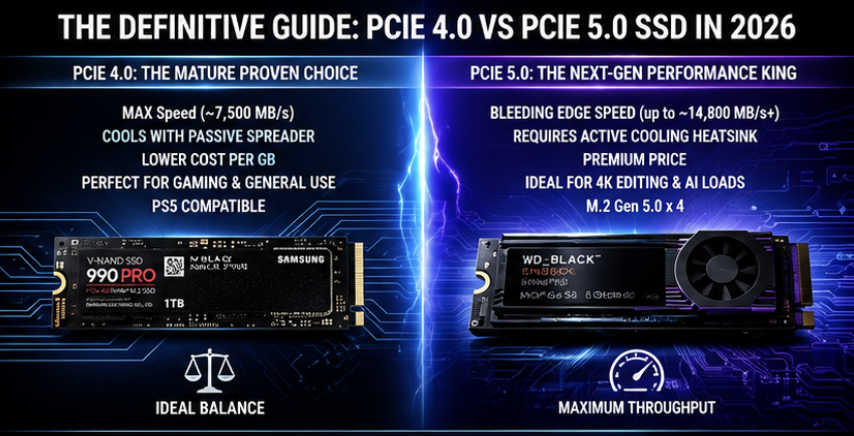
PCIe 5.0 SSDs are genuinely impressive pieces of hardware, but in 2026, they remain a solution mostly waiting for its problem to catch up. DirectStorage delivers real, tangible open-world stutter reduction, just only in the small number of titles specifically engineered to use it. For everything else in your library, a well-chosen PCIe 4.0 drive will feel just as smooth, and that GPU upgrade you were debating instead will likely do far more for your actual gaming experience than a faster drive sitting mostly idle in the background.

Comments
Sign in to join the conversation
Sign inNo comments yet
Be the first to share your thoughts!