

🖥️ Glossy vs. Matte QD-OLED Panels: The Enthusiast Debate Over Modern Monitor Clarity
Ask ten PC enthusiasts which OLED monitor coating is better, and you will get ten confident, completely opposite answers. It is one of the few debates in PC hardware that has nothing to do with specs on paper and everything to do with the room you are sitting in.
In 2026, this argument finally has real substance behind it, because for the first time, buyers actually have a genuine choice between glossy and matte QD-OLED panels rather than settling for whatever a manufacturer happened to ship.
🎯 The Trend: Choice Finally Arrives for OLED Monitor Buyers
For years, OLED monitor buyers had almost no real decision to make. According to FlatpanelsHD's coverage of the shift, every WOLED panel shipped with a matte coating, while QD-OLED panels were marketed as semi-glossy, though in practice they leaned much closer to matte than most buyers expected.
That finally changed. Asus led the charge by introducing five glossy OLED monitors across 27 and 32 inch sizes, some built on LG Display's newer RGB Tandem OLED panels. LG Electronics followed with its own native glossy models, applied directly during production rather than as an aftermarket modification.
What actually changed in 2026:
- 🆕 Genuine native glossy OLED monitors from Asus and LG entered the market for the first time
- 🎨 Samsung significantly improved its QD-OLED matte coating, closing part of the gap with glossy panels
- 🔬 New anti-reflective films with reflectance as low as 0.3% made glossy panels viable even in brighter rooms
- 💡 Peak HDR brightness on some tandem panels reached up to 4,500 nits, giving glossy coatings more tools to fight ambient light
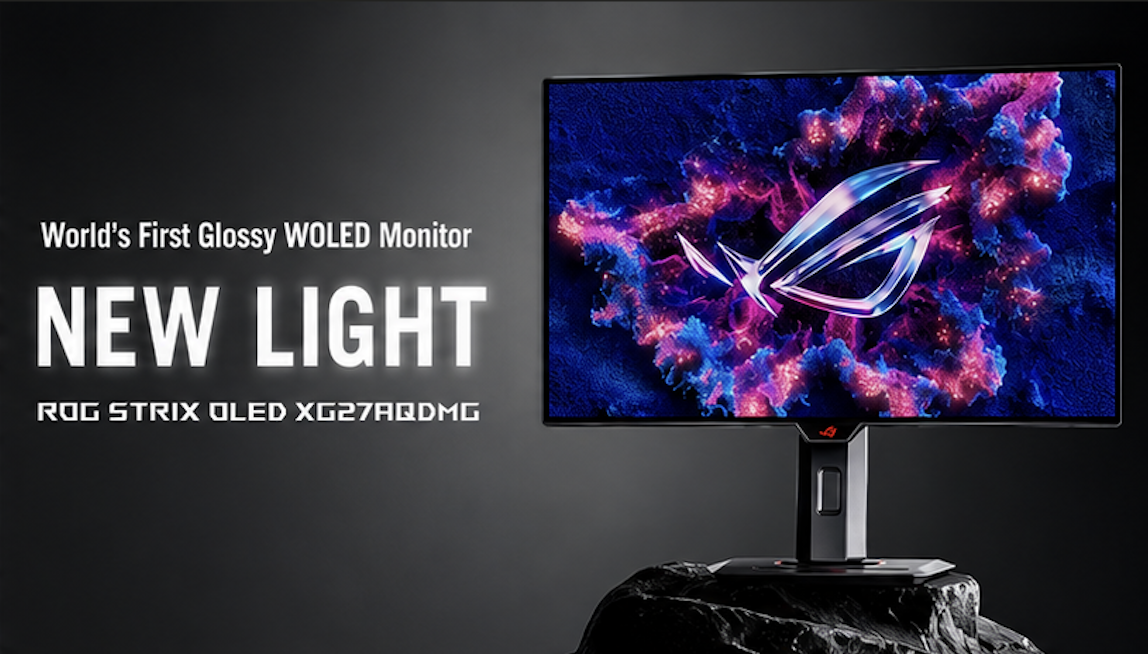
Quick note: "Glossy" and "matte" refer to the physical coating applied over the OLED panel itself, not the underlying display technology. The panel produces the same image either way. The coating only changes how light reflects off the surface before it reaches your eyes.
🔍 The Physics Behind the Two Approaches
Understanding why this debate even exists requires understanding what each coating is actually doing to the light hitting your screen.
✨ How glossy coatings work
Glossy panels typically rely on anti-reflective coatings that use thin-film interference to cancel out specific wavelengths of light through destructive interference. This approach can achieve extremely high light transmission, often above 99%, while keeping the image underneath completely undisturbed. Nothing sits between your eyes and the actual pixels, which is exactly why glossy panels are famous for their inky blacks and sharp clarity.
🌫️ How matte coatings work
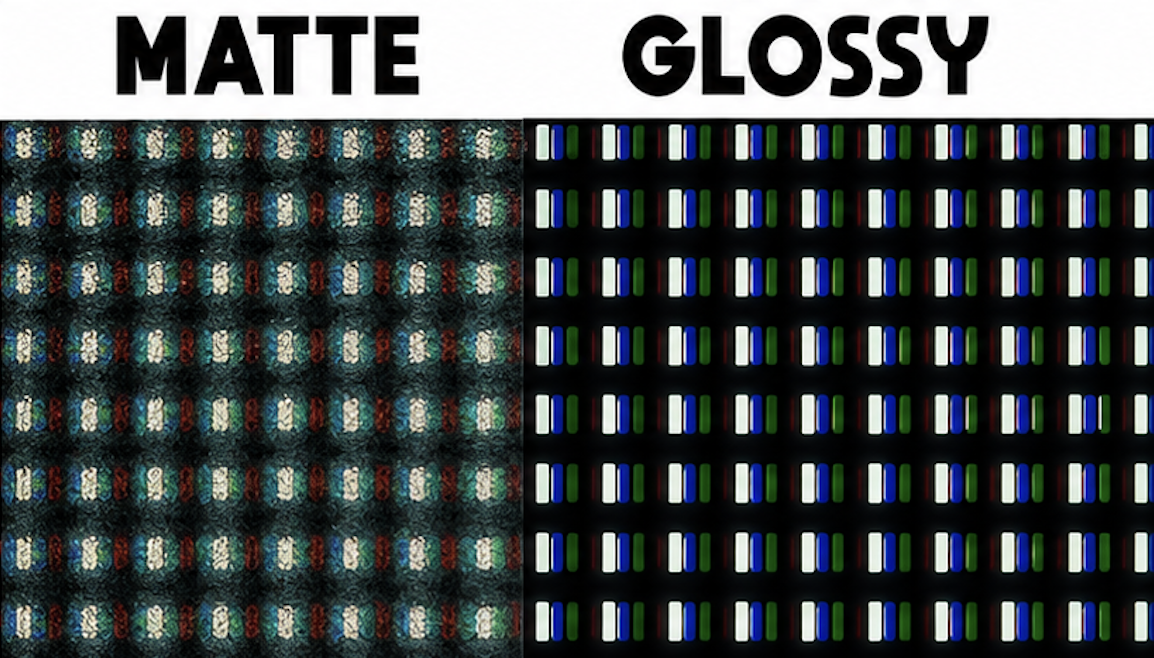
Matte coatings take a different approach entirely. Instead of canceling reflections, they diffuse incoming light by scattering it across the panel's surface. This does successfully break up sharp, distracting reflections, but it comes at a real cost. That same scattering effect slightly raises black levels and introduces a fine grain that becomes noticeable during long sessions of text heavy work or solid color scenes.
According to KTC's detailed breakdown of the two coatings, this effect is particularly visible on QD-OLED panels specifically, which can show a faint purplish tint under ambient light because they lack a traditional polarizer layer that other panel types use.
⚖️ Where Each Coating Actually Wins
The honest answer to which coating is better depends far more on your environment than on any objective quality metric.
Glossy panels tend to win when:
- 🌑 You game or work in a dark, controlled lighting environment
- 🎬 Contrast, black depth, and color saturation matter more to you than avoiding reflections
- 🏠 You have full control over lighting placement and can position the monitor to avoid direct reflections
- 🎮 You care primarily about competitive clarity and image sharpness in dim rooms
Matte panels tend to win when:
- ☀️ Your desk sits near a window or under uncontrolled overhead lighting
- 💼 You spend most of your time on text heavy productivity work rather than gaming or cinematic content
- 🏢 You share a workspace where lighting cannot realistically be adjusted
- 😌 You personally find diffused ambient glow less distracting than sharp, mirror like reflections
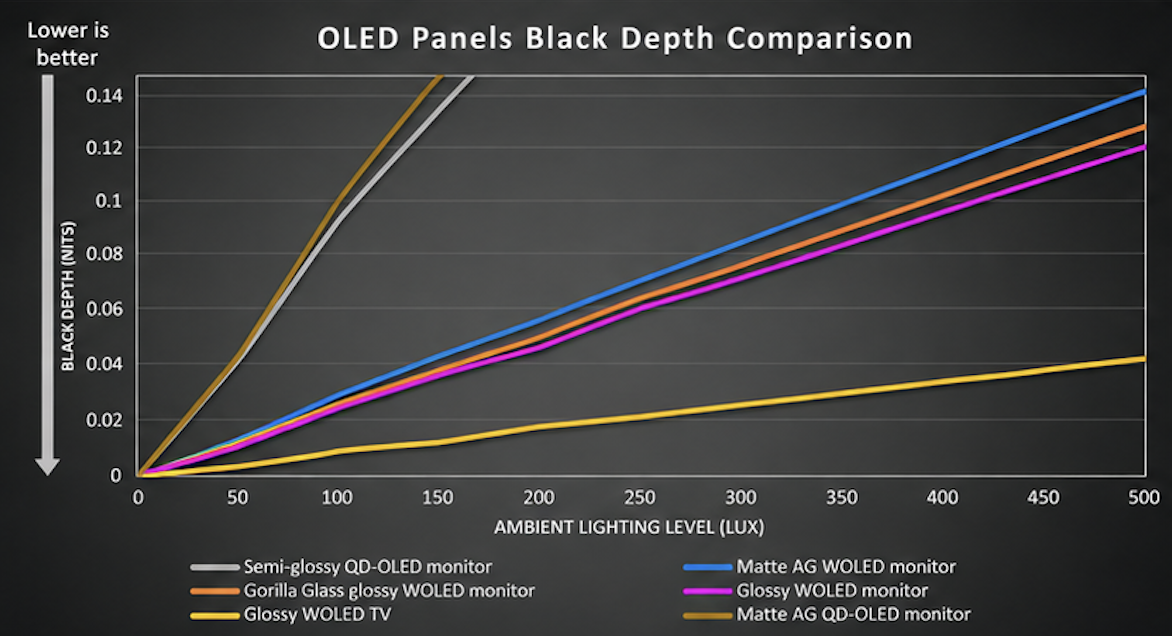
Room lighting, measured roughly in lux, ends up being the single biggest factor in this decision. In dark rooms with lighting under 50 lux, glossy wins on nearly every dimension. In bright, sunlit spaces above 500 lux, matte becomes close to a requirement rather than a preference, since glossy reflections simply overwhelm the image at that point.
🧠 What Enthusiasts Actually Argue About
Beyond the pure physics, this debate carries a surprising amount of personal identity for PC hardware enthusiasts, and the arguments tend to fall into a few recurring camps.
The glossy camp argues that any diffusion layer fundamentally compromises what makes OLED special in the first place. Their position is straightforward: if you are paying a premium for OLED's legendary contrast and color, a matte coating is actively working against the reason you bought the panel. Enthusiasts in this camp frequently point out that glossy OLEDs consistently top best-of-the-year monitor lists specifically because of the image quality difference.
The matte camp counters that usability matters more than theoretical peak image quality. Their argument centers on the idea that a stunning glossy panel is worthless if you cannot comfortably use it in your actual room, and that Samsung's newer QD-OLED matte coatings in particular have narrowed the visible gap enough that the trade-off is no longer as painful as it once was.
There is also a smaller, more nuanced group that argues the entire debate is increasingly situational rather than universal, pointing out that someone with two different setups, a dark gaming room and a bright home office, might legitimately want a glossy panel in one and a matte panel in the other.
🏁 Final Takeaway
The glossy versus matte QD-OLED debate does not have a single correct answer, and anyone claiming otherwise is probably only describing their own room. Glossy panels deliver the deepest blacks, richest color, and sharpest clarity OLED technology is capable of, but only when your lighting cooperates. Matte panels trade some of that peak image quality for genuine usability in spaces where reflections cannot be controlled.
If you have never actually seen a glossy OLED monitor in person, it is worth experiencing one in a realistic, everyday lighting setup rather than judging it under harsh retail lighting alone. The difference in a properly darkened room can feel dramatic. But if your desk sits anywhere near a window or overhead light you cannot move, matte remains the safer, more livable choice, even with the small trade-offs it brings along with it.



Comments
2Sign in to join the conversation
Sign in