
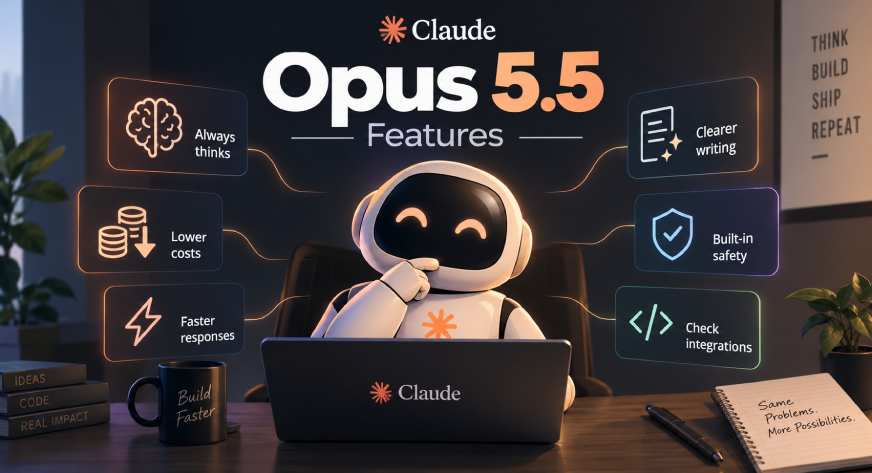
Anthropic just gave Claude Opus 5.5 a new capability filter and it may have created an awkward problem for one of its biggest partners.
The company says Opus 5.5 uses special classifiers for a small number of tasks connected to frontier AI development, including low-level kernel development for certain machine-learning accelerators. When one of those classifiers activates, the request can fall back from Opus 5.5 to an earlier model.
The unusual part?
Independent testing suggests the restriction may affect Huawei's Ascend 950DT.
Even more unexpectedly, similar testing appears to trigger the safeguard when developers target Amazon's Trainium3.
Anthropic has not publicly confirmed a hardware-specific blacklist, so the exact scope remains uncertain. But if the observed behavior holds, Opus 5.5 has effectively drawn a new line around who, and what hardware, it will help build frontier AI infrastructure for.
This Isn't a Normal Hardware Ban
There is an important distinction before the story gets misunderstood.
Anthropic isn't blocking Huawei hardware from physically running Claude.
The restriction concerns something much narrower: using Opus 5.5 to develop low-level software for certain AI accelerators in the context of frontier LLM development.
Think of an AI accelerator as a specialized engine.
The kernel is part of the software that tells that engine how to perform its calculations efficiently.
Good kernel code can determine:
How efficiently memory is used
How mathematical operations are scheduled
How quickly attention mechanisms execute
How much compute is wasted
How efficiently a large model trains or runs
For frontier AI systems, those optimizations can have enormous consequences.
So an AI model capable of writing and optimizing those kernels isn't merely helping someone write ordinary software.
It can potentially help make an entire AI infrastructure stack faster and cheaper.
That appears to be the capability Anthropic is trying to put behind an additional layer of protection.
Why Huawei Is the Obvious Flashpoint
Huawei's inclusion is the part that immediately makes geopolitical sense.
China has been developing domestic alternatives to the advanced AI accelerators used by Western AI companies, while the United States has increasingly tightened controls around advanced semiconductor technology and AI capabilities.
Huawei's Ascend platform is an important part of that effort.
The latest generation of Huawei accelerators is designed to support increasingly sophisticated AI workloads, making software optimization just as important as the silicon itself.
That's where Opus 5.5 becomes interesting.
A highly capable coding model could potentially help developers optimize kernels for a competing accelerator architecture without needing the same level of manual expertise.
Anthropic's safeguard therefore appears less concerned with whether Huawei's chip can run software and more concerned with how much assistance its most capable model provides in making frontier AI systems run efficiently on that chip.
That's a much more targeted restriction.
The Amazon Problem Nobody Expected
Then comes the part that makes this story considerably more complicated.
Amazon Trainium3 reportedly triggers the same behavior.
Amazon isn't Huawei.
It's one of Anthropic's most important infrastructure partners, and Claude is available through Amazon Web Services.
Amazon has also invested heavily in its own Trainium accelerator family as it attempts to build a larger alternative to relying entirely on third-party AI accelerators.
Anthropic itself uses Amazon's custom AI hardware as part of its infrastructure strategy.
So if Opus 5.5 really restricts advanced kernel development for Trainium3, an obvious question appears:
Why would Anthropic restrict assistance for hardware it relies on itself?
There are several possible explanations.
The classifier could be identifying a category of accelerator development rather than specific companies.
It could be triggered by the particular frontier-model workload being requested.
The detection system could also simply be broader than intended and produce false positives.
And there is another possibility: the hardware itself could be one of the signals used by the classifier, even if Anthropic hasn't publicly disclosed such a rule.
At the moment, there isn't enough public evidence to determine which explanation is correct.
What Anthropic Actually Confirmed
This distinction matters because the headline is more dramatic than the documented policy.
Anthropic's Opus 5.5 safeguards cover a small set of capabilities related to frontier LLM development, including kernel development for certain machine-learning accelerators.
Requests caught by those classifiers can fall back to an earlier model.
Anthropic also says the safeguards shouldn't affect the vast majority of traditional AI or machine-learning development, research, or general coding.
So this isn't a blanket prohibition on writing code for AI chips.
It's a restriction around a particular category of high-end AI development.
That's an important difference.
A developer asking Claude to explain GPU programming isn't necessarily affected.
A researcher asking for help optimizing a low-level kernel specifically intended to improve a frontier model's performance on a particular accelerator is much closer to the restricted category.
Why Kernel Code Has Become Geopolitical
This is where the story gets bigger than Claude.
For years, the AI race was largely framed around who had the best chips.
Then it became about who could manufacture those chips.
Now there's another layer:
Who has the best software for those chips?
Hardware specifications only tell part of the story.
Two accelerators can have enormous theoretical computing power while producing very different real-world performance depending on their software stack.
Compiler technology, kernels, memory management and optimization can turn theoretical hardware capability into practical AI performance.
That means an advanced AI coding model could itself become part of the infrastructure race.
Instead of merely helping researchers write applications, it can potentially help researchers extract more performance from the machines training the next generation of AI.
And that makes AI coding assistants strategically interesting.
The Trainium3 Twist Changes the Story
If only Huawei were involved, the narrative would be relatively straightforward.
Anthropic has increasingly focused its safety systems on preventing powerful models from being used for certain frontier AI development activities.
But Amazon changes the equation.
Amazon is simultaneously:
A major cloud provider for Claude
An Anthropic investor
A provider of custom AI accelerators
A major infrastructure partner
A company developing its own Trainium ecosystem
That makes an apparent Trainium3 restriction particularly intriguing.
It doesn't necessarily mean Anthropic deliberately targeted Amazon.
In fact, the available evidence doesn't establish that.
But it does demonstrate the difficulty of designing AI safeguards around increasingly specific technical capabilities.
A classifier designed to stop one category of frontier AI development can have unexpected consequences elsewhere.
The Bigger Battle: AI That Helps Build AI
There's a deeper reason Anthropic might care about this capability.
Modern AI systems are increasingly capable of assisting with their own infrastructure.
They can write training code.
They can optimize kernels.
They can debug distributed systems.
They can identify performance bottlenecks.
They can suggest architectural improvements.
That creates a strange feedback loop.
The better the model becomes at AI engineering, the more useful it becomes for people trying to build the next model.
Eventually, restricting the model's ability to perform certain AI-development tasks becomes less about traditional content moderation and more about controlling the acceleration of AI research itself.
That's a fundamentally different kind of safety problem.
What Happens Next?
The biggest thing to watch is whether Anthropic publishes a clearer explanation of the affected hardware and workloads.
Right now, the public description focuses on the capability category rather than providing a comprehensive list of accelerators.
Independent testing has suggested differences between hardware targets, but those results need broader replication before they can be treated as a definitive hardware blacklist.
Several questions remain open:
Is Huawei's Ascend 950DT deliberately targeted?
Why does Trainium3 appear to trigger similar behavior?
Are other AI accelerators affected?
Does the classifier distinguish frontier training from ordinary kernel development?
Could legitimate developers be incorrectly downgraded to an earlier model?
Will Anthropic change the classifier after receiving feedback?
The answers could determine whether this becomes a narrowly targeted safeguard or the beginning of a broader policy around AI models assisting with frontier infrastructure.
🎮 The Bottom Line
Claude Opus 5.5 isn't simply becoming better at coding.
It's becoming more selective about which kinds of AI development its strongest capabilities can accelerate.
The apparent restriction around Huawei's Ascend hardware fits into the growing geopolitical competition surrounding advanced AI.
The possible Trainium3 restriction is what makes the story fascinating.
If Anthropic's own safety system is catching Amazon's AI hardware in the same net, the challenge may not be as simple as blocking a geopolitical rival.
It could be evidence of how difficult it is to build a classifier that understands the difference between legitimate AI engineering and frontier-model acceleration.
And as AI models become increasingly capable of building the infrastructure used to create better AI models, that distinction is only going to become more important.
What do you think? Should frontier AI models be allowed to optimize any AI hardware, or should companies restrict assistance for technologies that could accelerate the next generation of powerful models? Let us know in the comments.