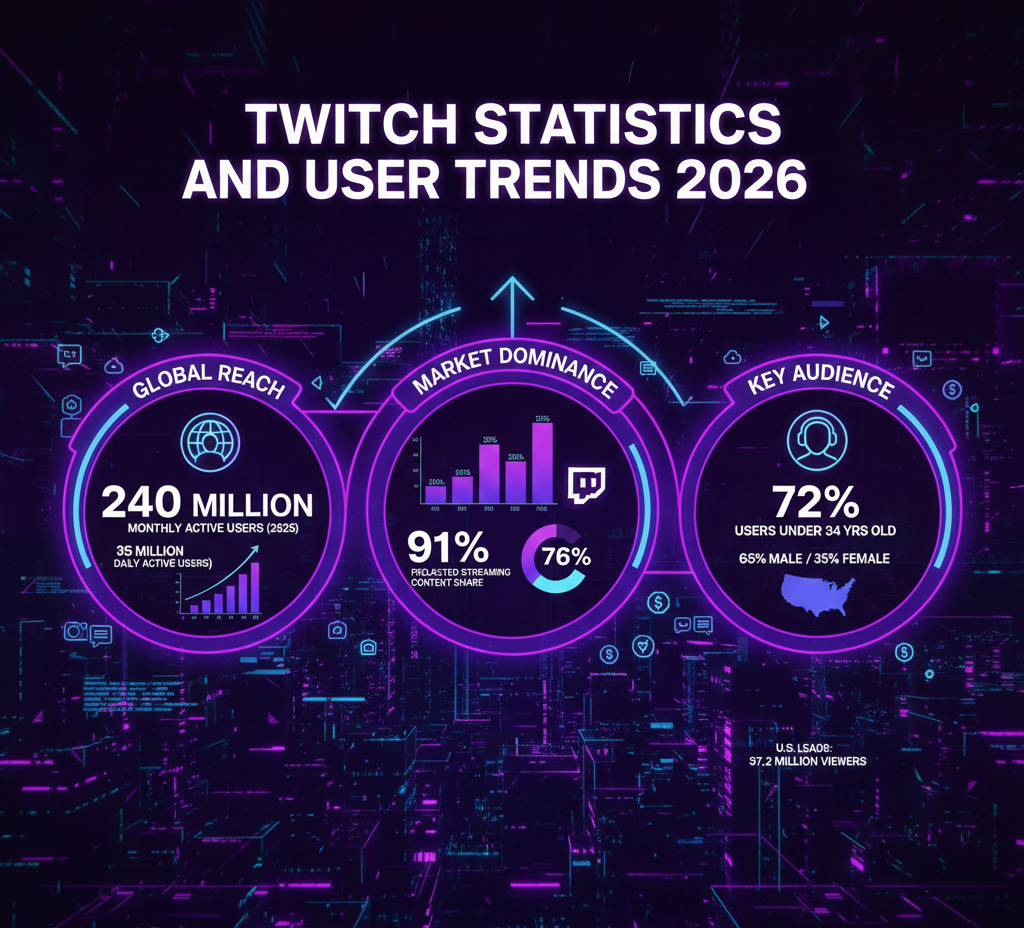

The Ultimate Guide to Twitch's Q3 2026 Market Share
Twitch remains the largest player in live streaming, with 2026 market-share reporting placing it at around 54% of global live-streaming watch time. At the same time, Kick has continued to challenge the platform through a creator-focused business model built around higher revenue shares and financial incentives.
The result is a streaming market where Twitch's established audience and ecosystem are competing directly with Kick's aggressive approach to creator compensation.
Twitch's Q3 2026 Market Position
Twitch's reported 54% market share refers to live-streaming watch time rather than the percentage of all registered users.
That distinction matters. A platform can have a large number of registered accounts without generating the same amount of viewing activity.
Throughout 2026, Twitch has continued to account for the largest portion of live-streaming watch time, while competitors such as YouTube Gaming and Kick have expanded their shares.
Quick Facts
| Metric | Twitch | Kick |
|---|---|---|
| Reported 2026 market share | ~54% | ~11% |
| Subscription revenue share | Standard 50/50 | 95/5 |
| Platform position | Established market leader | Fast-growing challenger |
| Creator incentives | Monetization and advertising programs | Revenue split + incentive programs |
Market-share figures can vary depending on methodology.
Why Twitch Still Holds 54%
Twitch's position is not based on a single feature.
The platform has spent years building a large creator ecosystem, established communities, gaming categories, moderation systems, advertising infrastructure, subscriptions, Bits, and integrations with other gaming services.
This creates a network effect: creators attract viewers, viewers attract more creators, and established communities give streamers a reason to remain on the platform.
Even with competitors offering different financial terms, that existing ecosystem remains an important part of Twitch's market position.
Kick's 95/5 Revenue Split
Kick's biggest differentiator is its creator revenue model.
The platform's headline subscription model gives eligible creators 95% of subscription revenue, with the remaining 5% going toward the platform and processing costs.
For a $5 subscription, the basic calculation looks like this:
- Kick: approximately $4.75 to the creator
- Remaining amount: approximately $0.25
By comparison, Twitch's commonly cited standard subscription split is 50/50, although some eligible creators can receive higher shares through specific programs.
Kick's Creator Incentives
The 95/5 split is only part of Kick's strategy.
Kick has also used creator incentive programs and performance-based payments to attract streamers. These programs have included arrangements involving compensation for qualifying creators, although eligibility requirements and structures can change over time.
This gives Kick two major financial selling points:
- Creators keep a larger percentage of subscription revenue.
- Selected creators can receive additional incentives through platform programs.
The strategy is designed to make the financial side of streaming particularly attractive to creators who already have an audience they can bring to the platform.
Twitch vs. Kick: The Core Difference
The competition is ultimately about more than the percentage attached to a subscription.
Twitch's model is built around a large established audience and mature streaming ecosystem.
Kick's model emphasizes creator economics, with the 95/5 split and additional incentives serving as major parts of its platform pitch.
This creates an important distinction between audience share and creator revenue share.
A platform can offer a creator a larger percentage of each subscription without necessarily having the same total audience. Conversely, a platform with a larger audience can potentially offer creators access to more viewers even when its revenue split is less generous.
Twitch's Market Share vs. Kick's Growth
Reported 2026 figures place Twitch around 54% of the market and Kick around 11%, although different reports can use different methodologies and measurement periods.
Kick's growth has nevertheless been substantial, with the platform expanding its overall viewing activity and creator base.
This means the two platforms occupy different positions:
- Twitch: larger existing share and established viewing ecosystem.
- Kick: smaller market share but aggressive expansion.
- Kick: substantially higher headline subscription revenue share.
-
Twitch: broader established creator and viewer base.
What the 54% Figure Actually Means
The 54% number should not be interpreted as Twitch controlling 54% of every part of the streaming industry.
Market-share measurements can be based on specific categories, regions, platforms, or hours watched.
For this comparison, the figure concerns live-streaming viewing activity. That makes it useful for understanding audience consumption, but it should not be confused with revenue share, registered-user share, or creator share.
Why the Competition Matters for Streamers
The Twitch-Kick competition has changed the economics of creator platforms.
Higher revenue shares create pressure on established platforms to provide competitive monetization programs. At the same time, Twitch's large audience demonstrates that creator income depends on more than the percentage received from each subscription.
Other factors include:
- Average concurrent viewers
- Subscriber numbers
- Advertising revenue
- Sponsorships
- Platform incentives
- Discoverability
- Community size
- Streaming contracts
- Multistreaming opportunities
For creators, the headline percentage is therefore only one part of the overall business equation.
The 2026 Streaming Landscape
Twitch's reported 54% share shows that Kick's aggressive creator economics have not displaced Twitch's position as the largest live-streaming platform.
At the same time, Kick's growth and creator incentives demonstrate that market leadership does not prevent competitors from changing how streamers are compensated.
The two platforms are competing on different strengths: Twitch's established audience ecosystem versus Kick's creator-focused financial model.
Why It Matters
Twitch's Q3 2026 market share illustrates how difficult it is to displace an established streaming platform.
Kick's 95/5 model has created a major financial contrast, while its incentive programs provide additional reasons for creators to experiment with the platform. Yet the reported market-share gap shows that creator compensation and total audience share are separate measurements.
For the broader streaming industry, the competition could continue pushing platforms to reconsider subscription splits, creator incentives, contracts, and monetization structures.
🎮 The Bottom Line
Twitch remains the largest live-streaming platform by reported watch-time share in 2026, with figures around 54%. Kick, meanwhile, continues challenging the established model through its 95/5 creator revenue split and additional creator incentives.
The Q3 2026 market-share picture therefore highlights two different measures of platform strength: Twitch's audience scale and Kick's creator economics.