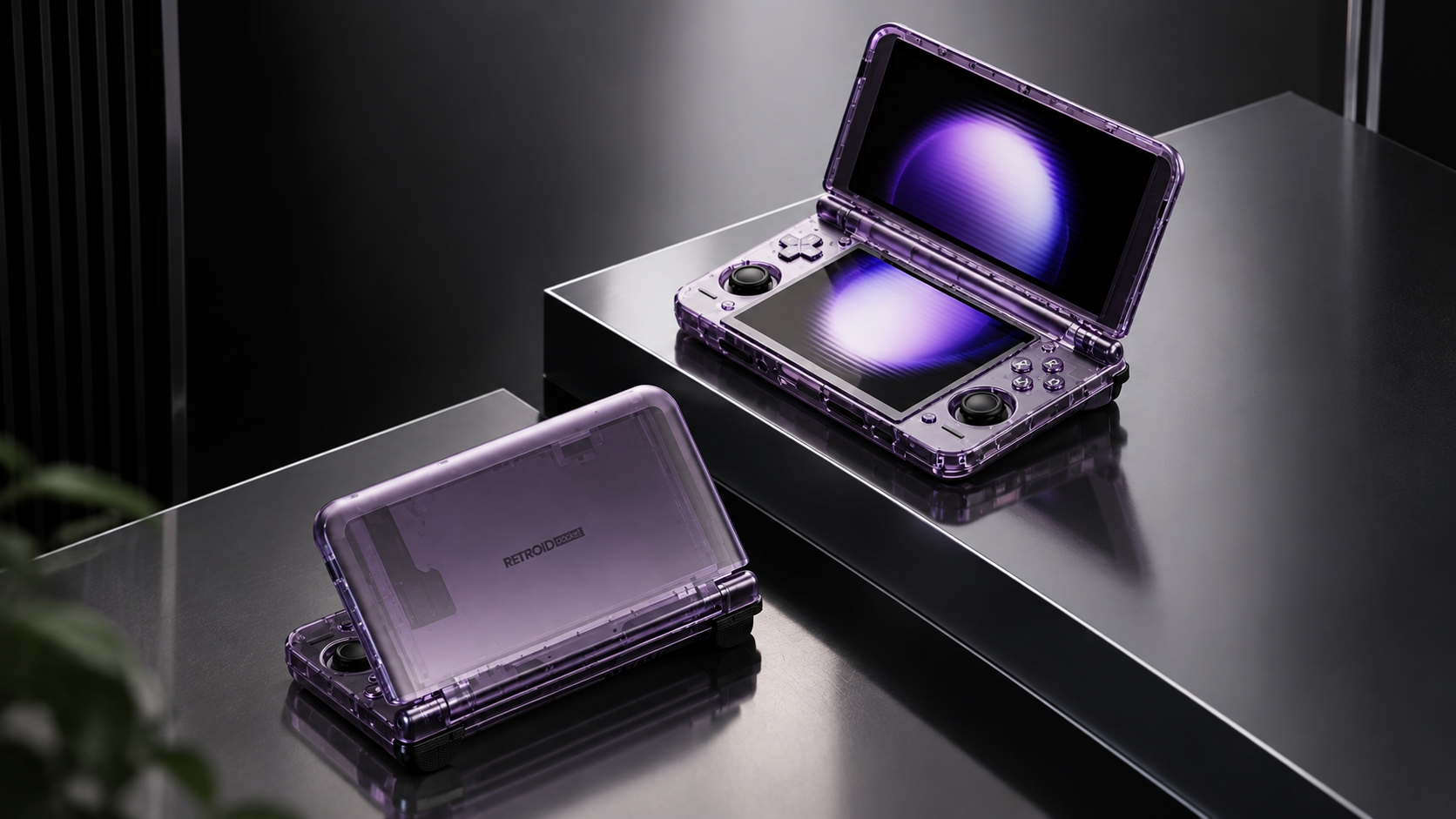

What Is the Retroid Pocket Duo Lite+?
The Retroid Pocket Duo Lite+ is a new dual-screen Android gaming handheld positioned between the original Pocket Duo Lite and the higher-end Pocket Duo.
The biggest change is inside the hardware. Retroid keeps the slimmer Duo Lite chassis and dual-screen layout, but replaces the Lite's Qualcomm QCS6125 with the much more powerful Qualcomm Dragonwing Q-7790.
It also comes with 8GB of RAM and 128GB of UFS 2.1 storage, giving the Lite+ the same processor and memory configuration as the standard Pocket Duo while retaining the Lite model's TFT displays and digital triggers.
Quick Facts
| Feature | Retroid Pocket Duo Lite+ |
|---|---|
| Processor | Qualcomm Dragonwing Q-7790 |
| CPU | 1× A720 2.6GHz + 4× A720 2.4GHz + 3× A520 1.8GHz |
| GPU | Adreno 722 at 1.15GHz |
| RAM | 8GB LPDDR4x |
| Storage | 128GB UFS 2.1 |
| Operating System | Android 16 |
| Main Display | 5.5-inch TFT, 1080p, 60Hz |
| Secondary Display | 4.2-inch TFT, 960p, 60Hz |
| Battery | 6,000mAh |
| Wi-Fi | Wi-Fi 6E |
| Bluetooth | Bluetooth 5.4 |
| Cooling | Active cooling |
| Controls | Hall sticks, digital L2/R2 |
| Retail Price | $219 |
| Current Promotional Price | $199 with LITEPLUS code |
| Shipping | Mid-November 2026 |
Retroid's official specifications list the Lite+ with the Q-7790, 8GB/128GB configuration, Android 16, 6,000mAh battery, Wi-Fi 6E and Bluetooth 5.4.
The Dual-Screen Design
The defining feature of the Duo Lite+ is its clamshell dual-screen design.
Instead of relying on software to reproduce two handheld screens on a single display, the Duo Lite+ provides two separate physical panels.
Main Screen
The upper display measures 5.5 inches and runs at:
1920 × 1080 resolution
60Hz refresh rate
TFT panel technology
This is the primary gaming screen and is large enough for conventional Android games and emulated systems.
Secondary Screen
The lower display measures 4.2 inches and has a resolution of 960p, with a 60Hz refresh rate.
Its physical position is particularly useful for systems designed around two screens, including Nintendo DS and Nintendo 3DS.
Retroid's standard Pocket Duo uses larger AMOLED displays with 120Hz refresh rates, while the Lite+ retains the more cost-conscious TFT panels from the Duo Lite.
Why Two Screens Matter for DS Emulation
Nintendo DS emulation has always presented a hardware-layout problem.
A normal Android handheld has one physical display, meaning the emulator has to place both the top and bottom DS screens onto the same panel.
That can result in:
Smaller gameplay windows
Uneven screen layouts
Touch controls occupying valuable space
Constant switching between screen positions
The Duo Lite+ approaches the problem differently.
The emulator can place one DS screen on the 5.5-inch upper display and the other on the 4.2-inch lower display, closely reproducing the original handheld concept.
For games that make heavy use of the touchscreen, this physical separation can also make the lower screen easier to interact with than a virtual touchscreen overlay.
Nintendo DS Emulation
The Duo Lite+ is particularly interesting as a Nintendo DS emulation handheld because the hardware has been designed around the two-screen form factor.
The Q-7790 provides substantially more processing capability than the QCS6125 used by the standard Duo Lite, while the two physical displays remove one of the biggest interface problems associated with DS emulation.
The actual DS experience will still depend on the emulator, configuration and individual game.
The important distinction is that the hardware is well suited to the physical requirements of DS emulation, rather than Retroid guaranteeing compatibility with every DS title.
Users should also remember that emulation software does not provide games themselves. Games should be used from sources the player is legally entitled to use.
What About 3DS Emulation?
The Q-7790 upgrade also makes the Duo Lite+ much more interesting for Nintendo 3DS emulation.
The standard Duo Lite uses the QCS6125 and has already been demonstrated running lighter 3DS software. Retroid's original Duo Lite demonstration showed Mario Kart 7 running through the Azahar emulator at 2× resolution.
The Lite+ uses a substantially more capable Q-7790 and an Adreno 722 GPU, so it has considerably more headroom for demanding emulation workloads.
However, this should not be interpreted as a guarantee that every 3DS game will run perfectly.
3DS emulation can vary significantly between games because performance depends on:
Emulator version
Graphics drivers
Internal resolution
CPU workload
GPU workload
Game-specific compatibility
Thermal conditions
Azahar is an open-source Android 3DS emulator designed to run 3DS software with features such as higher resolutions and modern controller support.
The Q-7790 Upgrade
The Dragonwing Q-7790 is the most important hardware change over the original Duo Lite.
The Lite uses:
Qualcomm QCS6125
4× Cortex-A73 + 4× Cortex-A53
Adreno 610
The Lite+ moves to:
Qualcomm Q-7790
1× A720 at 2.6GHz
4× A720 at 2.4GHz
3× A520 at 1.8GHz
Adreno 722
The result is a completely different performance class from the original Lite.
It also means the Lite+ shares its processor and memory configuration with the more expensive standard Pocket Duo.
Memory and Storage
The Lite+ comes in one configuration:
8GB RAM + 128GB storage
The RAM uses LPDDR4x, while the internal storage uses UFS 2.1.
This is a significant upgrade over the standard Duo Lite, which is available with 4GB/64GB and 6GB/128GB configurations using eMMC storage.
For an emulation-focused Android handheld, the larger RAM configuration also gives the system more room for demanding applications, multitasking and higher-end emulation workloads.
Controls
The Lite+ keeps the more straightforward control design of the Duo Lite.
It includes:
Hall-effect analog sticks
Digital L2/R2 triggers
Standard handheld controls
Physical buttons
Clamshell form factor
One of the major differences from the standard Pocket Duo is the trigger design.
The flagship Duo uses analog L2/R2 controls, while the Lite+ retains digital triggers.
Battery and Cooling
The Duo Lite+ includes a 6,000mAh battery and active cooling.
The larger battery is important because the Q-7790 is designed for substantially more demanding workloads than the QCS6125.
Active cooling is also useful when running:
High-resolution emulation
3DS games
Android games
Long gaming sessions
Actual battery life will vary depending on emulator settings, display brightness, refresh rate, wireless connectivity and game workload.
Android 16
The Duo Lite+ ships with Android 16.
This gives the device access to the Android gaming ecosystem alongside compatible emulators.
For a dual-screen handheld, the operating system also plays an important role because applications need to behave correctly across two physical displays.
This is one area where the software experience can be just as important as raw processor performance.
Retroid Pocket Duo Lite+ vs Duo Lite
| Feature | Duo Lite | Duo Lite+ |
|---|---|---|
| Chipset | QCS6125 | Q-7790 |
| GPU | Adreno 610 | Adreno 722 |
| RAM | 4GB/6GB | 8GB |
| Storage | 64GB/128GB eMMC | 128GB UFS 2.1 |
| OS | Android 15 | Android 16 |
| Main Screen | 5.5" TFT, 60Hz | 5.5" TFT, 60Hz |
| Secondary Screen | 4.2" TFT, 60Hz | 4.2" TFT, 60Hz |
| Battery | 6,000mAh | 6,000mAh |
| Wi-Fi | Wi-Fi 5 | Wi-Fi 6E |
| Bluetooth | Bluetooth 5.0 | Bluetooth 5.4 |
| Triggers | Digital | Digital |
The biggest difference is therefore performance, not the physical display arrangement.
Retroid Pocket Duo Lite+ vs Pocket Duo
The Lite+ is effectively a middle configuration between the two existing models.
| Feature | Duo Lite+ | Pocket Duo |
|---|---|---|
| Price | $219 | $269 |
| Processor | Q-7790 | Q-7790 |
| RAM | 8GB | 8GB |
| Storage | 128GB | 128GB |
| Main Display | 5.5" TFT, 60Hz | 5.5" AMOLED, 120Hz |
| Secondary Display | 4.2" TFT, 60Hz | 4.5" AMOLED, 120Hz |
| Battery | 6,000mAh | 6,000mAh |
| Triggers | Digital | Analog |
| Wi-Fi | Wi-Fi 6E | Wi-Fi 6E |
| Bluetooth | 5.4 | 5.4 |
| OS | Android 16 | Android 16 |
The key point is that the Lite+ has the same Q-7790 platform as the standard Duo but gives up the premium OLED displays and analog triggers.
Retail Pricing
The Retroid Pocket Duo Lite+ has a $219 retail price.
Retroid is also offering a promotional discount during the preorder period.
Using the LITEPLUS code reduces the price by $20, bringing the promotional price to:
$199
The discount is scheduled to remain available through October 31, 2026, while shipping for the Lite+ is scheduled to begin in mid-November 2026.
This makes the pricing structure:
| Model | Retail Price | Current Promotional Price |
|---|---|---|
| Pocket Duo Lite 4GB/64GB | $149 | $135 with applicable promotion |
| Pocket Duo Lite 6GB/128GB | $169 | $155 with applicable promotion |
| Pocket Duo Lite+ 8GB/128GB | $219 | $199 with LITEPLUS |
| Pocket Duo | $269 | $249 with applicable promotion |
Prices and promotional discounts can change, so the official Retroid store should be checked before purchase.
When Does the Duo Lite+ Ship?
Retroid currently lists mid-November 2026 as the expected shipping period for the Lite+.
This makes it later to ship than the original Duo Lite, which began shipping in September.
Who Is the Duo Lite+ Designed For?
The Duo Lite+ is primarily aimed at players who want a dual-screen Android handheld without moving all the way up to the premium Pocket Duo.
Its strongest use case is the combination of:
Dual physical displays + Q-7790 performance + Android emulation.
That makes it particularly interesting for players interested in Nintendo DS and 3DS emulation, while also leaving enough performance headroom for other demanding Android and emulation workloads.
Important Emulation Limitations
The Duo Lite+ should not be viewed as a guarantee of perfect emulation across every platform.
Even powerful Android handhelds can experience game-specific problems.
For 3DS in particular, results can vary depending on the emulator, graphics driver, resolution and individual game.
Community testing of the original Duo Lite has already shown a distinction between relatively strong DS performance and more variable 3DS performance, although the Lite+ has substantially stronger hardware.
The Lite+ therefore has the hardware characteristics needed for stronger emulation, but a complete game-by-game compatibility list should not be assumed before broader testing.
Key Features at a Glance
Dual-Screen Hardware
A 5.5-inch upper screen and 4.2-inch lower screen provide a physical two-display setup.
Q-7790 Performance
The same Qualcomm Dragonwing Q-7790 platform used by the standard Pocket Duo gives the Lite+ a major performance upgrade over the original Lite.
8GB RAM
The single 8GB/128GB configuration provides more memory than the original Lite models.
DS-Friendly Layout
The two physical displays are particularly useful for Nintendo DS-style emulation.
3DS Potential
The Q-7790 and Adreno 722 provide significantly more headroom for 3DS emulation than the original Lite hardware.
Android 16
The device ships with Google's current Android platform generation for this Retroid model.
$219 Retail Price
The standard retail price is $219, with a temporary $199 preorder price using Retroid's LITEPLUS discount code.
FAQ
What is the Retroid Pocket Duo Lite+?
The Retroid Pocket Duo Lite+ is a dual-screen Android gaming handheld using the Qualcomm Dragonwing Q-7790, 8GB RAM and 128GB storage.
How many screens does it have?
It has two physical screens: a 5.5-inch 1080p TFT display and a 4.2-inch 960p TFT display, both running at 60Hz.
Is the Duo Lite+ good for Nintendo DS emulation?
Its physical dual-screen design is particularly well suited to Nintendo DS emulation, because each emulated screen can be displayed on its own physical panel.
Can it emulate Nintendo 3DS?
The Q-7790 platform gives the Lite+ substantially more performance headroom for 3DS emulation than the original Duo Lite. Actual performance remains dependent on the emulator, game and settings.
What emulator can be used for 3DS?
Azahar is an open-source 3DS emulator available for Android and other platforms.
How much does the Duo Lite+ cost?
Its listed retail price is $219. Retroid currently offers a $20 LITEPLUS discount, reducing the preorder price to $199 through October 31, 2026.
When will the Duo Lite+ ship?
Retroid lists mid-November 2026 for shipping.
Does the Lite+ use OLED displays?
No. The Lite+ uses TFT displays. The more expensive Pocket Duo uses AMOLED panels.
Does the Lite+ have analog triggers?
No. It uses digital L2/R2 triggers. The standard Pocket Duo has analog L2/R2 controls.
How much storage does it have?
The Duo Lite+ comes with 128GB of UFS 2.1 storage and 8GB of LPDDR4x RAM.
Final Verdict
The Retroid Pocket Duo Lite+ takes the core idea of the Duo Lite and makes one major change: significantly more powerful hardware.
Its combination of the Q-7790 processor, 8GB RAM, 128GB UFS storage, Android 16 and physical dual-screen layout makes it especially relevant to players interested in DS and 3DS emulation.
The trade-off is that it retains the Lite's 60Hz TFT screens and digital triggers instead of the standard Duo's 120Hz AMOLED displays and analog triggers.
At $219 retail, or $199 during the current promotional preorder period, the Lite+ occupies a distinct position in Retroid's Duo lineup. Its real-world value will ultimately depend on how well its dual-screen software and emulation stack perform across a wider range of games once the hardware begins shipping in November 2026.