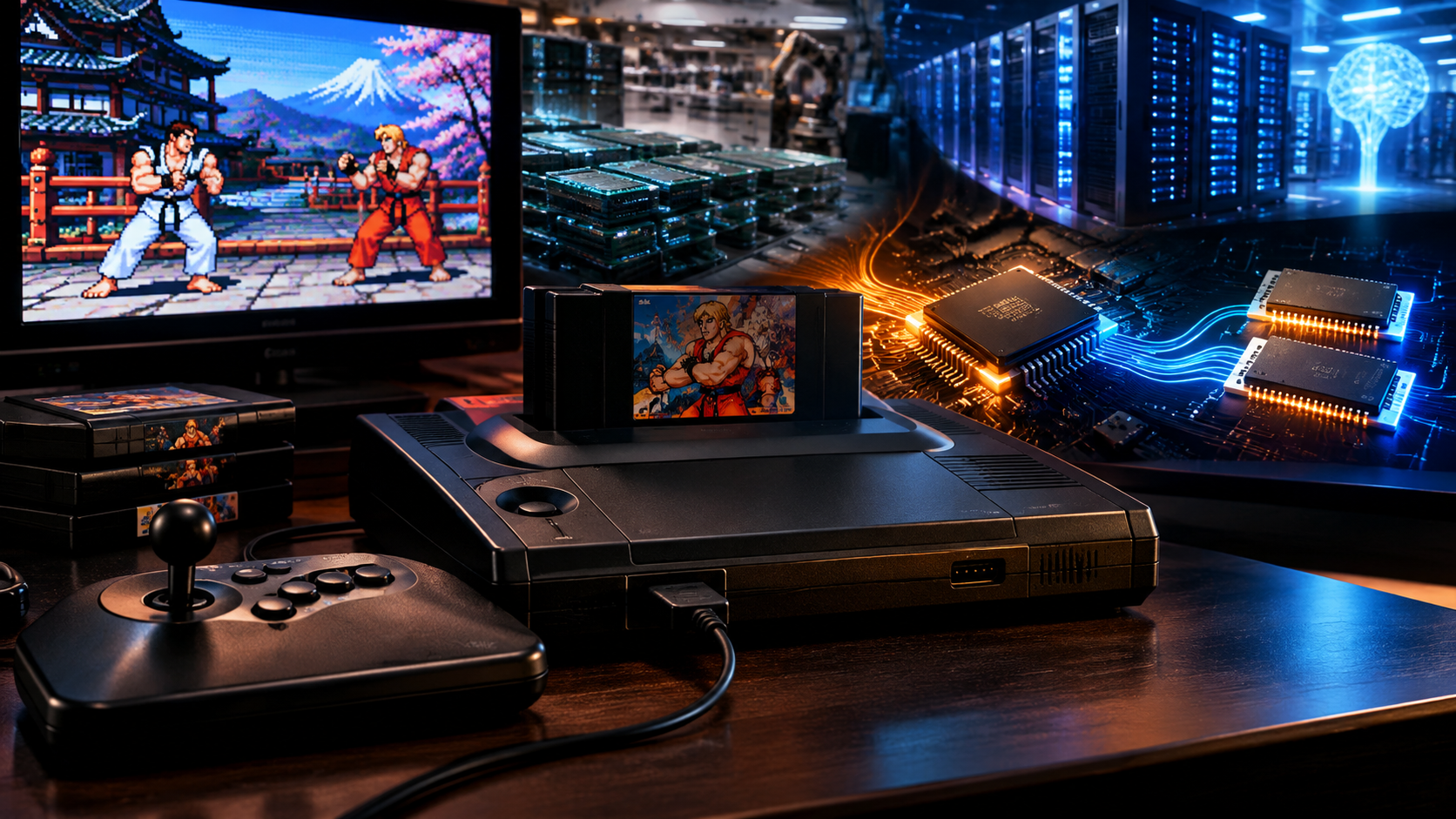

What Is the Neo Geo AES+?
The Neo Geo AES+ is a modern recreation of SNK's legendary Neo Geo AES, the home console version of the company's arcade hardware.
Developed through a collaboration between SNK and PLAION, the AES+ is designed around custom ASIC hardware rather than conventional software emulation.
The goal is to reproduce the original Neo Geo experience while adding modern conveniences such as HDMI output, CRT connectivity, configurable system options and compatibility with original Neo Geo AES cartridges.
The project became much more complicated in 2026 when a shortage of the Parallel NOR flash memory required for production threatened the entire console.
PLAION's engineers eventually found a solution by redesigning the cartridge hardware to support more readily available Serial NOR flash.
Quick Facts
| Feature | Neo Geo AES+ |
|---|---|
| Original Platform | Neo Geo AES |
| Developer / Publisher | SNK / PLAION |
| Hardware Approach | Custom ASIC |
| Software Emulation | No |
| Original Cartridge Support | Yes |
| Video Output | HDMI up to 1080p + analog AV |
| Original Accessories | Supported |
| Original AES Cartridges | Compatible |
| Launch Date | September 16, 2027 |
| Original Planned Launch | November 12, 2026 |
| Standard Edition | €199.99 / regional equivalent |
| Anniversary Edition | €299.99 / regional equivalent |
| Major Production Issue | Parallel NOR flash shortage |
| Workaround | Serial NOR flash conversion |
| Main Chip Technology | Custom ASICs |
The launch was originally planned for November 2026, but PLAION subsequently moved the worldwide release to September 16, 2027 because of component supply problems.
The AI-Driven Chip Crisis
The biggest story surrounding the AES+ is not an AI processor inside the console.
Instead, AI infrastructure demand indirectly threatened the console's production.
According to PLAION hardware and software director Ben Jones, the company encountered serious difficulties obtaining the memory components needed for the AES+ when it entered the production procurement phase.
The components were Parallel NOR flash chips.
The problem was severe enough that PLAION's suppliers could not provide the required quantities on the expected schedule.
Jones described the situation as an unprecedented procurement problem in his experience, with AI demand being identified as a major factor behind the shortage.
Why AI Affected a Retro Console
The AES+ is obviously not an AI device.
The connection is the broader semiconductor supply chain.
Modern AI data centers and accelerated computing infrastructure have created enormous demand for memory and other semiconductor components. That demand can put pressure on components that are also used in completely unrelated products.
For PLAION, the problem appeared when it tried to source the Parallel NOR flash needed for the AES+.
The company reportedly faced a potential wait of around six months simply to determine whether the required chips could be supplied.
For a niche retro console, waiting that long for a critical component was potentially unsustainable.
The Production Failure That Almost Happened
PLAION had already invested heavily in the AES+ project.
The console had been announced, preorders had opened, and demand was reportedly much stronger than expected.
Then production procurement hit the flash-memory problem.
The company faced several choices:
Wait for the unavailable chips.
Attempt to source the same component elsewhere.
Redesign the hardware around another type of memory.
Potentially cancel the project.
PLAION ultimately chose the third option.
That decision became the Serial NOR workaround.
Parallel NOR vs Serial NOR
To understand the solution, it helps to understand the two memory technologies involved.
Parallel NOR Flash
Parallel NOR communicates through multiple data lines simultaneously.
The original AES+ design was built around this type of flash architecture.
The problem was availability.
Serial NOR Flash
Serial NOR transfers information through a serial interface using fewer physical connections.
It is widely used in modern electronics and was easier for PLAION to source under the circumstances.
However, the Neo Geo's hardware architecture expected a parallel flash interface.
Simply replacing one chip with another therefore was not enough.
The system needed a way to translate between the two interfaces.
The Serial-to-Parallel Workaround
This is where the AES+ cartridge ASICs became critical.
PLAION had already produced two ASIC chips for the cartridges that handle memory-related operations and communicate with the console.
Instead of throwing away that existing hardware, engineers investigated whether those ASICs could be redesigned to support the alternative memory architecture.
The solution was to add technology capable of converting the serial flash signal into the parallel interface expected by the Neo Geo system.
In simplified terms:
Original approach
Serial/parallel? No conversion
→ Parallel NOR flash
→ Cartridge ASIC
→ AES+ console
Revised approach
Serial NOR flash
→ Conversion logic in redesigned cartridge ASIC
→ Parallel-style communication
→ AES+ console
This allowed PLAION to use a memory technology that was more readily available without completely redesigning the console around an entirely different architecture.
Why the Cartridge Saved the Console
The most interesting part of the workaround is that the solution was found inside the cartridge ecosystem.
PLAION had already produced thousands of the relevant ASICs for its cartridges.
That meant the company had an existing piece of silicon capable of becoming the bridge between the new memory technology and the AES+ architecture.
Instead of abandoning the hardware design, engineers could use the cartridge as the point where the memory-interface conversion happened.
That turned a potential project-ending supply problem into an engineering problem.
Why the Workaround Caused a Delay
The workaround was not simply a firmware update.
PLAION had to:
Redesign the cartridge ASICs
Implement the new flash conversion
Validate the revised hardware
Test the new cartridges
Rework production processes
Confirm compatibility with the AES+ system
Those additional engineering and testing requirements contributed to the extended launch timeline.
The result is a delay of almost one year.
From November 2026 to September 2027
The Neo Geo AES+ was originally scheduled for November 12, 2026.
PLAION announced in September 2026 that the worldwide launch would instead take place on:
September 16, 2027
The company said the extraordinary response to the console combined with global component constraints meant it could not manufacture enough systems for the worldwide launch it wanted.
Existing preorders remain protected under the announced arrangements, including their price and priority.
The Custom ASIC Architecture
The AES+ is notable because it does not attempt to recreate the Neo Geo experience through ordinary software emulation.
Instead, the system uses custom ASIC silicon designed to reproduce the behavior of the original Neo Geo hardware.
Engineers JOTEGO and Furrtek have been involved in the ASIC development, with the project originating from Neo Geo FPGA work before being implemented in silicon.
This architecture is intended to provide:
Hardware-level reproduction
Extremely low input latency
Original-style cartridge behavior
Accurate graphics processing
Original-style audio behavior
Why ASIC Instead of Emulation?
Software emulation runs an approximation of another system's hardware behavior through software.
The AES+ instead uses dedicated silicon designed specifically for the Neo Geo architecture.
This has several advantages for a hardware recreation:
Low latency: Input handling can be directly connected to the dedicated hardware.
Consistency: The hardware is built around a fixed Neo Geo implementation.
Cartridge compatibility: The system is designed to interact with physical Neo Geo cartridges rather than simply loading ROM files.
Authentic architecture: The project aims to reproduce the original hardware behavior at the silicon level.
The project developers have described the AES+ ASIC as deriving from earlier FPGA work while moving the design into dedicated silicon.
Original Neo Geo Cartridge Compatibility
One of the AES+'s biggest selling points is its physical cartridge support.
PLAION and SNK have confirmed compatibility with original 1990s Neo Geo AES cartridges.
New AES+ cartridges are also designed to work with the original hardware, making the project more than a standalone retro console.
This creates a two-way compatibility model:
Old cartridges → AES+
New AES+ cartridges → compatible original AES hardware
For collectors, that is a major part of the console's appeal.
Modern Video Output
The AES+ adds modern display connectivity while retaining support for older CRT setups.
The system supports:
HDMI output up to 1080p
Analog AV output
RGB output for CRT displays
Recent demonstrations have shown the AES+ running real hardware at 1080p over HDMI, while a September 2026 CRT test also demonstrated its analog output with genuine scanlines.
Original-Style Controls
The AES+ is designed to preserve the physical feel of the original console.
The arcade stick is modeled closely on the classic Neo Geo AES controller.
PLAION has also demonstrated a controller based on the Neo Geo CD-style pad, giving players an alternative to the traditional arcade stick.
Original Neo Geo accessories are also intended to remain compatible with the new console.
System Features
The AES+ adds several modern quality-of-life features without abandoning its retro architecture.
These include:
HDMI output
CRT RGB output
Region switching
AES/MVS mode switching
Memory-card management
Soft DIP switches
Permanent high-score saving
Custom system BIOS
Optional overclocking
The system menu allows users to configure game-specific options such as demo sound and number of lives.
24 MHz Overclocking
The original Neo Geo AES operated around a 12 MHz CPU clock.
The AES+ can reportedly reach 24 MHz through its overclocking functionality.
This can eliminate slowdowns found in certain original games, including the famous slowdown in Metal Slug 2.
The important point is that this is an optional hardware feature rather than the default behavior required for ordinary compatibility.
Launch Games
The initial AES+ software lineup includes recreated physical cartridges for several classic Neo Geo titles.
The announced games include:
Metal Slug
The King of Fighters 2002
Garou: Mark of the Wolves
Samurai Shodown V Special
Shock Troopers
Magician Lord
Pulstar
Twinkle Star Sprites
Over Top
Big Tournament Golf
The launch lineup consists of 10 games, with individual cartridges positioned as physical recreations of the originals.
Neo Geo AES+ Editions
The console is planned in multiple editions.
| Edition | Launch Price |
|---|---|
| Standard Edition | €199.99 |
| Anniversary Edition | €299.99 |
| Ultimate Edition | Higher-priced collector bundle |
The Anniversary Edition adds items including the wireless arcade stick, Metal Slug cartridge and memory card.
The exact regional pricing can vary.
What Happened to Existing Preorders?
The September 2026 delay did not cancel existing orders.
PLAION stated that existing preorders would:
Remain valid
Keep their priority
Keep their existing price
Require no reordering
The company also announced a Founding Supporters Bonus for the initial production run.
The AES+ at Tokyo Game Show 2026
Despite the production delay, the AES+ was publicly demonstrated at Tokyo Game Show 2026.
Multiple units were shown running real games, providing evidence that the hardware itself is functioning rather than remaining a purely promotional prototype.
The demonstrations showed:
Real cartridges
Playable hardware
1080p HDMI output
Original-style arcade controls
AES+ system menus
A station also reportedly demonstrated Zero Wing, although its status as an official AES+ release had not been formally confirmed at the time of the demonstration.
Was the Neo Geo AES+ Really Saved by AI?
The short answer is:
Indirectly, yes.
But calling it an AI chip workaround would be inaccurate.
There is no AI chip inside the AES+ responsible for saving the console.
Instead:
AI infrastructure demand
↓
Higher semiconductor demand
↓
Parallel NOR flash becomes difficult to procure
↓
AES+ production is threatened
↓
PLAION redesigns cartridge ASICs
↓
Serial NOR flash becomes usable
↓
AES+ production continues
That distinction is important because the actual engineering achievement was the memory-interface workaround, not the addition of artificial intelligence to the console.
Could the AES+ Have Been Cancelled?
According to PLAION hardware and software director Ben Jones, yes, there was a genuine risk of cancellation.
The company had already spent years developing the project, but without a workable flash-memory solution, the production plan was in serious trouble.
Jones told VGC that without the flash workaround, he believed the project was effectively dead.
That makes the component shortage more significant than an ordinary manufacturing delay.
The workaround effectively turned a potential cancellation into a one-year postponement.
Why This Matters for Retro Hardware
The AES+ situation demonstrates how modern semiconductor supply chains can affect even extremely niche products.
A console designed to recreate hardware from 1990 is competing for semiconductor resources within the same global manufacturing environment as modern electronics and AI infrastructure.
The irony is hard to miss:
A retro console revival nearly disappeared because of demand generated by one of the biggest modern technology trends, AI computing.
The final solution, meanwhile, required engineers to rethink the architecture of the console's physical game cartridges.
Key Features at a Glance
Custom ASIC Hardware
The AES+ uses dedicated silicon rather than conventional software emulation.
Original Cartridge Support
Existing 1990s Neo Geo AES cartridges are designed to work with the new system.
Serial NOR Workaround
Redesigned cartridge ASICs allow Serial NOR flash to serve an architecture originally built around Parallel NOR.
1080p HDMI
The console supports modern HDMI displays while retaining analog output for CRT users.
Original-Style Controls
The AES+ retains the classic Neo Geo arcade-stick philosophy.
Optional 24 MHz Overclock
The system can run at up to 24 MHz to eliminate slowdowns in supported games.
2027 Launch
The worldwide release is now scheduled for September 16, 2027.
FAQ
What is the Neo Geo AES+?
The Neo Geo AES+ is a modern, officially licensed recreation of SNK's original Neo Geo AES home console, developed with PLAION.
Does the AES+ use emulation?
No. The project uses custom ASIC hardware designed to reproduce the original Neo Geo architecture at the silicon level.
What caused the AES+ production crisis?
PLAION encountered difficulty sourcing Parallel NOR flash memory needed for production. AI-driven semiconductor demand was identified as a contributing factor to the component shortage.
What was the workaround?
Engineers redesigned the cartridge ASICs to support Serial NOR flash and convert its signaling so that it could work with the Neo Geo's parallel-style architecture.
Was the AES+ almost cancelled?
According to PLAION's Ben Jones, the project was at serious risk of cancellation if a workable flash-memory solution could not be found.
Is there an AI chip inside the AES+?
No. AI is connected to the story through semiconductor demand, not through an AI processor inside the console.
When will the Neo Geo AES+ launch?
The current worldwide launch date is September 16, 2027.
Can it play original Neo Geo cartridges?
Yes. SNK and PLAION have confirmed compatibility with original Neo Geo AES cartridges.
What resolution does the AES+ support?
The AES+ supports HDMI output up to 1080p. It also includes analog output for CRT setups.
Can the AES+ eliminate Metal Slug 2 slowdown?
The console's optional 24 MHz overclocking capability is designed to eliminate slowdowns present in games such as Metal Slug 2.
Final Verdict
The Neo Geo AES+ has become one of the more unusual stories in modern retro hardware.
The console was designed to recreate a 1990s system using custom silicon, physical cartridges and original-style controls. Then, just as the project approached production, the modern semiconductor economy created an unexpected threat.
AI-driven demand contributed to shortages of the Parallel NOR flash memory the AES+ needed.
PLAION's answer was not to abandon the project, but to redesign the cartridge ASICs so that more readily available Serial NOR flash could be converted into the interface the Neo Geo architecture required. That engineering workaround appears to have prevented a potential cancellation, although it came at the cost of a major delay.
The result is a console now scheduled for September 16, 2027, with its original cartridge compatibility, custom ASIC architecture, HDMI output and CRT support still intact.
The most accurate way to describe the story is therefore not “an AI chip saved the Neo Geo AES+.”
It is:
AI-driven chip demand nearly killed the revival, and a clever cartridge-side memory workaround kept it alive.