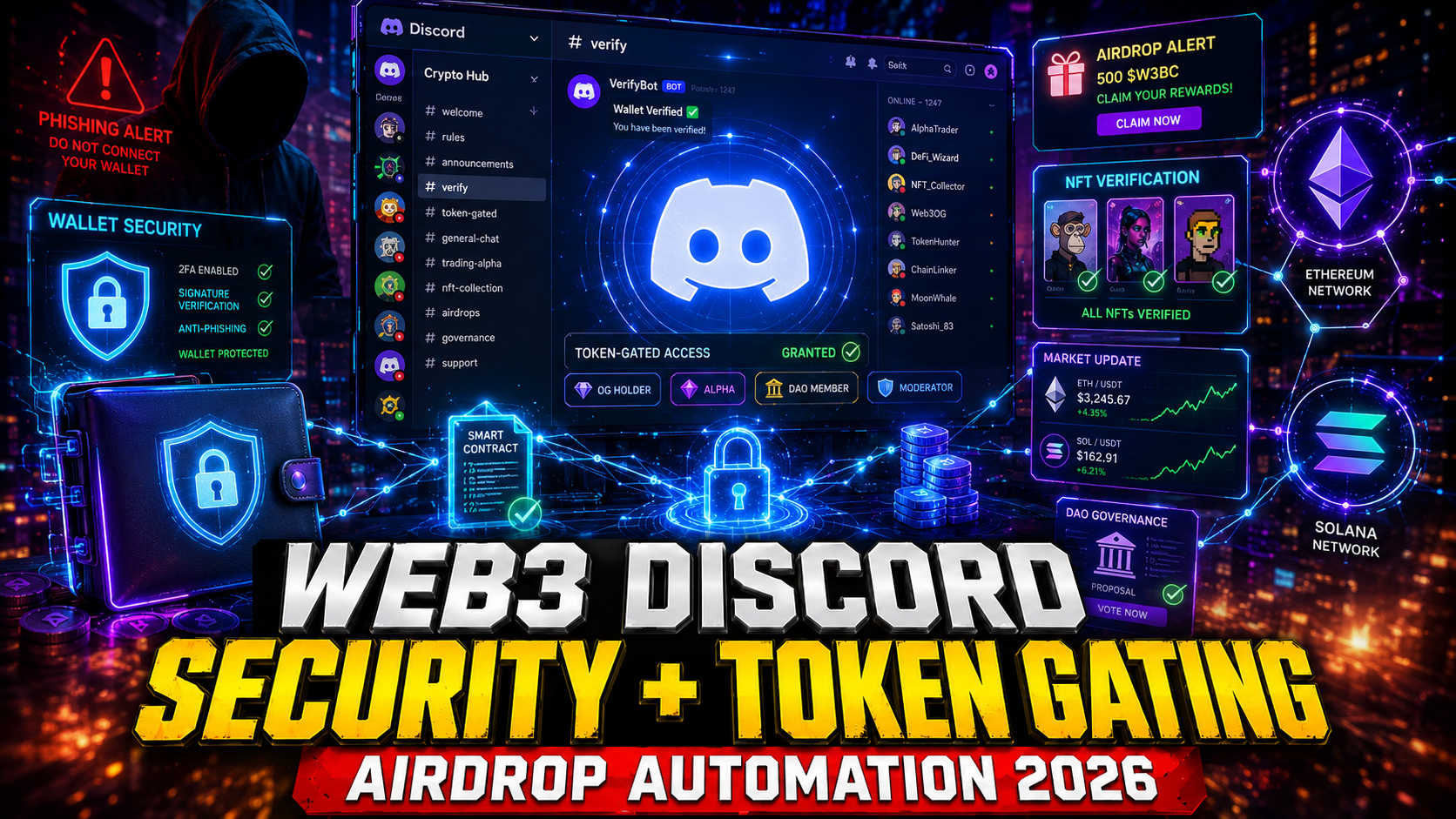

The Web3 Discord Setup Every Crypto Community Needs in 2026 (Security, Token Gating & Airdrop Automation)
Most Web3 communities don’t fail because they lack members.
They fail because they lose trust.
A single wallet-draining phishing link, a fake NFT verification bot, or an unmoderated announcement channel can wipe out months of community building in a few hours. As crypto communities become larger and more valuable, Discord has evolved from a simple chat platform into the operating system of Web3 communities.
The strongest Discord servers in 2026 are not just well moderated—they are architected. They use wallet-linked role systems, automated token verification, phishing-resistant onboarding flows, and real-time airdrop tracking to create communities that are both secure and scalable.
If you’re running a DAO, NFT project, memecoin community, gaming guild, or even a private alpha group, this is the Discord setup that matters now.
🧱 Why Web3 Communities Need a Different Discord Architecture
A traditional Discord server is built around permissions and moderation.
A Web3 Discord server is built around wallet ownership.
Instead of asking, “Is this user a moderator?” the server asks, “Does this wallet hold a specific NFT, token, or governance asset?”
That shift changes everything.
Token holders can automatically receive private channels, governance access, alpha discussions, whitelist roles, and event permissions without manual intervention. More importantly, access updates automatically when wallet ownership changes.
This is the foundation of token gating.
🔐 Token-Gated Roles: The Core of Modern Web3 Discord
Token gating allows Discord roles to be assigned dynamically based on on-chain assets.
For example:
Hold 1 NFT from Collection A → Verified Holder
Hold 1000 governance tokens → DAO Member
Stake tokens for 30 days → Core Contributor
Hold assets across multiple chains → VIP Access
The two tools most commonly used for this are Guild.xyz and Collab.Land.

Guild.xyz
Guild.xyz creates rule-based communities where access depends on wallet conditions. You can combine multiple requirements, such as NFT ownership, token balances, DAO participation, GitHub activity, or social account verification.
It is particularly useful for projects that want layered permissions rather than a simple holder/non-holder model.
Collab.Land
Collab.Land focuses on wallet verification and automated role assignment. Users connect a wallet, prove ownership of specific assets, and receive Discord roles instantly.
For many NFT and token communities, this remains the fastest way to automate verification.
The key advantage of both systems is that roles update automatically. When a user sells an NFT or transfers tokens, access can be removed without a moderator doing anything manually.
🛡️ The Biggest Threat in Web3 Discord: Wallet-Draining Phishing
The most dangerous attack in crypto communities is rarely a technical exploit.
It is social engineering.
Attackers impersonate moderators, support staff, project founders, or verification bots and convince users to connect their wallets to malicious websites.
A typical attack looks like this:
A fake announcement appears.
The user is told to “verify ownership.”
The wallet connects to a malicious contract.
Assets are drained within minutes.
The best Web3 communities assume that phishing attempts will happen.

Practical Security Rules
Every serious Web3 Discord should implement:
No wallet verification through direct messages
Verification only through official bot commands
Read-only announcement channels
Moderator verification badges
Automod filters for suspicious links
Dedicated security warning channels
Regular phishing awareness announcements
One simple message pinned across onboarding channels can prevent significant losses:
“Team members will never DM you first. Verify wallets only through official verification channels.”
That single rule eliminates a large percentage of common Discord scams.
🤖 Automating Token and NFT Verification
Manual verification does not scale.
If your community grows from 500 members to 20,000 members, moderators cannot check wallets individually.
A scalable verification flow looks like this:
Recommended Onboarding Flow
#start-here
#verify-wallet
Connect wallet through Guild.xyz or Collab.Land
Receive dynamic role
Unlock holder channels automatically
This creates a clean user experience while keeping verification consistent and secure.
Additional automation can also verify:
NFT collections
ERC-20 token balances
Solana assets
Multi-chain wallets
Governance participation
Staking status
The goal is to make access permissionless but secure.
📡 Airdrop Automation: The Feature Most Communities Ignore
Airdrops have become one of the strongest engagement mechanisms in Web3.
The problem is that most communities rely on manual announcements, which are slow and often inaccurate.
Instead, dedicated alert channels can automate updates for:
New token airdrops
NFT mint announcements
Snapshot reminders
Governance votes
Market events
Listing alerts
Wallet eligibility checks
A useful Discord structure looks like this:

Recommended Alert Channel Structure
#airdrop-alerts
#mint-tracker
#snapshot-reminders
#governance-votes
#market-watch
#security-alerts
Automation bots and webhook integrations can publish updates directly into these channels, reducing moderator workload while keeping the community active.
For alpha-focused communities, fast notification speed often becomes a competitive advantage.
⚙️ A Practical Web3 Discord Architecture
Here is a structure that works well for most crypto communities.
Onboarding
#welcome
#rules
#verify-wallet
#security-guide
Public
#general
#news
#education
#support
Token-Gated
#holder-chat
#dao-discussion
#alpha-signals
#research
#governance
Automation
#airdrop-alerts
#mint-tracker
#market-watch
#security-alerts
Moderation
#mod-chat
#incident-log
#bot-controls
This layout separates public engagement from on-chain privileges while keeping security and automation centralized.
🚨 Common Mistakes That Expose Communities
Even experienced Web3 teams often make avoidable mistakes.
Overusing Administrator Permissions
Bots should receive only the permissions they actually need.
Allowing Link Posting Everywhere
Public channels should use moderation filters and restricted posting rules.
Mixing Verification and Support
Verification should occur in a dedicated channel, not inside general chat.
No Backup Verification Method
If a bot fails or an integration breaks, moderators need a documented recovery process.
Ignoring Bot Audits
Third-party bots should be reviewed regularly and removed if no longer maintained.
Security in Web3 is rarely about one perfect tool—it is about reducing unnecessary trust.
🌍 The Future of Web3 Community Infrastructure
The interesting trend is that Discord servers are beginning to resemble decentralized operating systems.
Wallet identity, governance participation, token ownership, reputation, and automation are increasingly connected through one community layer.
The progression looks something like this:
Community Chat
↓
Wallet Verification
↓
Token-Gated Access
↓
Automated Governance
↓
On-Chain Community Infrastructure
As more DAOs, gaming projects, and creator communities move on-chain, Discord is becoming the bridge between social coordination and blockchain identity.
Final Thoughts
The best Web3 Discord servers in 2026 are not simply active—they are architected for security, automation, and ownership.
Token-gated roles create dynamic communities. Wallet verification reduces manual moderation. Automated airdrop tracking keeps members engaged. Strong anti-phishing systems protect both users and project reputation.
If you are building a crypto community today, start with wallet verification, add token-gated roles, implement phishing-resistant onboarding, and automate airdrop and mint alerts. That foundation will scale far better than manual moderation ever could.
In Web3, your Discord server is no longer just a community chat.
It is part of your protocol.