
The 'Smart Glasses' Streaming Setup: How Creators Are Prepping for Apple's 2027 Wearable Push
IRL streaming has always had one awkward problem.
The camera is never exactly where the creator needs it to be.
You can hold a phone.
You can mount a GoPro.
You can wear an action camera.
You can carry a backpack full of batteries, modems and streaming hardware.
But none of those options gives viewers the exact perspective of the person actually walking through the world.
Smart glasses come much closer.
And creators are already experimenting with that idea.
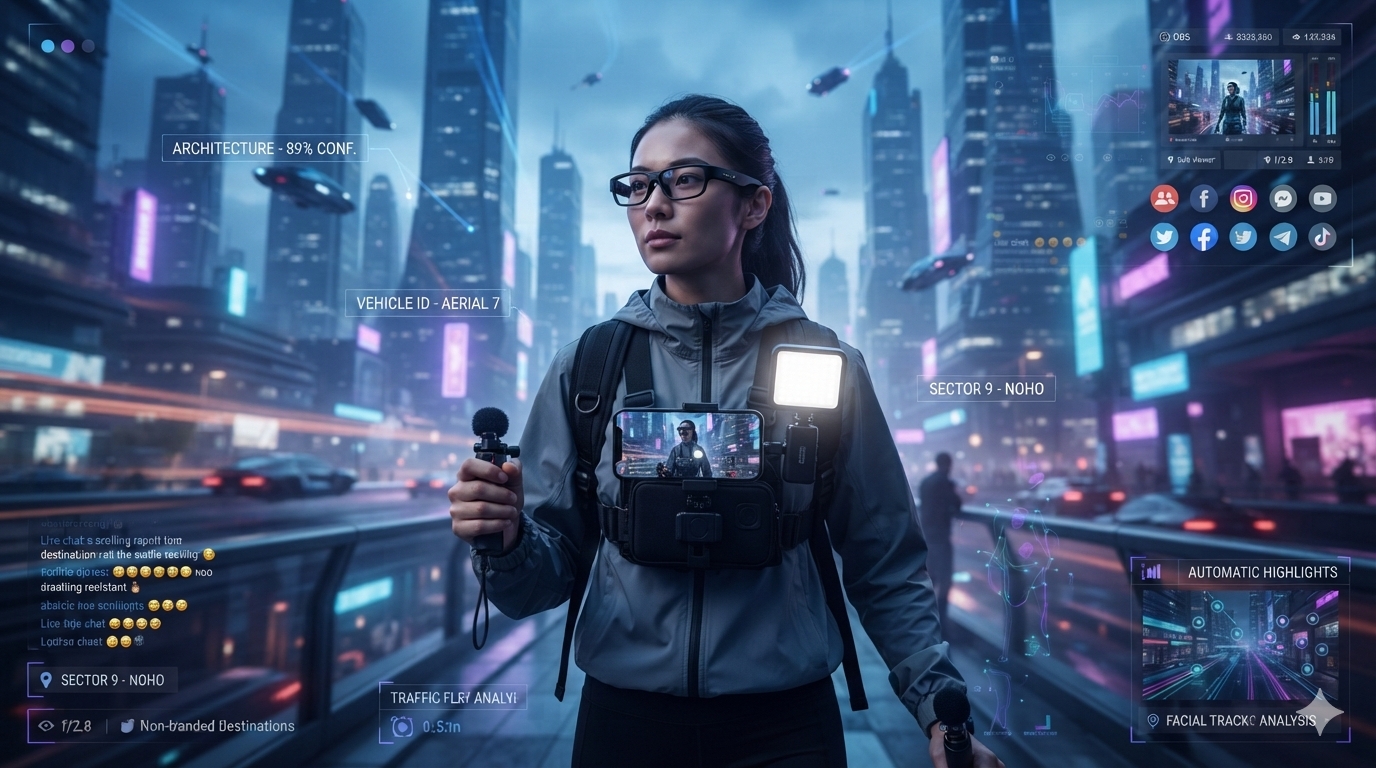
Today's smart glasses can capture first person video, connect to phones and, with third party software, feed their camera output into streaming platforms and OBS. Some developers are even building AI systems that understand what the wearer is looking at in real time.
Now add Apple to the equation.
According to multiple reports, Apple is working on lightweight smart glasses targeted for 2027. The first version is expected to focus on cameras, microphones, speakers and AI rather than an augmented reality display. Bloomberg reporting summarized by MacRumors says Apple is targeting a 2027 launch, while later reports have pushed the expected release toward late 2027.
If that happens, the biggest change for creators may not be the glasses themselves.
It could be the software stack built around them.
The Camera Is Moving Onto Your Face
The most interesting thing about Apple's rumored glasses is what they may not have.
Reports indicate that Apple's first generation smart glasses will not include a traditional display inside the lenses. Instead, they are expected to rely on cameras, microphones, speakers and AI features connected closely with the iPhone.
That sounds less impressive than an AR headset.
For streamers, however, it could actually make more sense.
A display isn't necessary for capturing video.
It isn't necessary for listening to an AI assistant.
And it isn't necessary for giving viewers a first person perspective.
The glasses can simply become the camera that the creator always has with them.
That changes the entire idea of an IRL rig.
Instead of asking:
“Where should I mount the camera?”
The answer becomes:
“The camera is already looking where I am looking.”
What Apple's Rumored Glasses Could Actually Do
Apple has not officially announced these glasses, so everything about the hardware should be treated as reported information rather than confirmed specifications.
Current reports suggest Apple is working on a product designed more like an AI companion than a miniature Vision Pro.
The rumored glasses could include cameras capable of capturing photos and video, another camera or sensing system for understanding the environment, microphones, speakers and deep integration with Siri and Apple Intelligence. Reports also suggest hand gesture recognition could become part of the interaction model.
The lack of a display is important.
Instead of looking at information through the glasses, the creator could simply ask for it.
That makes voice interaction much more important.
For an IRL streamer, that could be surprisingly useful.
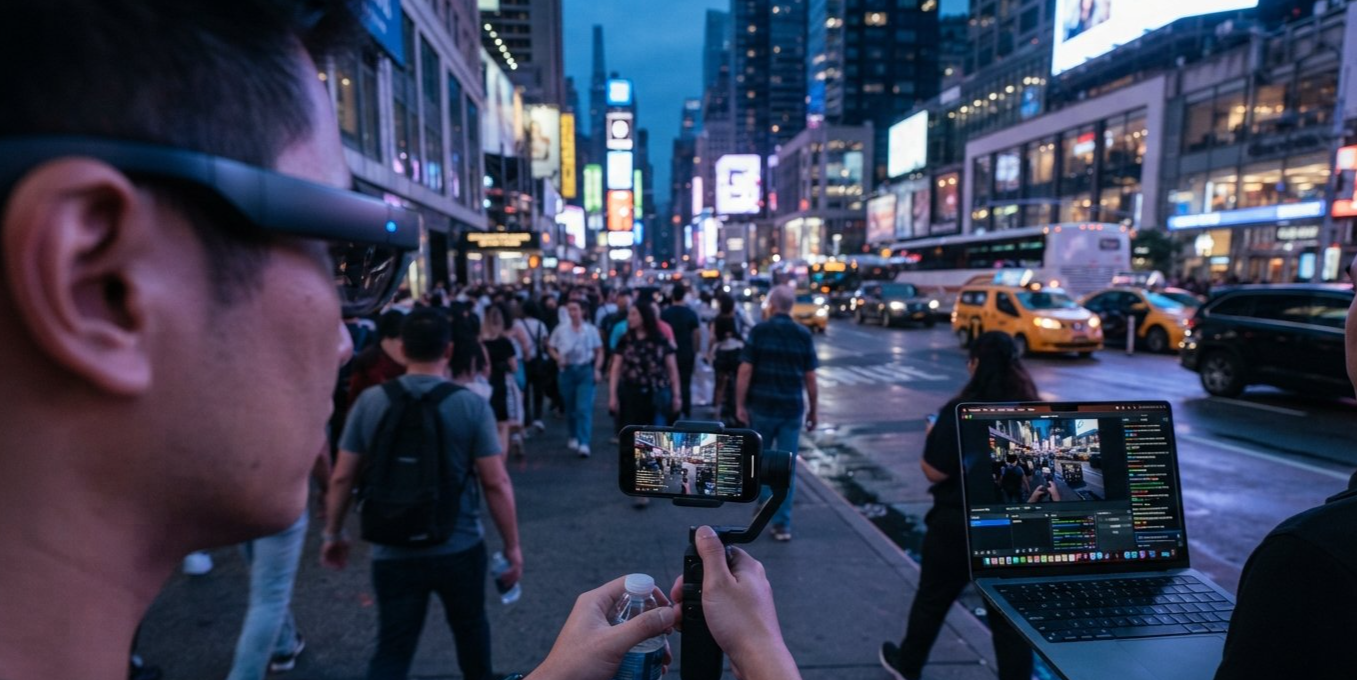
Imagine walking through a busy city while streaming and asking:
“What is that building?”
The assistant could potentially use the camera's view to understand the environment and respond through the glasses.
The audience might never see that interaction.
But the creator could.
And that is where wearable AI becomes interesting for live broadcasting.
Why IRL Streamers Are Already Experimenting
Apple hasn't created this workflow yet.
Creators don't need to wait for Apple.
The building blocks already exist.
Ray-Ban Meta glasses are currently being used by developers as a platform for first person streaming experiments. One third party application, MetaLensAI, advertises the ability to send a Ray-Ban Meta camera feed to YouTube, Twitch, TikTok, Kick, OBS Studio and custom RTMP destinations.
Other IRL streaming platforms are also built around a similar concept.
A camera produces the feed.
A mobile device or encoder handles the connection.
SRT or RTMP moves the video.
OBS or cloud OBS handles production.
The stream gets sent to Twitch, YouTube or another platform.
The important part is that the glasses are becoming another camera source.
That means creators can start building the software architecture today even if Apple's eventual hardware looks completely different.
The New Streaming Stack
The traditional IRL setup might look like this:
Camera → Phone → Streaming Platform
The more advanced setup is becoming something closer to:
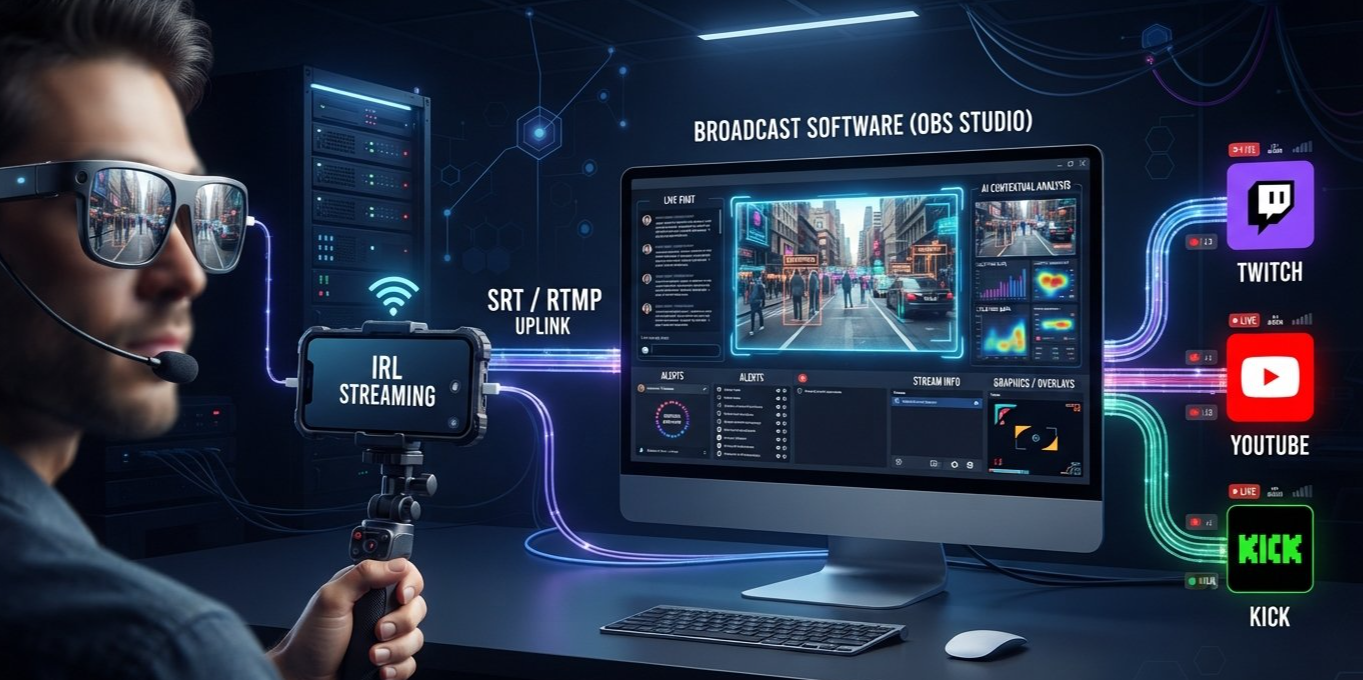
Smart Glasses → Phone → SRT or RTMP → OBS → Stream Platform
Then AI gets added on top.
Smart Glasses → Visual AI → Context → Creator
And eventually both systems could operate together.
The camera isn't only producing video anymore.
It is producing information.
That's the big shift.
A wearable camera can potentially provide a constant stream of visual context to an AI system.
Research projects are already exploring this idea. VisionClaw, for example, demonstrated an always available AI agent running with Meta smart glasses that combines first person visual perception with voice driven agent actions.
This is still experimental technology.
But the direction is obvious.
The camera is becoming an input for AI, not just a source for video.
OBS Becomes the Production Brain
This is where the creator's existing software stack becomes important.
OBS doesn't need to care whether the camera is mounted on a tripod, attached to a phone or sitting on someone's face.
As long as it receives a compatible video source, it can treat that feed as another production input.
That means creators can keep using familiar tools for:
Scenes
Alerts
Chat overlays
Donations
Brand graphics
Captions
Multiple camera angles
Transitions
Recording
The wearable simply becomes another camera.
Services designed specifically for IRL production are already experimenting with this workflow. StreamHand, for example, describes a system where smart glasses, phones and remote cameras can be pulled into OBS as video sources and combined with overlays before being restreamed.
That is important because creators don't necessarily need a completely new streaming application.
They can keep the production tools they already understand.
First Person Video Changes the Stream
Think about a normal IRL stream.
The creator is walking through a market.
The camera is either being held, mounted to a chest rig or attached to a selfie stick.
Viewers see what the camera sees.
But the perspective isn't always natural.
Now put the camera near the creator's eye line.
Suddenly the audience sees:
What the creator notices.
Where they look.
What they reach toward.
What they are reacting to.
That creates a much stronger connection between the creator and the viewer.
It also opens up completely different content formats.
A travel streamer could walk through a new city.
A food creator could explore a market.
A gaming creator could visit a gaming convention.
A tech creator could walk around CES or another major event.
The camera doesn't need to be constantly repositioned.
The creator just looks.
AI That Understands What the Creator Sees
This could be the biggest change.
Today's camera asks:
“What should I record?”
An AI enabled camera can potentially ask:
“What is happening here?”
That's a completely different relationship.
Imagine you're streaming from a football stadium.
You point your head toward the scoreboard.
The AI recognizes the teams and score.
You ask:
“Who is leading?”
The answer comes through the glasses.
Or you're walking through a technology exhibition.
You look at an unfamiliar device.
You ask:
“What is that?”
The system analyzes the camera feed and gives you context.
For creators, this could become part of the content itself.
The audience watches the creator explore something.
The creator has an AI assistant quietly helping in the background.
That is very different from opening a phone and searching Google every thirty seconds.
Imagine a Stream That Knows Where You Are
This is where the idea starts feeling almost like science fiction.
But the components already exist separately.
Smart glasses provide the camera.
GPS provides location.
AI provides interpretation.
Streaming software provides the broadcast.
Put them together and you can imagine an IRL system that understands much more of the creator's environment.
Suppose a travel streamer walks past a famous building.
The system could recognize the location.
The creator could ask for a quick explanation.
The answer could be delivered through audio.
Meanwhile, the camera feed continues going to the audience.
The viewer sees the experience.
The creator gets an invisible AI assistant.
That could make IRL content considerably easier to produce.
The Phone Still Matters
There is one thing that shouldn't get lost in all the smart glasses excitement.
The glasses probably won't do everything themselves.
Apple's rumored design is expected to rely heavily on the iPhone, with the glasses functioning more like an extension of Apple's existing ecosystem than a completely independent computer.
For streamers, that makes sense.
The glasses can concentrate on:
Camera
Microphones
Sensors
Audio
Basic interaction
The phone can handle:
Network connection
Processing
Streaming
App integration
Battery management
That division keeps the glasses lighter.
And lightweight matters.
Nobody wants to wear a tiny computer on their face that feels like a Vision Pro.
Why Displayless Glasses Could Actually Be Better
A lot of people hear displayless and immediately think Apple is cutting corners.
For creators, I'm not convinced.
A display introduces a lot of complexity.
You need:
More power.
More processing.
More heat management.
More weight.
More visual software.
More things competing for the creator's attention.
A displayless pair of glasses can focus on one simple idea:
See the world. Hear the assistant. Capture the moment.
That could actually make the product more useful during an active livestream.
An IRL creator doesn't necessarily want a screen floating in front of their eye while walking through a crowded street.
They want to see the street.
The AI can talk.
Privacy Is Going to Become a Huge Problem
This is the part that cannot be ignored.
A camera on a person's face is fundamentally different from a phone camera.
People are used to seeing someone pull out a phone.
They are less comfortable with someone wearing glasses that might be recording continuously.
The issue has already appeared with current smart glasses.
Meta has recently taken stronger measures around tampering with the recording indicator on its glasses, including disabling camera functionality on devices where the privacy light has been deliberately altered.
Some venues have also restricted smart glasses because of recording concerns.
Apple will have to deal with exactly the same problem.
And streamers will have an even bigger responsibility.
Because they aren't simply recording for themselves.
They are broadcasting to potentially thousands of people.
That means consent, recording indicators, venue rules and privacy controls need to become part of the streaming workflow.
A Smart Glasses Stream Should Have a Privacy Layer
A serious creator setup could eventually include automatic rules such as:
Recording indicator always visible
Automatic privacy blur
Face detection
Restricted location mode
Automatic muting
Camera disabled in restricted venues
Private conversation detection
The technology will need to become smarter than simply recording everything.
Otherwise, the convenience of hands free streaming could quickly become a liability.
What Creators Should Build Before 2027
The good news is that creators don't need Apple's glasses to start experimenting with this workflow.
The useful preparation is mostly software.
If you're an IRL creator, learning how your existing setup handles OBS, RTMP, SRT, mobile encoders and remote camera feeds is probably more valuable than buying hardware based on rumors.
You can already experiment with first person camera sources.
You can already bring remote video into OBS.
You can already build scenes around multiple camera feeds.
And developers are already connecting smart glasses to OBS and streaming platforms through third party software.
By the time Apple's hardware arrives, creators who understand that workflow will have a significant advantage.
They won't be learning how to build an IRL production system from scratch.
They'll simply be adding another camera.
The Real Upgrade Is Not the Glasses
This is the part I find more interesting than Apple's hardware rumors.
The next generation of IRL streaming may not be defined by one camera.
It could be defined by context.
Today's streaming software mostly understands video.
Tomorrow's software could understand:
Where you are.
What you're looking at.
Who is speaking.
What just happened.
What the audience is reacting to.
What happened ten minutes ago.
And potentially what the creator is trying to do next.
That is a much bigger upgrade than simply moving a camera from a tripod onto someone's face.
The AI Layer Could Become the Creator's Invisible Producer
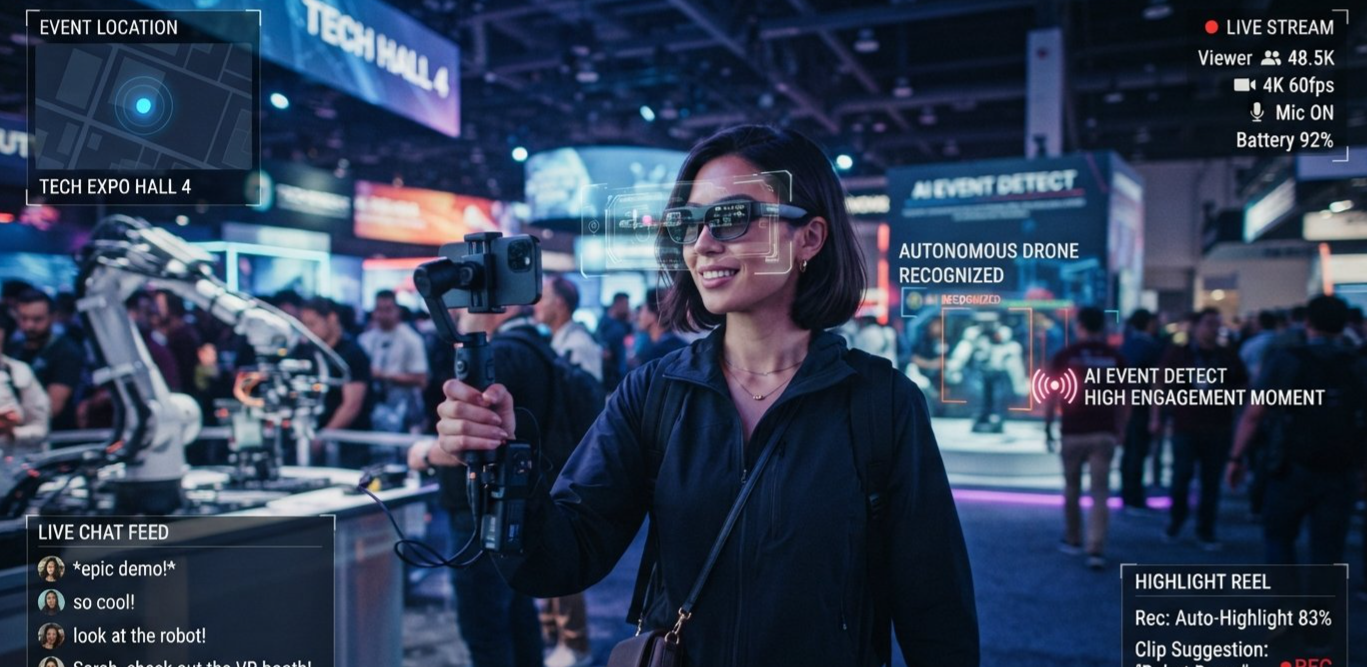
Imagine you're walking around a huge event.
Your glasses capture the environment.
Your phone handles the connection.
OBS handles the broadcast.
An AI system watches the incoming information.
Then something interesting happens.
The AI could flag it.
It might recognize that the creator has stopped in front of a major product announcement.
It might identify a sudden spike in chat activity.
It could suggest a scene change.
It could generate a caption.
It could remember the timestamp.
The creator doesn't need to touch a laptop.
They simply keep walking.
That is the kind of workflow that could make wearable AI genuinely useful for professional creators.
Not because the glasses replace the production team.
Because they can quietly handle some of the boring work.
The 2027 Question
The big question isn't whether smart glasses will exist.
They already do.
The question is whether Apple can make them useful enough that normal people actually want to wear them all day.
And for creators, there is an even more interesting question.
Can Apple's ecosystem turn smart glasses into a serious production tool?
The hardware rumors suggest Apple is aiming at a lighter product than Vision Pro, with cameras, microphones, speakers and AI capabilities rather than a full AR display. Reports currently point toward a 2027 release, although the exact timing remains uncertain.
Meanwhile, the software ecosystem is already moving.
Developers are connecting smart glasses to OBS.
IRL platforms are building around SRT and RTMP.
Researchers are testing visual AI agents.
Creators are experimenting with first person broadcasting.
None of this guarantees that Apple's glasses will become the next big streaming device.
But the pieces are beginning to fit together.
Final Verdict
Apple's rumored smart glasses may end up being one of the most important pieces of creator hardware in 2027.
Or they may simply become another expensive wearable.
Right now, nobody knows.
What we do know is that the software direction is already changing.
Smart glasses are becoming cameras.
Cameras are becoming AI sensors.
AI is becoming a real time assistant.
And streaming software is becoming increasingly comfortable with remote and wearable video sources.
That means creators don't necessarily need to wait for Apple.
They can start preparing now.
Learn OBS.
Understand RTMP and SRT.
Experiment with multiple camera sources.
Build better IRL scenes.
Explore AI assisted workflows.
Think about privacy.
And most importantly, start treating the camera as more than something that simply records video.
Because the most interesting future isn't:
“Look, I can stream from my glasses.”
It's:
“My glasses understand what I'm seeing, my AI understands what is happening, and my audience gets to experience it with me.”
That is where the smart glasses story gets genuinely interesting.
📊 The Future IRL Streaming Stack
| Layer | Today's Setup | Emerging Setup |
|---|---|---|
| Camera | Phone / action camera | Smart glasses + multiple cameras |
| Connectivity | WiFi / mobile data | 5G + bonded networks + SRT |
| Production | OBS | OBS + cloud production |
| AI | Separate tools | Real time visual AI |
| Interaction | Phone / chat | Voice + wearable controls |
| Context | Creator manually explains | AI interprets surroundings |
| Clips | Manual editing | AI assisted highlights |
| Audience | Watches the camera | Experiences creator's perspective |
Chart note: This is an editorial projection, not a prediction of Apple's confirmed product specifications.
🔗 Useful Reading for Creators
PC Build Guide for Beginners
A useful companion for creators building a dedicated streaming machine.
Read the guide
The 2026 GPU Arms Race
Useful background for understanding why AI workloads are increasingly competing for local GPU resources.
Read the article
Smart Glasses Research
Recent research is already exploring first person visual AI and continuous wearable perception.

Comments
Sign in to join the conversation
Sign inNo comments yet
Be the first to share your thoughts!