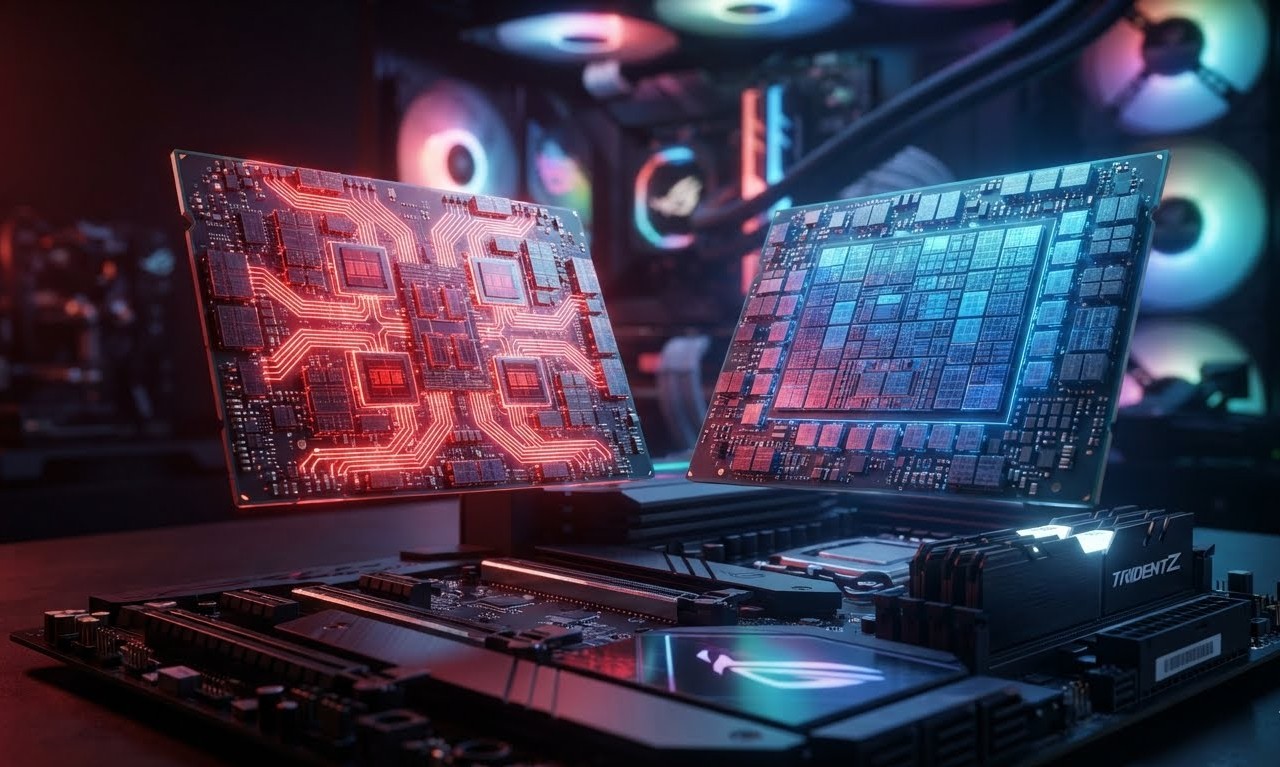

⚔️ AMD Zen 6 vs Intel Nova Lake
The next major desktop CPU battle is taking shape.
AMD Zen 6 vs Intel Nova Lake could become one of the most important processor matchups of the year.
AMD is preparing its next-generation Zen 6 architecture. Intel is working on Nova Lake, a new generation designed to bring major changes to its desktop lineup.
Neither platform has a complete retail performance picture yet, so early specifications should be treated carefully.
There is also an important correction to the memory story.
Current evidence points to Zen 6 desktop remaining on DDR5, not DDR6. AMD's officially documented AM5 platform supports DDR5, and AMD's first Zen 6 products already shipping in 2026 — EPYC 9006 "Venice" — use DDR5 memory.
So the real battle is more interesting than simply "AMD gets DDR6."
It is about architecture, memory bandwidth, cache, core scaling, efficiency, and platform longevity.
🚨 Important: Many Zen 6 and Nova Lake specifications circulating online are leaks or industry reports. Final desktop specifications can still change before launch.
🧠 AMD Zen 6: What We Know
AMD has already brought Zen 6 into its server portfolio.
The EPYC 9006 series uses Zen 6 and Zen 6c cores and is built using TSMC's 2nm process technology. AMD's server chips can scale to as many as 256 cores and support up to 16 channels of DDR5 memory.
Desktop Zen 6 will use a very different platform.
Current reports point toward AMD continuing its chiplet strategy, with Zen 6 CCDs potentially increasing from eight cores to 12 cores per CCD.
That could allow a conventional dual-CCD desktop design to reach 24 cores.
Those numbers remain unofficial, but multiple reports have pointed toward larger Zen 6 CCDs.
The potential advantages are obvious:
- More cores
- More cache
- Higher performance per watt
- Better multicore performance
- Continued chiplet scalability
- Possible higher clock speeds
AMD has also confirmed that the AM5 platform will remain supported beyond the current generation.
That could become a major advantage for existing Ryzen owners.
🔵 Intel Nova Lake: A Major Redesign
Intel's response is Nova Lake.
Nova Lake is expected to introduce the Core Ultra 400 generation for desktop systems.
Intel has officially documented Nova Lake as an upcoming architecture, with reports pointing to new Coyote Cove performance cores and Arctic Wolf efficiency cores.
The rumored desktop lineup is much more aggressive than today's mainstream Core Ultra processors.
Reports suggest configurations reaching as high as:
16 P-cores + 32 E-cores + 4 LP E-cores
That would produce a headline-grabbing 52-core configuration.
Other reported configurations are expected to target more mainstream desktops.
This is where Intel's approach differs from AMD.
AMD's strategy remains heavily focused on scalable homogeneous Zen cores and chiplets.
Intel continues to use a hybrid design combining different core types.
The question is whether Intel can make those cores work together efficiently enough to deliver excellent gaming performance while also dominating heavily threaded workloads.
🧩 Chiplets and Core Design
The two companies are taking different paths.
AMD
AMD's Zen architecture popularized chiplets in mainstream x86 desktop processors.
The basic concept separates CPU compute chiplets from other components such as I/O.
That allows AMD to manufacture and scale different parts of the processor independently. AMD itself describes chiplets as a key part of the Zen architecture's scalability.
Intel
Intel's modern desktop strategy uses tiles and a hybrid collection of P-cores and E-cores.
Nova Lake reportedly pushes this design much further.
That could give Intel a huge advantage in heavily threaded workloads.
But raw core count is not everything.
A 52-core CPU does not automatically beat a 24-core CPU in gaming.
Software scheduling, cache, latency, clock speed, and core performance all matter.
💾 DDR6 vs DDR5: The Memory Question
This is one area where the original battle narrative needs some correction.
There is currently no strong evidence that mainstream Zen 6 desktop CPUs will launch with DDR6.
AMD's AM5 platform is based around DDR5, and AMD's current Zen 6 EPYC 9006 processors officially use DDR5.
Reports about Zen 6 desktop have instead pointed toward faster DDR5 support.
One report has suggested DDR5-6400 as a potential baseline for Zen 6 desktop, although this remains unofficial.
Intel Nova Lake is also expected to use DDR5.
Some reports suggest support for very high DDR5 speeds, potentially reaching DDR5-8000 on certain configurations.
So the real memory battle is likely:
Faster DDR5 + better memory controllers
rather than:
DDR6 vs DDR5.
⚡ IPC Could Decide the Battle
This may be the most important specification that cannot be settled by a core-count chart.
IPC means Instructions Per Cycle.
It measures how much useful work a CPU can perform at a given clock speed.
A processor running at 5 GHz with higher IPC can outperform a processor running at 5 GHz with lower IPC.
AMD's Zen architecture has historically competed heavily on IPC and efficiency.
Intel is reportedly targeting a significant IPC increase with Nova Lake.
Some industry reports have claimed around 20% IPC improvement, but that figure should be treated as a leak rather than an official Intel benchmark.
That distinction matters.
Until independent reviews test both processors using the same workloads, claims about "20% faster IPC" should not be treated as final performance numbers.
🔗 INTERNAL LINK #1
Add your existing article:
Intel Binary Optimization Tool Explained
This is especially relevant when discussing CPU architecture and how software optimization can influence real-world performance.
🧠 Cache Could Become the Secret Weapon
CPU cache could be just as important as core count.
AMD has already made cache a major part of its gaming strategy through 3D V-Cache.
The company demonstrated this approach again with the Ryzen 9 9950X3D2 Dual Edition in 2026, which uses dual 3D V-Cache technology and 208MB of total cache.
Zen 6 is expected to continue that strategy.
Some reports have suggested dramatically larger cache configurations, including possible 3D V-Cache designs.
Intel is not ignoring the trend.
Leaks have pointed toward a Big Last Level Cache, or bLLC, for some Nova Lake processors.
Some reports claim capacities could eventually reach extremely high levels.
Those numbers remain unofficial.
If both companies dramatically increase cache, gaming benchmarks could become extremely interesting.
🎮 Gaming Performance
Gaming is where this competition becomes complicated.
Gamers do not simply need the most CPU cores.
They need:
- High IPC
- Low latency
- Strong cache performance
- High clocks
- Good memory latency
- Efficient scheduling
- Consistent frame times
AMD has built a strong reputation in gaming with its X3D processors.
That means Zen 6 X3D could be particularly important.
Intel appears to understand the threat.
The reported Nova Lake bLLC designs suggest Intel may be trying to attack AMD's cache advantage directly.
The likely battle:
AMD → IPC + chiplets + 3D V-Cache
Intel → IPC + hybrid cores + larger cache + aggressive core counts
The winner will not be decided by specifications alone.

🔗 INTERNAL LINK #2
Add:
Beginner PC Build Guide: How to Build Your First Gaming PC
This is useful for readers who want to understand CPU, motherboard, RAM, and compatibility before upgrading.
🏢 Productivity and Multicore Performance
This is where Intel could have a major advantage.
If Nova Lake really reaches configurations with dozens of E-cores alongside its P-cores, heavily threaded workloads could scale dramatically.
Potential workloads include:
- Video rendering
- 3D rendering
- Software compilation
- Compression
- Virtual machines
- AI workloads
- Large multitasking workloads
AMD's possible move to 12-core CCDs would also increase multicore performance.
But Intel's rumored maximum core count is much higher.
That creates an interesting split.
Gaming
Potential AMD advantage
Heavy multicore workloads
Potential Intel advantage
Efficiency
Unknown until independent testing
Productivity
Too early to call
📊 EARLY ARCHITECTURE COMPARISON
| Feature | AMD Zen 6 | Intel Nova Lake |
|---|---|---|
| Architecture | Zen 6 | Coyote Cove + Arctic Wolf |
| Core design | Primarily Zen cores | P-core + E-core hybrid |
| Desktop cores | Up to 24 rumored | Up to 52 rumored |
| Memory | DDR5 expected | DDR5 expected |
| DDR6 | ❌ No solid desktop evidence | ❌ Not expected |
| Cache | Larger cache expected | Large bLLC rumored |
| 3D cache | Expected to continue | Competing cache design rumored |
| Chiplet/tile strategy | Chiplets | Tiles |
| Process | TSMC 2nm expected/reported | Mixed process/tile approach reported |
| Socket | AM5 expected | New LGA1954 reported |
| Launch | Late 2026 / potentially 2027 | Late 2026 / potentially 2027 |
Note: Several entries are based on leaks and industry reports, not final retail specifications. Zen 6's server implementation is confirmed on TSMC 2nm, but that does not automatically prove every desktop Zen 6 component will use the identical process configuration.
🖥️ Platform and Upgrade Path
This could be one of AMD's biggest advantages.
AMD has committed to supporting the AM5 platform through 2027 and beyond.
Recent reporting also indicates Zen 6 desktop processors are expected to retain AM5 compatibility.
That could make a Zen 6 upgrade easier for existing Ryzen owners.
Intel appears to be moving Nova Lake to a new platform.
Reports point toward an LGA1954 socket for Nova Lake-S.
That means buyers upgrading from current Intel desktop systems may need:
New CPU + new motherboard
This is important when comparing total upgrade costs.
A slightly faster CPU can become much less attractive if the platform upgrade is significantly more expensive.
🔗 INTERNAL LINK #3
Add your existing hardware article:
Nintendo Switch 2 Hardware Specs Explained
Use it as an additional internal hardware article.
🔥 AMD vs Intel: Who Has the Better Strategy?
The two companies are approaching the problem differently.
AMD's Strategy
AMD appears to be focusing on:
Efficiency + chiplets + cache + platform longevity
The company does not necessarily need 50 CPU cores in a mainstream desktop.
It can instead optimize fewer high-performance cores and use cache to improve gaming.
Intel's Strategy
Intel appears to be focusing on:
IPC + massive core counts + hybrid scaling + larger cache
If Nova Lake delivers on the rumored specifications, Intel could become extremely competitive in both single-threaded and multicore workloads.
That would put serious pressure on AMD.
⚠️ What We Still Don't Know
This is where buyers should be careful.
We still need independent testing for:
Real IPC
Leak-based IPC numbers are not the same as benchmark results.
Gaming
The most important test will be frame rates and frame-time consistency.
Power
A high-core-count CPU can consume significantly more power.
Pricing
Architecture does not matter much if the final product is too expensive.
Availability
Launch timing remains uncertain.
There have been reports suggesting that both Zen 6 and Nova Lake desktop products could slip toward early 2027. Other reports still point to late-2026 launches.
That means buyers should avoid making a purchase decision based solely on rumored release dates.
📈 CHART — THE 2026 CPU BATTLE
Potential Strengths
| Category | Zen 6 | Nova Lake |
|---|---|---|
| Gaming | 9 | 8 |
| IPC | 9 | 9 |
| Multicore | 8 | 10 |
| Cache | 10 | 9 |
| Platform longevity | 10 | 7 |
| Efficiency | 9 | 8 |
Chart Caption:
Illustrative editorial scoring based on current architectural expectations, not benchmark results.
Important: These are not measured performance scores. Replace them with benchmark data once retail CPUs are available.
🏆 FINAL VERDICT
AMD Zen 6 vs Intel Nova Lake could become one of the most exciting CPU battles of this generation.
AMD appears to be doubling down on its successful chiplet and cache strategy.
Intel appears ready to make Nova Lake a much more aggressive redesign, with new cores, a larger hybrid configuration, and potentially huge cache capacity.
But one part of the original narrative needs correcting:
Zen 6 desktop should not currently be described as a DDR6 platform.
The evidence available today points toward DDR5, with faster DDR5 support expected or rumored. AMD's confirmed Zen 6 server processors also use DDR5.
The real fight is therefore:
AMD: chiplets + cache + efficiency + AM5
versus
Intel: IPC + hybrid cores + massive multicore scaling + new platform
If AMD's Zen 6 X3D delivers another major gaming advantage, Intel could struggle to take the gaming crown.
But if Nova Lake's IPC and multicore improvements arrive as rumored, Intel could finally have the architecture needed to seriously challenge AMD across the desktop market.
The winner will be decided by real benchmarks, not leaked specifications.
And that is what makes this CPU battle so interesting.
🚨 CALLOUT BOX
Bottom Line:
Zen 6 and Nova Lake are shaping up as very different answers to the same problem. AMD is betting on efficient chiplets and cache. Intel is betting on IPC, hybrid scaling, and a much larger core count. The real winner will come down to gaming, power, pricing, and independent benchmarks.
🔗 INTERNAL LINKS TO ADD
Use these 3 links in the article:
- Intel Binary Optimization Tool Explained — Internal article
- Beginner PC Build Guide — Internal article
- Nintendo Switch 2 Hardware Specs Explained — Internal article
These should help fix the Internal Links warning in your SEO checker.
🌐 EXTERNAL LINKS
For credibility, use:
Comments
Sign in to join the conversation
Sign inNo comments yet
Be the first to share your thoughts!