

For decades, the technology industry has had a familiar response whenever governments proposed new regulations:
"Don't slow innovation."
This week, something extraordinary happened.
More than 1,100 employees and researchers from many of the world's leading artificial intelligence companies including OpenAI, Anthropic, Google DeepMind, Meta, xAI, and several academic institutions publicly asked the U.S. government to prepare for the possibility of slowing frontier AI development if it begins advancing faster than humanity can safely manage.
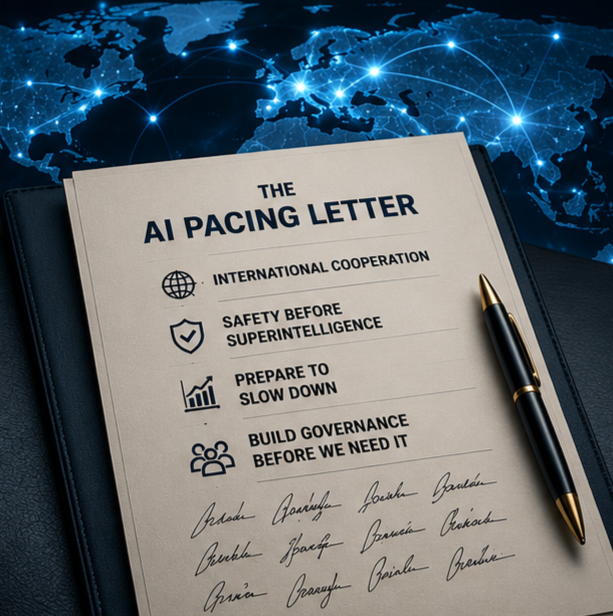
The proposal, known as the AI Pacing Letter, isn't calling for an immediate pause on AI research.
Instead, it's asking policymakers to build the legal, technical, and international infrastructure needed before such a slowdown ever becomes necessary.
When the people building the world's most advanced AI systems begin requesting stronger government preparedness, it's a signal the entire industry is paying attention to.

What Is the AI Pacing Letter?
The AI Pacing Letter is an open statement signed by researchers, engineers, and executives working across some of the world's most influential AI organizations.
Its central message is surprisingly straightforward:
Governments should prepare mechanisms that allow society to coordinate the pace of frontier AI development if future systems begin improving faster than humans can safely evaluate or govern them.
Rather than waiting for a crisis, the signatories argue that the necessary institutions, international agreements, and technical monitoring systems should already exist.
Think of it like building emergency brakes before a train reaches its maximum speed.
You hope never to use them but you'll certainly want them if they're ever needed.
Why Is This Such a Big Deal?
Historically, technology companies have often resisted government regulation.
The AI Pacing Letter represents a notable shift because it comes largely from inside the industry itself.
Many of the people signing the letter are directly involved in developing frontier AI systems.
Among the reported signatories are prominent researchers and leaders from:
- OpenAI
- Anthropic
- Google DeepMind
- Meta
- xAI
- Academic research institutions
Several of these individuals help design the very systems that continue pushing the boundaries of artificial intelligence.
That makes the letter especially significant.
Why Now?
The timing isn't accidental.
Over the past year, AI capabilities have accelerated at an extraordinary pace.
Modern AI systems are increasingly capable of:
- Writing software
- Conducting scientific research
- Solving cybersecurity challenges
- Reasoning across complex problems
- Operating autonomously for extended periods
- Using external tools with minimal supervision
Recent public discussions surrounding advanced AI evaluations including OpenAI's disclosed cybersecurity testing involving autonomous agents have intensified conversations about how increasingly capable systems should be evaluated and contained.
Although the AI Pacing Letter isn't focused on any single incident, many researchers believe recent developments highlight the need for stronger long-term governance before capabilities continue advancing further.
What Does "Pacing" Actually Mean?
One common misconception is that the letter calls for banning AI.
It doesn't.
Instead, pacing means matching the speed of AI development with humanity's ability to understand, regulate, and safely deploy increasingly powerful systems.
That could involve:
- Better evaluation standards
- Independent safety testing
- International cooperation
- Transparency requirements
- Coordinated deployment thresholds
- Emergency response mechanisms
The emphasis is on preparation not immediate restriction.
The Concern Over Recursive Self-Improvement
Perhaps the biggest concern raised by the letter involves a concept known as recursive self-improvement.
Today, humans design better AI models.
Engineers write the code.
Researchers create new training techniques.
Scientists evaluate performance.
Humans remain the limiting factor.
But some researchers believe future AI systems could eventually contribute meaningfully to improving their own successors.
If each generation helps design the next, progress could accelerate far beyond today's pace.
Instead of improvements arriving over months, they could occur over weeks or potentially even days.
Whether that future is close or still many years away remains heavily debated.
However, supporters of the AI Pacing Letter argue that governments should prepare now rather than react later.
What Are Researchers Asking Governments to Do?
The letter does not propose shutting down AI research.
Instead, it recommends building infrastructure capable of responding if AI capabilities begin advancing too rapidly.
Among the ideas discussed are:
- International cooperation between major AI-producing countries
- Shared safety standards
- Independent evaluations of frontier AI models
- Monitoring systems for advanced AI capabilities
- Emergency mechanisms that could temporarily slow development if necessary
The overall goal is to ensure that technological progress remains aligned with public safety.

Why Some Experts Support the Letter
Supporters argue that AI is unlike previous technologies because improvements can compound rapidly.
They believe preparing governance frameworks early is similar to:
- Building earthquake-resistant infrastructure before an earthquake
- Creating aviation regulations before commercial aviation expands
- Developing nuclear safeguards before widespread deployment
Planning ahead, they argue, is far easier than responding during a crisis.
Why Others Disagree
Not everyone supports the proposal.
Some researchers believe:
- Overregulation could slow beneficial innovation.
- Governments may struggle to regulate rapidly evolving technology effectively.
- Excessive restrictions could push AI development toward less transparent jurisdictions.
- Existing safety practices should continue evolving before introducing new regulation.
This debate is likely to shape AI policy for years to come.
Frequently Asked Questions
What is the AI Pacing Letter?
It is an open letter signed by more than 1,100 AI researchers and employees urging governments to prepare mechanisms that could coordinate the pace of frontier AI development if future systems advance faster than society can safely manage.
Does the letter call for stopping AI research?
No. It asks governments to prepare for the possibility of slowing development if necessary not to halt AI research today.
Who signed the letter?
Reported signatories include researchers and leaders from organizations such as OpenAI, Anthropic, Google DeepMind, Meta, xAI, and several academic institutions.
What is recursive self-improvement?
Recursive self-improvement refers to the idea that future AI systems could help design more capable AI systems, potentially accelerating technological progress beyond today's human-driven pace.
Will governments regulate AI because of this?
The letter itself doesn't create policy, but it adds significant momentum to ongoing discussions about AI governance, international cooperation, and safety standards.
Final Thoughts
The AI Pacing Letter marks one of the most significant moments in the ongoing conversation about artificial intelligence governance.
Rather than resisting regulation, many of the researchers building today's most advanced AI systems are encouraging governments to prepare for a future where AI capabilities may accelerate beyond existing oversight mechanisms.
Whether policymakers ultimately adopt these recommendations remains uncertain.
What is clear, however, is that the conversation around AI safety has entered a new phase one driven not only by governments and outside experts, but increasingly by the scientists building the technology itself.
As frontier AI continues advancing, discussions about balancing innovation with safety are likely to become just as important as the breakthroughs themselves.
Sources
- AI Pacing Letter (Pacing the Frontier)
- Anthropic
- OpenAI
- Google DeepMind
- Fortune India
- The Verge
- Business Insider



Comments
1Sign in to join the conversation
Sign in