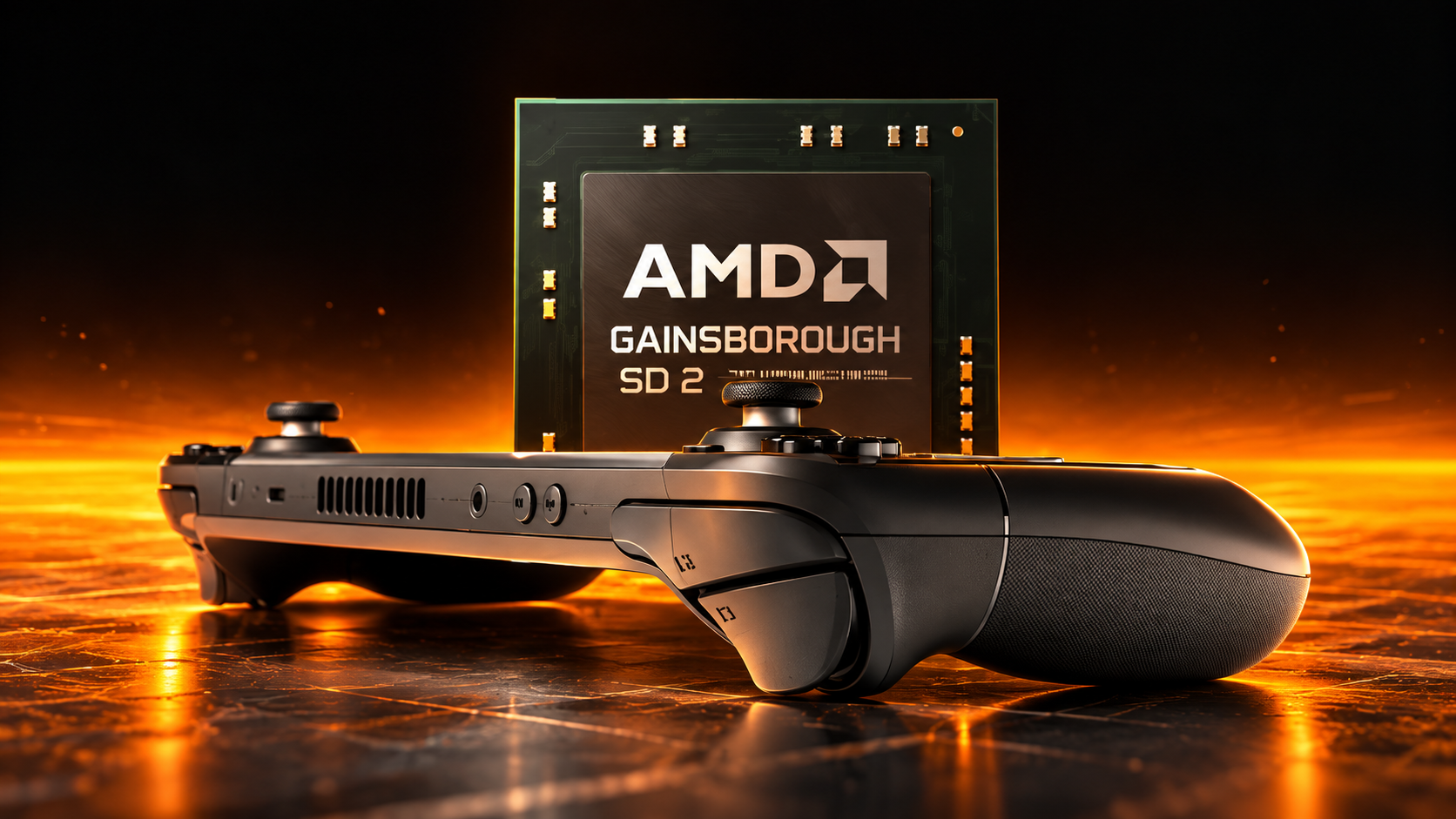

The Complete Wiki to the AMD Gainsborough APU Leak
AMD's next generation of handheld processors is already generating confusion before the company has officially announced the hardware.
At the center of the latest leaks is an AMD APU called Gainsborough.
The codename immediately caught attention because AMD's custom processor for the original Steam Deck was called Aerith, while the Steam Deck OLED's updated chip was called Sephiroth. Both names come from Final Fantasy VII, making "Gainsborough" look like an unusually obvious continuation of that naming theme.
But the hardware evidence is not conclusive.
Recent reports describe Gainsborough as a semi-custom AMD APU manufactured on TSMC's N3P process, with a reported 25 x 25 mm FF6 package. That combination looks appropriate for a future handheld. At the same time, newly leaked information about Ryzen Z3 and Ryzen Z3 Extreme points to those chips also using a 25 x 25 mm package and a 15W to 25W handheld-oriented design.
That creates two competing possibilities:
Gainsborough could be connected to Valve's next Steam Deck.
Or:
Gainsborough could be related to AMD's own Ryzen Z3 handheld platform.
There is currently no official AMD announcement that resolves the question.
Quick Facts
| Category | Current Information |
|---|---|
| Chip Codename | AMD Gainsborough |
| Manufacturer | AMD |
| Reported Process | TSMC N3P |
| Reported Package | FF6, 25 x 25 mm |
| Chip Type | Reported semi-custom APU |
| Possible CPU Architecture | Zen 6 family |
| Possible GPU Architecture | Conflicting reports, RDNA 5 or related architecture |
| Possible Alternative | Ryzen Z3 / Z3 Extreme connection |
| Possible Valve Connection | Steam Deck successor |
| Power Target | Unconfirmed |
| Reported Ryzen Z3 Target | Around 15W |
| Reported Z3 Extreme Target | Around 25W |
| Officially Announced by AMD | No |
| Steam Deck 2 Confirmation | No |
| Ryzen Z3 Confirmation | No |
| Current Status | Leak and speculation |
What Is AMD Gainsborough?
Gainsborough is the codename of an apparently unreleased AMD processor that has recently surfaced through driver and supply-chain information.
According to current reporting, the chip appears to be semi-custom, meaning it could have been designed or configured for a particular customer or product rather than being a conventional retail Ryzen processor.
That distinction is important.
AMD frequently develops silicon for specific platforms. A semi-custom chip can contain technology derived from AMD's broader CPU and GPU architectures while being configured differently from a standard consumer APU.
That makes Gainsborough difficult to identify from its specifications alone.
Why the Name Gainsborough Is So Interesting
The biggest clue is the name itself.
The original Steam Deck's AMD APU was known as Aerith.
The Steam Deck OLED used a smaller revision known as Sephiroth.
Those are references to characters from Final Fantasy VII.
Aerith Gainsborough is the full name of the character Aerith.
So:
Aerith → Sephiroth → Gainsborough
looks like a very strong Steam Deck-related naming pattern.
However, there is an important correction to the common interpretation.
The Final Fantasy codenames are reportedly AMD's names, not Valve's internal product codenames. The Verge reported that Valve designers told the publication they did not particularly want the Final Fantasy naming convention, and that AMD selected the names.
Therefore:
Gainsborough's name is evidence of an AMD naming connection, not proof that Valve commissioned the chip.
The Aerith Connection
Valve's Steam Deck hardware page confirms that the company partnered with AMD to create a custom APU optimized for handheld gaming. The original processor combines Zen 2 CPU technology with RDNA 2 graphics.
That custom relationship makes a future semi-custom AMD chip a logical possibility for another Valve handheld.
But "logical" does not mean "confirmed."
Valve has not announced that Gainsborough is the processor for a Steam Deck 2.
The TSMC N3P Connection
One of the most important claims surrounding Gainsborough is its reported use of TSMC N3P.
N3P is an enhanced version of TSMC's 3nm-class process technology.
The process is particularly interesting for handheld hardware because efficiency is critical when a processor operates from a battery.
AMD already uses N3P in its high-end CDNA 4 compute dies, demonstrating that AMD has experience with the process. AMD's documentation says N3P provides improved logic density and performance compared with the previous N5 process in that context.
However, AMD's use of N3P for CDNA 4 does not confirm that Gainsborough uses the same process.
The Gainsborough N3P claim remains leak-based.
Why N3P Would Make Sense for a Handheld
A handheld gaming device has a difficult power problem.
It needs:
High performance
while simultaneously maintaining:
Low power consumption
and:
Reasonable battery life
A more advanced manufacturing process can potentially improve the performance-per-watt characteristics of a chip.
For a Steam Deck-class device, that is particularly important.
Valve has historically emphasized the balance between performance, efficiency and battery life rather than simply maximizing benchmark performance.
That makes an efficient 3nm-class APU an attractive possibility.
What Is an APU?
An APU combines CPU and GPU functionality into a single processor package.
AMD uses APUs extensively for handheld PCs.
The current Ryzen Z family is an obvious example.
AMD's official Ryzen Z2 lineup combines CPU cores and integrated Radeon graphics for handheld gaming systems. Current Z2 products range from the 4-core Z2 Go to the 8-core Z2 and Z2 Extreme.
This architecture is particularly useful for handhelds because CPU and GPU resources can share system memory and the same power budget.
The 25 x 25 mm Package Clue
Another important part of the Gainsborough leak is its reported package size.
The chip is reportedly associated with an FF6 package measuring 25 x 25 mm.
That sounds small compared with a desktop CPU package, but it is significant for handhelds.
A compact package allows manufacturers to build smaller motherboard layouts and potentially allocate more space to:
- Battery
- Cooling
- Memory
- Storage
- Wireless hardware
However, package size alone cannot identify the final device.
And this is where the Ryzen Z3 connection becomes important.
The Ryzen Z3 Conflict
Recent leaks about AMD's next-generation Ryzen Z3 handheld processors reportedly point to the same 25 x 25 mm FF6 package.
VideoCardz reports that the Ryzen Z3 is expected to use a semi-custom design derived from AMD's upcoming Medusa Point platform. The leaked configuration reportedly contains:
- 4 Zen 6 cores
- 2 low-power Zen 6 cores
- 12 RDNA4m compute units
- Around 15W optimization
The Z3 Extreme is reportedly targeted closer to 25W.
This creates an important alternative explanation for Gainsborough.
Could Gainsborough Actually Be Ryzen Z3?
Possibly, but this is not established.
The argument comes from several overlapping clues:
Gainsborough
- Semi-custom
- 25 x 25 mm
- Handheld-friendly power characteristics
- AMD internal appearance
- Advanced process technology
Ryzen Z3
- Semi-custom handheld design
- Reported 25 x 25 mm package
- Around 15W target
- Zen 6
- Next-generation Radeon graphics
Those similarities have led to speculation that the two stories could be connected.
But there is currently no public AMD document saying:
Gainsborough = Ryzen Z3.
Ryzen Z3's Reported Architecture
The newest leak presents Ryzen Z3 as a more customized handheld processor than AMD's previous Z-series products.
The reported configuration is:
4 Zen 6 cores + 2 low-power Zen 6 cores
for a total of:
6 cores / 12 threads
The GPU is reportedly based on RDNA4m with:
12 Compute Units
and the design is said to be optimized around 15W.
The Z3 Extreme is reportedly targeting around 25W.
These specifications are leak-based and may change before AMD's eventual product announcement.
RDNA4m vs RDNA 5
This is another area where the rumor landscape has become contradictory.
Some Gainsborough reports suggest a combination of:
Zen 6 + RDNA 5
while the latest Ryzen Z3 leaks point toward:
Zen 6 + RDNA4m
VideoCardz describes RDNA4m as a handheld-focused derivative related to AMD's RDNA 3.5 architecture with some newer capabilities.
Therefore, it would be incorrect to currently state as fact that:
Gainsborough = Zen 6 + RDNA 5
The GPU architecture remains one of the biggest unresolved parts of the story.
What Is RDNA4m?
The RDNA4m designation has appeared in recent leaks around AMD's next-generation handheld processors.
The "m" suggests a mobile or modified implementation rather than a straightforward desktop RDNA 4 GPU.
The leaked Z3 configuration reportedly contains:
12 RDNA4m CUs
This would make it substantially different from the current Z2 Extreme's:
16 RDNA 3.5 CUs.
However, compute-unit count alone does not determine gaming performance.
Architecture, clock speed, memory bandwidth, cache and power limits all matter.
Current Ryzen Z2 vs Rumored Ryzen Z3
| Feature | Ryzen Z2 Extreme | Rumored Ryzen Z3 |
|---|---|---|
| CPU Architecture | Zen 5 / Zen 5c | Zen 6 + low-power Zen 6 |
| CPU Cores | 8 | 6 |
| GPU Architecture | RDNA 3.5 | RDNA4m |
| GPU CUs | 16 | 12 |
| Power Range | 15 to 35W | Around 15W |
| Package | Not the same reported FF6 package | 25 x 25 mm FF6 |
| Status | Official | Leak |
AMD officially lists the Z2 Extreme as an 8-core Zen 5/Zen 5c processor with 16 RDNA 3.5 graphics cores and a 15 to 35W configurable TDP.
The Z3 specifications remain unofficial.
Why Would AMD Reduce CPU Cores?
A six-core handheld APU may initially sound like a downgrade from the eight-core Z2 Extreme.
But handheld APUs have a fixed power budget.
If AMD reduces CPU resources, it can potentially allocate more of the available power and silicon budget to:
- GPU performance
- Higher GPU clocks
- Larger graphics resources
- Better efficiency
- Memory subsystem improvements
The reported Z3 configuration appears to make exactly this kind of tradeoff.
However, without benchmarks, it is impossible to determine whether the overall gaming performance would be higher or lower.
Could Gainsborough Be a Valve Chip Instead?
There is still a strong case for the Valve interpretation.
The evidence includes:
1. The Name
Gainsborough follows directly from Aerith Gainsborough, linking it to the codename used for the original Steam Deck APU.
2. Semi-Custom Design
Valve's Steam Deck uses a custom AMD APU, making a new semi-custom AMD design plausible.
3. Handheld-Suitable Package
The reported 25 x 25 mm package is compatible with the compact requirements of a handheld.
4. N3P
A modern efficiency-focused process would make sense for a future handheld.
5. Valve Needs a Larger Performance Jump
Valve has repeatedly indicated that a Steam Deck successor needs a substantial improvement in performance and efficiency rather than simply being a faster version of the existing system. Recent reporting says Valve is still cautious about the timing of a successor.
Why the Valve Theory Is Not Proven
There are several reasons to remain cautious.
The Codename Is AMD's
The Final Fantasy naming scheme reportedly originates from AMD rather than Valve.
Package Size Matches Z3
The same 25 x 25 mm FF6 package has been associated with Ryzen Z3.
Semi-Custom Does Not Mean Valve
AMD can build semi-custom processors for multiple customers.
Valve Has Not Announced the Chip
There is no public Valve specification identifying Gainsborough as the next Steam Deck processor.
Steam Deck 2 Timing Is Unclear
Valve has not publicly committed to a specific Steam Deck 2 launch date.
Why the Ryzen Z3 Theory Is Interesting
If Gainsborough were actually connected to Ryzen Z3, the Steam Deck connection could be a coincidence created by AMD's naming convention.
That would produce a much simpler explanation:
Gainsborough = AMD handheld-oriented silicon
rather than:
Gainsborough = confirmed Steam Deck 2 APU
The problem is that the available evidence does not currently tell us which explanation is correct.
Could AMD Reuse the Design?
This is also possible.
A semi-custom processor does not necessarily have to remain exclusive to one device forever.
The original Steam Deck APU itself has a complicated history.
The Verge notes that the original Aerith chip was reportedly associated with other possible applications before Valve used it, although parts of that history remain based on long-running industry reports rather than official Valve documentation.
This demonstrates why:
"AMD chip exists"
does not automatically mean:
"AMD chip is for Valve."
The Steam Deck 2 Requirement
Valve's position has historically been that it wants a meaningful generational improvement before launching a successor.
That means a Steam Deck 2 APU would need to improve more than just peak GPU performance.
It would ideally need to improve the combination of:
- GPU performance
- CPU performance
- Performance per watt
- Battery life
- Thermals
- Memory efficiency
- Cost
The N3P rumor is interesting because a more advanced manufacturing process could potentially help with the efficiency side of that equation.
But again, there are no confirmed Gainsborough performance numbers.
The 15W Question
The rumored 15W target is especially relevant because it overlaps with the Steam Deck's general power envelope.
But this is not proof of a Valve connection.
AMD's handheld Ryzen Z family already operates in this general range.
For example, AMD lists the Ryzen Z2 with a configurable 15 to 30W range, while the Z2 Extreme supports 15 to 35W.
Therefore:
15W = handheld clue
but not:
15W = Steam Deck proof
Gainsborough vs Steam Deck Aerith
| Feature | Steam Deck Aerith | Gainsborough Rumor |
|---|---|---|
| CPU | Zen 2 | Possibly Zen 6 |
| GPU | RDNA 2 | RDNA4m or RDNA 5, depending on leak |
| Process | 7nm-class | TSMC N3P reportedly |
| Package | Smaller than reported Gainsborough package | 25 x 25 mm FF6 reportedly |
| Design | Custom AMD APU | Semi-custom AMD APU reportedly |
| Product | Steam Deck | Unknown |
| Status | Official | Rumored |
Valve officially describes the Steam Deck APU as a custom AMD processor combining Zen 2 and RDNA 2.
What Does N3P Mean for Performance?
It is important not to treat the process node as a performance specification.
A move to N3P does not automatically mean:
"3nm = twice as fast."
Performance depends on the complete architecture.
N3P can provide a different combination of:
- Transistor density
- Power efficiency
- Frequency capability
- Area efficiency
But the final result depends on how AMD designs the chip.
AMD's official N3P documentation for CDNA 4 describes improved density and performance compared with N5, but that does not establish the characteristics of a hypothetical Gainsborough APU.
The Most Important Clue: Semi-Custom
The phrase semi-custom may ultimately be more informative than the codename.
A normal Ryzen processor is designed as part of AMD's broader product portfolio.
A semi-custom APU can be adjusted for:
- Specific power targets
- Specific memory configurations
- Custom GPU layouts
- Different I/O
- Specific package requirements
- Particular customer requirements
That makes semi-custom silicon especially common in consoles and specialized gaming devices.
The Steam Deck itself is an example of AMD working with a hardware partner on a custom APU.
What We Know About AMD's Current Handheld Strategy
AMD's official product lineup currently includes the Ryzen Z1 and Ryzen Z2 families.
The company says it works with handheld manufacturers including ASUS, Lenovo, MSI, Valve and others.
The current Z2 family demonstrates AMD's willingness to create several configurations for different handheld power and performance levels.
That makes a future Z3 generation entirely plausible.
What is not yet confirmed is whether Gainsborough is one of those Z3 chips.
Why the Leak Is So Difficult to Decode
The confusing part is that several clues point in different directions.
Clue pointing toward Valve
Gainsborough
matches Aerith Gainsborough.
Clue pointing toward Ryzen Z3
25 x 25 mm FF6 package
appears in both the Gainsborough reports and Z3 leaks.
Clue pointing toward a generic AMD handheld chip
15W-class power
is common for handheld APUs.
Clue pointing toward next-generation architecture
Reports connect Gainsborough to N3P and potentially Zen 6.
None of these clues independently identifies the final product.
What Is Confirmed?
At the moment, the safest breakdown is:
Confirmed
AMD officially makes custom APUs for handheld gaming devices and currently sells Ryzen Z-series processors.
Valve officially partnered with AMD on the Steam Deck's custom APU.
AMD uses TSMC N3P in some of its current products, including CDNA 4 compute dies.
Reported but Unconfirmed
Gainsborough exists as an unreleased AMD APU.
Gainsborough is semi-custom.
Gainsborough uses N3P.
Gainsborough has a 25 x 25 mm FF6 package.
Gainsborough could be associated with Valve.
Conflicting Rumors
Gainsborough could be a Steam Deck successor chip.
Gainsborough could instead be connected to Ryzen Z3.
Gainsborough could potentially be an AMD design evaluated for one product and ultimately used elsewhere.
What We Still Don't Know
Several important details remain unknown:
- Exact CPU core count
- Exact Zen architecture
- Exact GPU architecture
- Number of GPU compute units
- Cache configuration
- Memory type
- Memory bandwidth
- NPU presence
- TDP
- Clock speeds
- Final package design
- Customer
- Product launch
- Whether Valve is involved
- Whether Gainsborough and Ryzen Z3 are actually related
Until AMD publishes documentation, these should remain open questions.
AMD Gainsborough Timeline
| Date | Development |
|---|---|
| 2022 | Steam Deck launches with custom AMD Aerith APU |
| 2023 | Steam Deck OLED introduces the smaller Sephiroth APU revision |
| 2025 | AMD introduces Ryzen Z2 handheld processors |
| 2026 | AMD continues expanding its handheld partnerships and Z2 ecosystem |
| October 2026 | Gainsborough reportedly appears in AMD-related leaks |
| October 2026 | Reports link Gainsborough to TSMC N3P and a 25 x 25 mm package |
| October 2026 | Separate Ryzen Z3 leaks also point to 25 x 25 mm FF6 packaging |
| Future | AMD announcement required to establish Gainsborough's actual product identity |
AMD's current official handheld portfolio remains the Ryzen Z1 and Z2 families.
Frequently Asked Questions
What is AMD Gainsborough?
Gainsborough is the codename of an unreleased AMD APU reported in recent leaks. It is described as a semi-custom chip potentially aimed at a handheld device.
Is Gainsborough the Steam Deck 2 chip?
Not confirmed. The codename has a strong connection to the Aerith name used for the original Steam Deck APU, but current evidence does not establish that Gainsborough is definitely for Valve.
Is Gainsborough based on TSMC N3P?
Current reports claim that it is, but AMD has not publicly confirmed the processor or its manufacturing process.
What is the reported Gainsborough package?
Reports identify an FF6 25 x 25 mm package.
Could Gainsborough be Ryzen Z3?
It is possible, but currently unconfirmed. Separate Ryzen Z3 leaks also point toward an FF6 25 x 25 mm package and handheld-oriented power targets.
What architecture will Ryzen Z3 use?
Current leaks reportedly point toward Zen 6 plus RDNA4m, with four standard Zen 6 cores and two low-power Zen 6 cores.
Is Gainsborough using RDNA 5?
Some reports speculate about RDNA 5, but this is not established. Other current handheld leaks point toward RDNA4m for Ryzen Z3. The GPU architecture of Gainsborough remains unresolved.
What is the difference between Gainsborough and Ryzen Z3?
At present, there is no confirmed evidence that they are separate chips or the same chip. Gainsborough is a codename from leaks, while Ryzen Z3 is the rumored next generation of AMD's branded handheld processors.
Why is the name Gainsborough connected to Steam Deck?
The original Steam Deck APU was called Aerith, and Aerith's surname is Gainsborough. However, reporting indicates the Final Fantasy-based names were chosen by AMD rather than Valve.
Does Valve have a Steam Deck 2?
Valve has discussed a successor and has said it wants a meaningful generational improvement before releasing one, but there is no publicly confirmed Gainsborough-powered Steam Deck 2 product announcement.
Current Status
AMD Gainsborough remains an unconfirmed APU leak with two major competing interpretations.
The first interpretation is the more exciting one for Steam Deck fans:
Gainsborough could be a semi-custom N3P APU intended for Valve's future handheld.
The evidence supporting that theory includes the Aerith Gainsborough naming connection, the reported semi-custom nature of the processor, and its apparent handheld-friendly package and power characteristics.
The second interpretation is that Gainsborough could be related to AMD's upcoming Ryzen Z3 family.
That theory gained credibility because separate Ryzen Z3 leaks point toward a 25 x 25 mm FF6 package, a semi-custom handheld design and a roughly 15W target.
The most important takeaway is therefore not to label Gainsborough as the Steam Deck 2 APU yet.
The evidence currently supports a narrower conclusion:
AMD appears to be developing or validating an advanced handheld-oriented APU called Gainsborough, reportedly using TSMC N3P, but its final customer and product remain unknown.
If the chip ultimately becomes Valve's next-generation Steam Deck silicon, the Aerith-to-Gainsborough naming connection will look remarkably appropriate.
If it instead becomes part of the Ryzen Z3 ecosystem, the same evidence will have represented a different branch of AMD's handheld strategy.
Until AMD officially identifies the chip, both possibilities remain open.
Go deeper into the Gainsborough leak