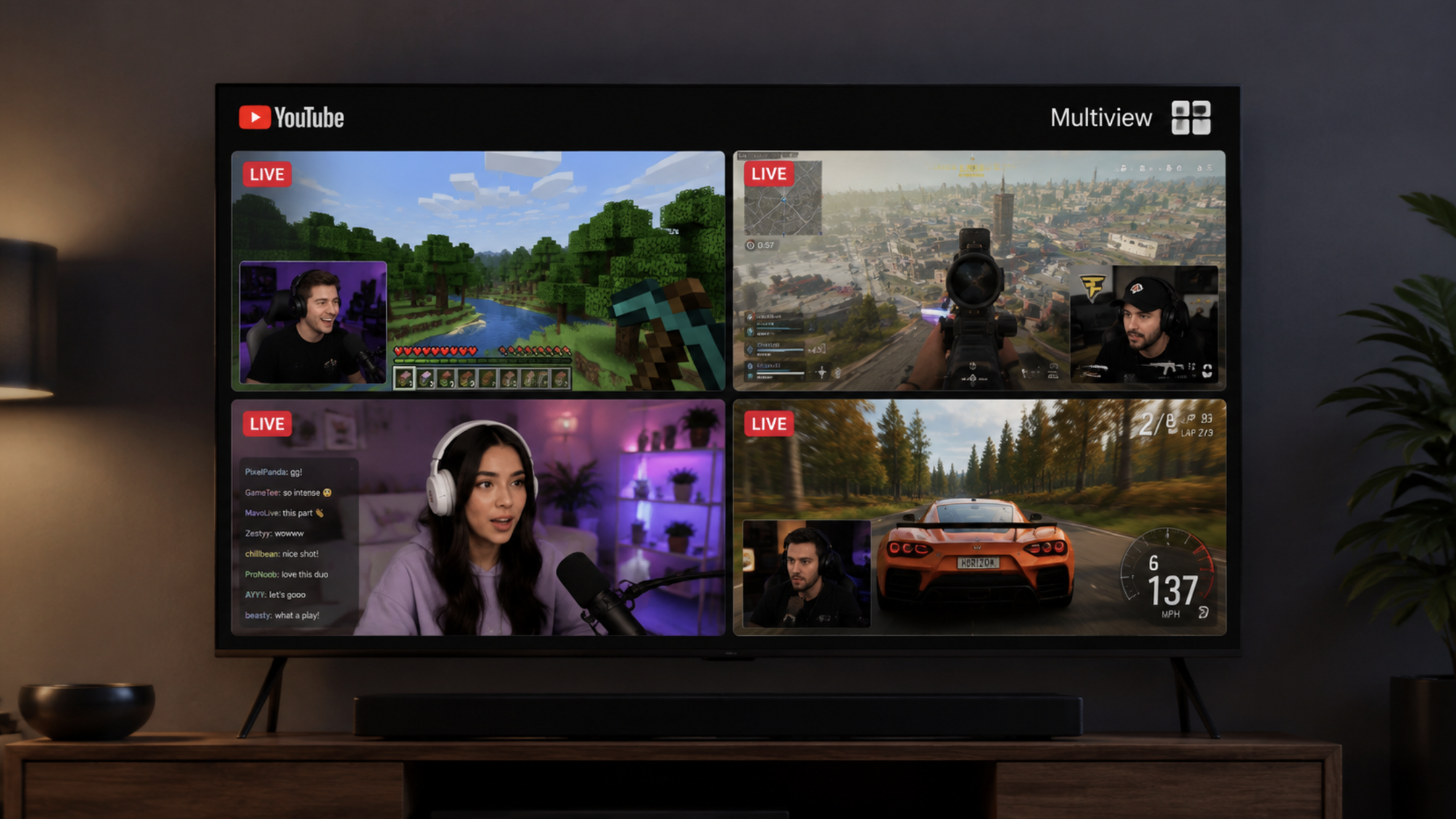

YouTube Live's Multiview Update: The Final Nail in the Co-Streaming Coffin?
What if viewers didn't have to choose which streamer to watch?
That is the promise behind YouTube's Multiview.
The feature can place up to four live streams on a single screen, allowing viewers to follow multiple broadcasts at once. YouTube already supports Multiview across supported TV and mobile experiences, with viewers able to switch audio between feeds and move individual streams into fullscreen.
That sounds like a convenient viewing feature.
But for the creator economy, it raises a much bigger question:
If audiences can watch multiple perspectives simultaneously, does the traditional co-streaming model still have the same purpose?
YouTube Is Turning One Broadcast Into Four
The basic idea behind Multiview is simple.
Instead of opening four browser tabs, viewers can watch multiple live feeds inside a single viewing experience.
YouTube's current system supports up to four simultaneous streams, with two to four feeds appearing depending on the available programming. Viewers can select which feed provides the audio and can switch individual feeds into fullscreen.
The technology has already been used for major live events.
During Coachella 2026, YouTube offered seven simultaneously streamed stages, with Multiview allowing viewers to watch up to four at once.
At EDC Las Vegas, YouTube similarly offered multiple live feeds and a four-stage Multiview experience.
The important idea is not simply “four videos.”
It is four perspectives inside one viewing experience.
Why This Could Change Co-Streaming
Co-streaming became popular because viewers wanted something individual broadcasts couldn't provide.
A streamer could watch an esports match, react to it, explain what was happening, and provide personality-driven commentary.
That created an alternative to the official broadcast.
But Multiview approaches the problem from the opposite direction.
Instead of asking:
“Which creator's perspective do I want?”
YouTube can potentially let viewers see multiple perspectives at once.
For sports and festivals, that is already useful.
Imagine following four stages at a music festival or keeping an eye on several simultaneous games without constantly switching tabs.
Now imagine that same concept becoming more deeply integrated with creator livestreams.
That's where things could get interesting.
But This Isn't Yet a Four-Creator Gaming Multiview
This distinction is important.
Despite the excitement around the idea, YouTube's current official Multiview documentation does not say that viewers can freely select four unrelated gaming creators and combine their active YouTube Gaming streams into a single Multiview.
The documented experience is currently tied to eligible programming, including YouTube Primetime Channels, with customizable combinations available for selected services such as NFL Sunday Ticket, Peacock, Paramount+ and FOX One.
So the idea of four gaming creators appearing together is better understood as where this technology could go, rather than a currently documented universal feature.
That actually makes the development more interesting.
YouTube has already built the infrastructure.
The question is how far it will extend it.
 And What About the Revenue Split?
This is where the biggest misconception needs to be cleared up.
YouTube's official documentation does not currently confirm automatic ad-revenue splitting between creators simply because their streams appear together in Multiview.
YouTube's standard live monetization system allows eligible creators to earn from ads, Super Chat, Super Stickers, memberships and other monetization features.
But Multiview itself is documented as a viewing feature, not a new revenue-sharing mechanism.
That distinction matters.
If YouTube eventually allows four independent creators to be combined into one creator-focused Multiview and automatically distributes revenue between them, that would be a much bigger development.
That would fundamentally change the economics of co-streaming.
For now, however, it remains a possibility rather than a confirmed feature.
YouTube Is Already Building a More Social Live Experience
Multiview isn't happening in isolation.
YouTube has been adding several features designed to make livestreaming more interactive and easier to distribute.
The platform supports simultaneous horizontal and vertical livestreams with shared chat, while creators can also use live gifts, memberships, Super Chat and other fan-funding tools.
YouTube has also introduced the ability to react live alongside eligible content, creating another way for creators to build commentary around live events.
That creates an interesting ecosystem.
YouTube doesn't necessarily need viewers to choose between watching the event and watching a creator react to it.
Eventually, both experiences could exist side by side.

The Real Threat to Co-Streaming Is Convenience
The strongest argument against traditional co-streaming isn't actually revenue.
It's friction.
If viewers want to follow four things at once, opening multiple streams is inconvenient.
Multiview removes that problem.
If YouTube can eventually apply the same system to creator-led broadcasts, viewers could potentially watch several personalities without leaving the platform or constantly changing tabs.
That could make collaborative viewing much easier.
It could also change how creators think about their role.
Instead of competing to become the one stream everyone watches, creators could become one of several perspectives within a larger live experience.
That's a very different model.
Analysis / Why It Matters
The bigger story here isn't whether Multiview immediately kills co-streaming.
It doesn't.
Co-streaming is valuable because personality matters.
A creator can provide jokes, analysis, context, reactions and a community that a raw event broadcast cannot replicate.
Multiview doesn't replace that.
What it potentially changes is how those personalities are discovered and consumed.
YouTube's own strategy increasingly treats the platform as a destination for every kind of screen and format, from Shorts and long-form videos to livestreams and television-style viewing. YouTube CEO Neal Mohan has also described creators as part of the platform's next era of entertainment.
Multiview fits perfectly into that direction.
It makes livestreaming feel less like opening one creator's channel and more like opening a digital control room.
And if YouTube eventually brings independent gaming creators into that environment, the competitive landscape could change dramatically.
What Happens Next?
The most important thing to watch is where YouTube takes Multiview next.
The technology is already capable of handling four simultaneous live feeds, and YouTube continues to expand live content across TV, mobile and major events.
The next logical step would be bringing more creator-driven programming into the experience.
If that happens, YouTube could eventually create a system where viewers choose their own combination of commentators, streamers and official broadcasts.
But the revenue question will be just as important.
A creator-friendly Multiview system would need clear rules around advertising, attribution, watch time and revenue before creators would treat it as a genuine alternative to traditional co-streaming.
Until then, Multiview is best viewed as a powerful piece of infrastructure — not the death of co-streaming yet.
🎮 The Bottom Line
YouTube Multiview isn't the final nail in the co-streaming coffin yet.
But it is pointing toward a future where viewers may no longer need to choose a single live perspective.
The ability to watch up to four live feeds simultaneously is already here for supported programming, and YouTube is steadily making live viewing more flexible across screens.
The really disruptive moment will come if YouTube applies that technology directly to independent gaming creators — especially if it eventually introduces a transparent way to share monetization between participating channels.
Until then, co-streaming still has one advantage Multiview can't easily replace:
the creator you choose to watch.
Would you rather watch one streamer with their full commentary, or four creators at once and switch between their perspectives? Let us know in the comments.

Comments
1Sign in to join the conversation
Sign in