
YouTube's 'Live Auto-Dubbing' Update: Why Global Streaming Just Changed Forever
For years, language has been one of the biggest invisible walls on the internet.
A creator can build an enormous audience in the United States, Brazil, Japan, India or Germany, but a viewer who does not understand that creator's language is often left watching from the outside.
YouTube is now trying to remove that wall.
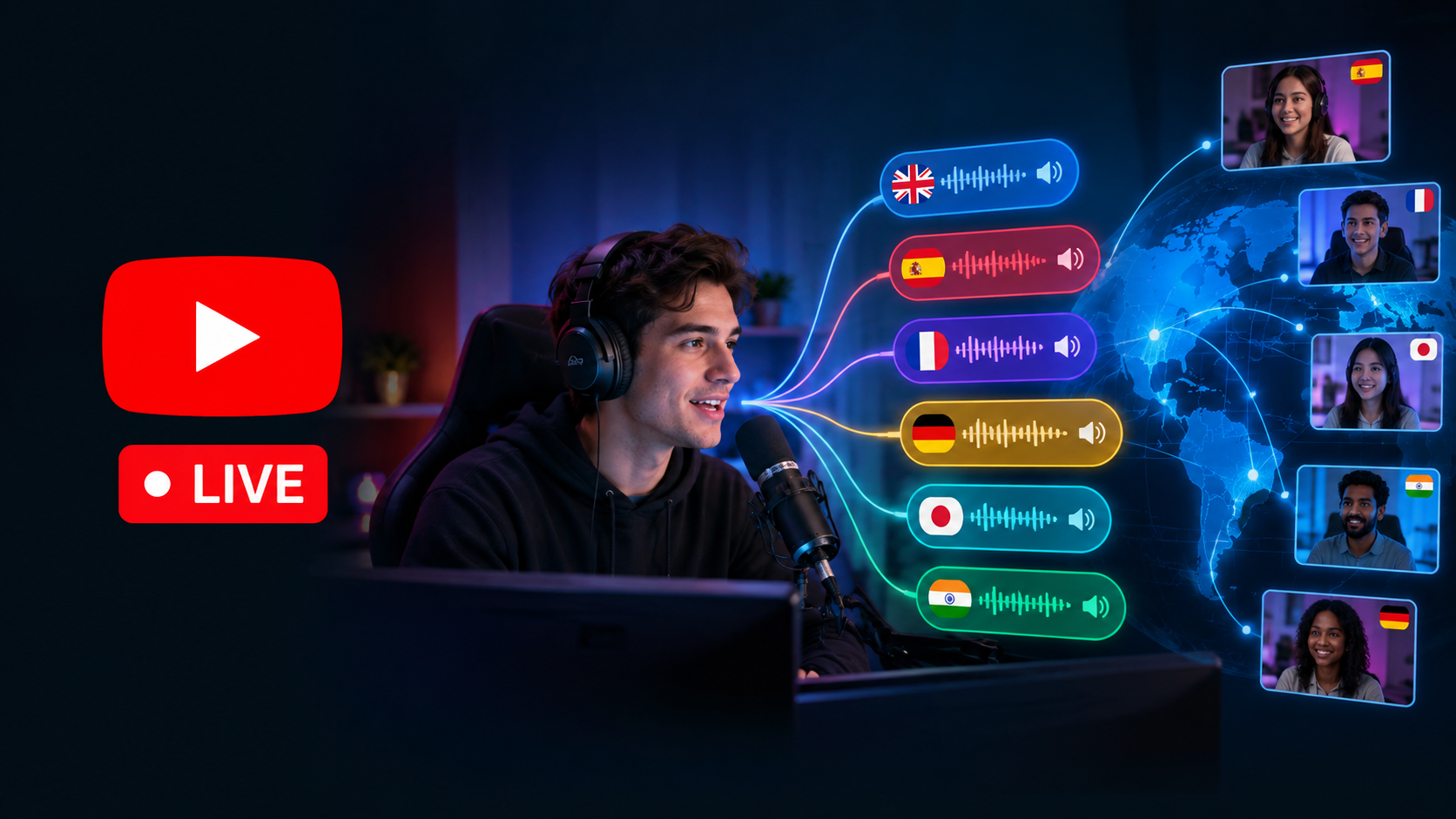
With its new YouTube Live Auto-Dubbing system, the platform plans to automatically translate a creator's speech while a livestream is happening, allowing viewers to listen to the broadcast in their preferred language.
The technology is scheduled to begin as a pilot in early 2027 rather than launching universally immediately. YouTube says more than 40% of live watch time comes from viewers outside a creator's home country, giving the company a huge incentive to solve the language problem.
That makes this more important than another AI feature buried inside YouTube Studio.
It could fundamentally change how livestream audiences are built.
A gaming streamer in Los Angeles could potentially speak English while viewers in Spain listen in Spanish.
A creator in London could reach audiences across Latin America without hiring a separate dubbing team.
An Indian streamer could potentially connect with viewers who do not understand Hindi or English.
And unlike traditional dubbing, nobody has to wait for the stream to end.
The translation happens while the conversation is happening.
That is the part that changes everything.
────────────────────────────────────────
────────────────────────────────────────
1. What YouTube Actually Announced
YouTube revealed Live Auto-Dubbing during its Made on YouTube event on September 23, 2026.
The basic idea is surprisingly simple.
A creator speaks normally.
YouTube processes the speech.
The system translates it into another language.
The viewer hears the translated version while the livestream continues.
YouTube describes the feature as automatically translating a creator's speech in real time so viewers can listen along in their preferred language. The first pilot is scheduled for early 2027.
That distinction matters.
This is not simply automatically generated subtitles.
It is not a translation appearing underneath the video.
It is not a creator uploading a Spanish version after finishing an English stream.
The goal is an actual translated audio experience during the broadcast.
That puts YouTube Live much closer to the idea of a universal livestream.
The person speaking and the person listening no longer necessarily need to use the same language.
────────────────────────────────────────
2. How Live Auto-Dubbing Works
At a technical level, live dubbing requires several AI systems to operate almost simultaneously.
First, YouTube has to recognize what the creator is saying.
That is speech recognition.
Then the system has to understand the sentence and translate it.
That is machine translation.
Then the translated sentence has to be converted into spoken audio.
That is AI voice generation.
And finally, all of this has to happen quickly enough that the viewer still feels like they are watching a live conversation.
That last part is the difficult one.
With a normal uploaded video, YouTube can take its time.
If a translation takes several minutes to process, the viewer can simply watch the finished version later.
Livestreaming does not provide that luxury.
A delay of even a few seconds can become noticeable.
A delay becomes especially awkward when thousands of viewers are reacting to something that the translated audience has not heard yet.
YouTube therefore has to balance four things:
| Requirement | Why It Matters |
|---|---|
| Speech recognition | The system needs to understand the creator |
| Translation | The meaning has to survive the language change |
| Voice generation | The translated words need to sound natural |
| Low latency | The translation has to remain close to the live moment |
That combination is what makes Live Auto-Dubbing substantially harder than ordinary video dubbing.
────────────────────────────────────────
────────────────────────────────────────
3. Why Livestreams Are Harder to Translate
Live content is fundamentally different from prerecorded content.
A recorded video can be edited.
A creator can remove mistakes.
A translator can review awkward sentences.
An AI system can process the entire video before the audience sees it.
A livestream has none of those advantages.
Creators interrupt themselves.
They change topics.
They speak over other people.
They use slang.
They react to chat.
They laugh.
They mumble.
They shout.
They suddenly scream because somebody just eliminated them in a game.
The AI has to handle all of it.
And gaming streams make the problem even harder.
Imagine a streamer playing a competitive shooter.
Someone appears behind them.
The streamer shouts.
Chat explodes.
The streamer immediately responds to three messages.
A teammate speaks at the same time.
Then the streamer starts laughing.
The translation system has to understand the situation and keep up.
That is a completely different technical challenge from dubbing a scripted YouTube video.
────────────────────────────────────────
4. YouTube Already Has an Auto-Dubbing System
Live Auto-Dubbing did not appear from nowhere.
YouTube has already spent years building automated dubbing for prerecorded content.
In February 2026, YouTube announced that auto dubbing had expanded to every channel with support for 27 languages. The company also introduced Expressive Speech for eight languages: English, French, German, Hindi, Indonesian, Italian, Portuguese and Spanish.
YouTube said that in December it averaged more than 6 million daily viewers who watched at least 10 minutes of auto-dubbed content.
That existing infrastructure is important.
YouTube already understands that audiences are willing to consume AI-dubbed content.
The next step is taking the same concept and removing the biggest advantage prerecorded videos have.
Time.
Instead of processing the video first, YouTube has to translate while the creator is still speaking.
────────────────────────────────────────
5. Why Live Dubbing Is a Much Bigger Step
The difference between ordinary auto-dubbing and live auto-dubbing is not simply speed.
It changes the entire experience.
A normal dubbed video can be treated as another version of the same piece of content.
A livestream has a social layer.
People are watching together.
They are chatting together.
They are reacting together.
They are donating together.
They are sending Super Chats.
They are becoming part of the broadcast.
YouTube itself describes livestreaming as a real-time connection between creators and communities, and the platform's August 2026 figures showed more than 600 million logged-in viewers watching live content, including archived live content, on average each day.
That means translation is not simply about converting words.
It is about translating a social experience.
If that works well, the implications are enormous.
────────────────────────────────────────
6. The 40% International Audience
YouTube's most revealing statistic is not the number of languages.
It is the audience distribution.
According to YouTube, more than 40% of live watch time comes from viewers outside a creator's home country.
That tells us something important.
International audiences are already watching livestreams.
The problem is that many of those viewers are doing so despite language barriers.
A creator does not necessarily need to become international.
Their audience is already international.
YouTube is trying to make that audience easier to serve.
That could change the economics of livestreaming.
A streamer who currently earns most of their revenue from one language market could potentially build an international audience without changing their entire content strategy.
The creator keeps speaking naturally.
The platform handles more of the localization.
That is the pitch.
────────────────────────────────────────
7. What This Means for Gaming Streamers
Gaming may be one of the biggest beneficiaries.
Gaming streams are already global.
A single major game can have communities across dozens of countries simultaneously.
But individual creators remain strongly tied to language.
A Japanese streamer can have enormous popularity in Japan while remaining relatively unknown in English-speaking markets.
An American streamer can attract viewers across Europe but still struggle to convert non-English speakers into regular viewers.
Live dubbing could weaken that connection.
Consider a major esports tournament.
Instead of creating separate broadcasts for different language markets, YouTube could theoretically allow viewers to select the language they want to hear.
The same stream could serve multiple audiences.
That could reduce the need for completely separate language versions of the same event.
For individual creators, the impact could be even more interesting.
A creator's personality remains the central product.
If AI can reproduce that personality across languages, the creator no longer needs to personally speak every language to reach the audience.
────────────────────────────────────────
────────────────────────────────────────
8. The End of Language-Locked Communities?
This is where YouTube's update becomes much bigger than a convenience feature.
For decades, internet communities have been divided by language.
There are English-speaking YouTube communities.
Spanish-speaking communities.
Portuguese-speaking communities.
Japanese-speaking communities.
Hindi-speaking communities.
French-speaking communities.
Those communities overlap, but language often determines where viewers spend their time.
Live Auto-Dubbing could make those boundaries less rigid.
A creator could theoretically develop one community that speaks multiple languages.
Imagine watching a streamer whose chat contains messages from:
New York.
Madrid.
Mumbai.
São Paulo.
Tokyo.
Paris.
The creator speaks one language.
The audience hears different languages.
Yet everyone is still watching the same broadcast.
That is the real promise.
Not translation by itself.
A larger shared audience.
────────────────────────────────────────
9. Why Chat Is Still a Problem
There is, however, a major weakness.
Audio translation does not automatically translate the community.
A Spanish-speaking viewer might hear the streamer in Spanish while the live chat remains filled with English messages.
That creates a strange experience.
The creator is translated.
The audience is not.
And chat is one of the most important parts of livestreaming.
YouTube's own live ecosystem is built around chat, reactions, Super Chats, memberships and other real-time interactions.
So the ultimate international streaming experience would probably require more than translated speech.
It would require better multilingual chat.
Potentially, that could mean automatically translating messages for individual viewers.
A viewer could write in Spanish.
The creator could see English.
Another viewer could see French.
Everyone participates in the same conversation.
YouTube has not announced that full system as part of this Live Auto-Dubbing announcement.
But it highlights where the technology could logically go next.
────────────────────────────────────────
10. What Happens When AI Gets a Joke Wrong?
Translation is not just about vocabulary.
It is about context.
A creator might say:
“Bro, that was absolutely cooked.”
A literal translation could make little sense.
The AI has to understand that “cooked” might mean something went badly.
Gaming communities are filled with slang like this.
Then there are cultural references.
Memes.
Sarcasm.
Regional jokes.
Irony.
Swearing.
Nicknames.
Inside jokes between creators and their communities.
A human translator can understand context.
AI systems are getting better at it, but real-time translation has very little room for correction.
One bad translation during a serious discussion can change the meaning of what a creator said.
One badly translated joke can kill the punchline.
And one mistranslated controversial statement can create a completely different interpretation.
That means accuracy will matter just as much as speed.
────────────────────────────────────────
WARNING: Live Translation Is Not Perfect
YouTube's existing automatic captioning documentation warns that speech recognition can struggle with poor audio, overlapping speakers, multiple languages and other conditions. Live automatic captions currently have additional limitations, including language and latency requirements.
Live Auto-Dubbing is a newer technology and will initially be piloted rather than treated as a universally available finished product.
Creators should therefore expect mistakes.
The technology will improve through real-world usage, but real-time translation cannot be treated as perfectly reliable.
────────────────────────────────────────
11. Streamer Voices Are Becoming Part of the Technology
There is another interesting layer to YouTube's AI strategy.
The goal is not necessarily to make every creator sound like a generic translator.
YouTube has already been working on more expressive AI dubbing for prerecorded videos, with the company emphasizing the preservation of emotion and performance across languages. Its February 2026 announcement introduced Expressive Speech across eight languages.
That matters enormously for livestreaming.
A streamer is not just a voice.
Their voice is part of their identity.
The laugh.
The shouting.
The pauses.
The excitement.
The frustration.
The personality.
If translated speech sounds robotic, international viewers may understand the words while losing the reason they enjoy the creator.
The ideal system therefore needs to translate language without destroying personality.
That may become one of the most important challenges of the technology.
────────────────────────────────────────
────────────────────────────────────────
12. The Business Impact
The biggest potential change could be economic.
A creator's audience is an asset.
More viewers can mean:
More advertising revenue.
More memberships.
More donations.
More sponsorship opportunities.
More merchandise sales.
More opportunities for brand partnerships.
But historically, language has limited how far that audience can travel.
Live Auto-Dubbing could reduce that limitation.
A creator with 100,000 viewers in one language does not necessarily need to become a multilingual creator.
If YouTube can make the content understandable to another market, the platform can potentially help that creator compete for international attention.
The creator does not have to operate ten channels.
YouTube does not need ten separate broadcasts.
One stream becomes the central source.
Localization happens around it.
That is an extremely powerful platform model.
────────────────────────────────────────
13. Could This Change Sponsorships?
Potentially.
International audiences are valuable to advertisers, but language has always complicated campaigns.
A brand might sponsor a creator for an English-speaking audience while having limited access to viewers in other markets.
If one livestream can serve multiple languages, the creator's international reach becomes easier to package.
That could change how sponsorship deals are negotiated.
Instead of saying:
“My audience is primarily English-speaking.”
A creator might eventually say:
“My stream reaches viewers across several language markets simultaneously.”
That is a very different proposition.
There are still obvious questions about advertising localization, legal requirements, regional pricing and sponsorship messaging.
YouTube has not announced that Live Auto-Dubbing automatically solves those issues.
But the underlying audience expansion could make international sponsorships more attractive.
────────────────────────────────────────
14. YouTube vs Twitch and Other Streaming Platforms
YouTube is not the only platform competing for livestream audiences.
Twitch remains one of the biggest names in streaming.
Kick has expanded aggressively.
TikTok Live has become a major live-video destination.
Other platforms continue experimenting with creator discovery, monetization and AI.
That makes YouTube's translation strategy particularly interesting.
YouTube already has something many competitors do not have to the same degree:
A massive library of prerecorded content combined with livestreaming.
Its auto-dubbing system already operates across a large catalog.
Now the company is trying to connect that technology directly to live broadcasting.
If the pilot works, language could become another area where YouTube has a platform-level advantage.
But that outcome is not guaranteed.
The technology has to work.
Creators need to trust it.
Viewers need to like the experience.
And YouTube needs to keep latency low enough that the stream still feels live.
────────────────────────────────────────
15. What Creators Should Prepare For
Creators do not need to completely change their strategy yet.
The Live Auto-Dubbing pilot is scheduled for early 2027.
But there are several things streamers can start thinking about now.
Speak clearly
AI systems perform better when speech is clean and understandable.
Improve microphone quality
Background noise and overlapping audio can make real-time speech processing harder.
Avoid unnecessary audio chaos
Multiple people talking simultaneously can create translation problems.
Think internationally
Creators should consider which languages are most relevant to their audience.
Build universal content
Visual storytelling can cross language barriers more easily than highly language-dependent jokes or references.
Watch for pilot access
YouTube's feature is beginning as a pilot, so availability will not necessarily be universal from day one.
────────────────────────────────────────
16. The Risks of Real-Time AI Dubbing
The technology also creates legitimate concerns.
Translation mistakes
A mistranslated statement could change the meaning of what a creator says.
Personality loss
A technically accurate translation could still sound emotionally wrong.
Latency
If translated audio arrives significantly later than the original, the experience could feel disconnected.
Voice identity
Creators may have questions about how their voices are processed and protected.
Moderation
A translated stream creates another layer of content moderation across multiple languages.
Cultural context
A phrase that is harmless in one country can mean something very different somewhere else.
These are not reasons the technology cannot work.
They are the problems YouTube will have to solve as the pilot expands.
────────────────────────────────────────
17. The 2027 Road Ahead
| Feature | Status |
|---|---|
| YouTube Live Auto-Dubbing | Pilot planned for early 2027 |
| Real-time speech translation | Core feature |
| Viewer-selected language experience | Intended use |
| International live audience | Major target |
| YouTube prerecorded auto-dubbing | Already broadly available |
| Expressive Speech | Available in selected languages |
| Lip-sync testing | Being tested for dubbed video |
| Multilingual live chat | Not announced as part of this update |
The most important date is early 2027.
Until then, Live Auto-Dubbing should be treated as an announced pilot rather than a fully released global feature.
That distinction will matter as creators plan their workflows.
────────────────────────────────────────
18. FAQ
What is YouTube Live Auto-Dubbing?
YouTube Live Auto-Dubbing is an upcoming AI feature designed to translate a creator's speech into other languages in real time while a livestream is happening.
When is YouTube Live Auto-Dubbing launching?
YouTube says it will begin piloting Live Auto-Dubbing in early 2027.
Will YouTube Live Auto-Dubbing be available to everyone immediately?
No. YouTube has announced an initial pilot, so availability will depend on the rollout.
Is Live Auto-Dubbing the same as subtitles?
No. The announced feature is designed to translate the creator's speech so viewers can listen to the livestream in another language, rather than simply reading translated captions.
Why is YouTube introducing live dubbing?
YouTube says more than 40% of live watch time comes from viewers outside a creator's home country, while language can prevent potential viewers from joining the conversation.
Does YouTube already have automatic dubbing?
Yes. YouTube expanded prerecorded auto-dubbing to 27 languages in 2026 and introduced Expressive Speech for eight languages.
Will viewers be able to choose their language?
The announced purpose of Live Auto-Dubbing is for viewers to listen to livestream speech in their preferred language. Exact controls and availability will depend on the pilot and rollout.
Will live chat automatically be translated?
YouTube's September 2026 Live Auto-Dubbing announcement does not say that multilingual live chat translation is included in the feature.
Will gaming streamers benefit from Live Auto-Dubbing?
Gaming is one of the areas that could benefit significantly because gaming audiences are already highly international. The feature could allow one creator to reach viewers who speak different languages without maintaining separate livestreams.
────────────────────────────────────────
19. Final Takeaway
YouTube's Live Auto-Dubbing update is easy to underestimate.
At first glance, it sounds like another AI translation feature.
It is much bigger than that.
For the first time, YouTube is attempting to make a livestream itself language-flexible.
The creator speaks one language.
The viewer chooses another.
And both can participate in the same broadcast at almost the same moment.
The technology still has a long way to go.
It needs to handle slang, jokes, accents, overlapping speakers, emotional delivery and the tiny delays that can make or break a live conversation.
But the direction is clear.
YouTube is trying to turn livestreaming from a language-specific experience into a global one.
And the timing makes sense.
More than 40% of live watch time already comes from outside creators' home countries. The audience is international.
The language barrier is what remains.
If YouTube's early-2027 pilot works at scale, the biggest change may not be that streamers can suddenly speak more languages.
It will be that they no longer need to.