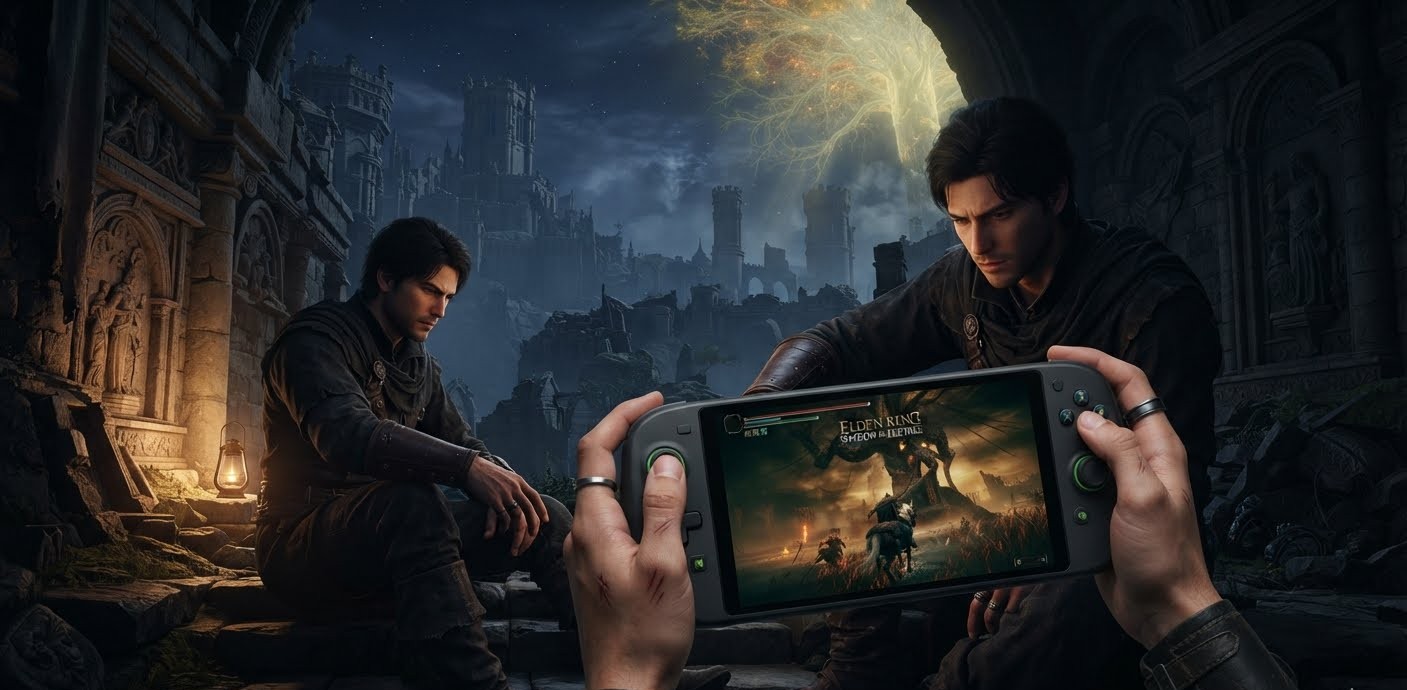

The Switch 2 Hardware Breakdown: Is the NVIDIA Tegra T239 Enough for Next-Gen Ports?
The Switch 2 hardware represents a massive jump over Nintendo's original hybrid console. At the heart of the system is a custom NVIDIA processor built around an Ampere-based GPU, paired with 12GB of memory and dedicated hardware for AI-powered upscaling and ray tracing.
And now we have a real-world test of what that hardware can accomplish.
Elden Ring: Tarnished Edition launched on Nintendo Switch 2 on August 28, 2026, bringing FromSoftware's massive open-world RPG and its Shadow of the Erdtree expansion to Nintendo's handheld for the first time.
The important distinction is that this is a native Switch 2 port, not necessarily a game rendered at native 1080p or 4K all the time. Current reviews report a generally solid 30 FPS experience, with visual compromises and occasional drops in demanding situations.
So the bigger question isn't simply whether the Switch 2 is powerful.
It's this:
How is a relatively small handheld running games originally designed for much more powerful hardware?
📑 Table of Contents
- What Is the NVIDIA T239?
- Switch 2 Hardware at a Glance
- The CPU: A Huge Step Forward
- The Ampere GPU
- Why 12GB of RAM Matters
- The Secret Weapon: DLSS
- Ray Tracing on a Handheld
- How Elden Ring Runs on Switch 2
- Why Optimization Matters More Than Raw Power
- Can Switch 2 Handle More Next-Gen Ports?
- Switch 2 vs Original Switch
- The Biggest Hardware Limitation
- Final Verdict
💡 KEY TAKEAWAY: Switch 2 doesn't compete with PS5 or Xbox Series X through raw performance alone. Its advantage comes from combining a much stronger GPU and CPU with DLSS, dedicated AI hardware, faster memory, and console-specific optimization.
⚙️ What Is the NVIDIA T239?
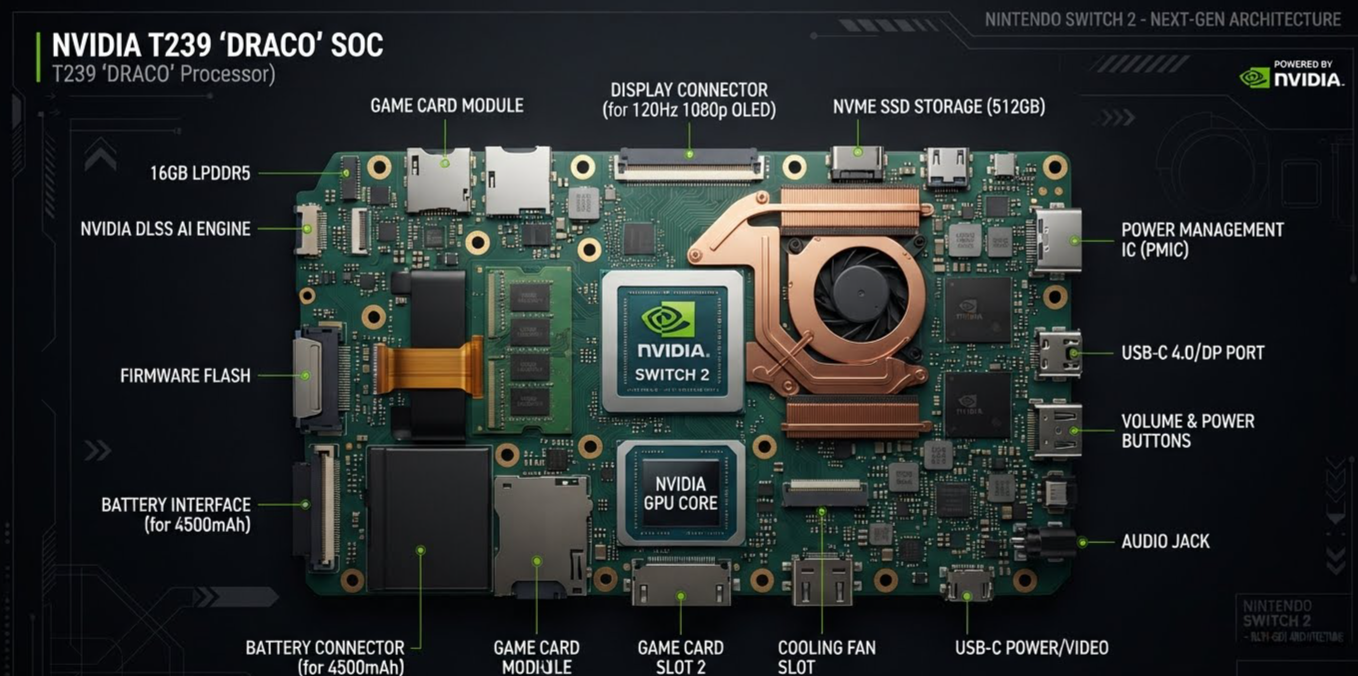
Nintendo officially describes the Switch 2's processor simply as a custom NVIDIA processor. Detailed technical analysis from Digital Foundry identifies the chip as the NVIDIA T239, featuring an eight-core ARM Cortex-A78C CPU and an Ampere-based GPU.
The T239 is important because it combines several different technologies into one system-on-chip.
Instead of having separate desktop-style components, Switch 2 puts its:
- CPU
- GPU
- memory controller
- AI hardware
- ray-tracing hardware
into a highly integrated platform.
That approach is particularly useful for a handheld because Nintendo has to balance performance, heat, battery life and size.
📊 Switch 2 Hardware at a Glance
| Component | Nintendo Switch 2 |
|---|---|
| Processor | Custom NVIDIA SoC / T239 |
| CPU | 8× ARM Cortex-A78C |
| Developer CPU cores | 6 |
| GPU architecture | NVIDIA Ampere |
| CUDA cores | 1,536 |
| System memory | 12GB LPDDR5X |
| Memory available to games | Approximately 9GB |
| Handheld memory bandwidth | ~68GB/s |
| Docked memory bandwidth | ~102GB/s |
| Internal storage | 256GB UFS |
| Handheld screen | 7.9-inch 1080p LCD |
| HDR | HDR10 |
| Refresh rate | Up to 120Hz |
| Maximum TV output | 4K/60 |
| Upscaling | NVIDIA DLSS |
Nintendo confirms the 7.9-inch display, 1080p resolution, HDR10, VRR up to 120Hz and 256GB of internal storage, while detailed T239 specifications have been documented by Digital Foundry and other technical analyses.
🧠 The CPU: A Huge Step Forward
The original Switch used four ARM Cortex-A57 CPU cores.
Switch 2 moves to eight Cortex-A78C cores, although two are reserved for system functions, leaving six for games and applications.
That is important for modern open-world games.
A game like Elden Ring isn't demanding only because of graphics.
The CPU also has to deal with:
- Enemy AI
- Physics
- NPC behavior
- World streaming
- Animation
- Game logic
- Object management
- Background systems
A stronger CPU gives developers considerably more room to manage those systems.
🎮 The Ampere GPU
The GPU is where the Switch 2 becomes particularly interesting.
The system uses NVIDIA's Ampere architecture and includes 1,536 CUDA cores. That's a dramatic increase over the 256 CUDA cores in the original Switch's Tegra X1 GPU.
The GPU also includes dedicated hardware for:
AI processing
and
real-time ray tracing.
NVIDIA says the Switch 2's GPU includes dedicated Tensor Cores and RT Cores, giving developers access to technologies such as DLSS and hardware-accelerated ray tracing.
💾 Why 12GB of RAM Matters
Memory might be one of the most important upgrades in the entire system.
Switch 2 has 12GB of LPDDR5X memory, compared with just 4GB in the original Switch. Around 3GB is reserved for system functions, leaving roughly 9GB for games.
That extra memory gives developers more room for:
- Higher-resolution textures
- Larger environments
- More detailed character models
- Bigger streaming buffers
- More complex game worlds
- Modern rendering techniques
For an open-world game such as Elden Ring, memory is particularly important because the game constantly needs to stream environmental assets as the player moves through the Lands Between.
🚀 The Secret Weapon: DLSS
Raw GPU power isn't the entire story.
One of Switch 2's biggest advantages is NVIDIA DLSS.
DLSS uses machine-learning hardware to reconstruct a higher-resolution image from a lower-resolution render. NVIDIA describes DLSS Super Resolution as a technology that uses lower-resolution frames, motion information and previous-frame data to produce a higher-resolution output.
This creates an important performance strategy:
Render fewer pixels
↓
Use AI reconstruction
↓
Produce a sharper final image
↓
Save GPU resources
That's extremely useful on a handheld.
Instead of forcing the GPU to render every frame at the display's full resolution, developers can spend those saved resources on other aspects of the game.
⚡ TECH TIP: DLSS isn't magic that turns a handheld GPU into a PS5. Its real advantage is allowing developers to make smarter compromises between internal resolution, image quality and GPU workload.
🌟 Ray Tracing on a Handheld
Switch 2 also supports hardware-accelerated ray tracing.
NVIDIA says the console includes dedicated RT Cores designed to accelerate real-time ray-traced lighting, reflections and shadows.
That doesn't mean every Switch 2 game will suddenly use heavy ray tracing.
Developers still have to decide whether the visual improvement is worth the performance cost.
But having the hardware available gives developers another option.
For a handheld console, that is significant.
⚔️ How Elden Ring Runs on Switch 2
Now we reach the most interesting test case.
Elden Ring: Tarnished Edition includes the original game, Shadow of the Erdtree, and additional character customization content. Nintendo lists the Switch 2 release date as August 28, 2026.
The game is a demanding test because it combines:
- A huge open world
- Large enemy encounters
- Dense environments
- Long-distance rendering
- Complex lighting
- Detailed character models
- Physics
- Extensive animation
- Large boss fights
And yet the Switch 2 version delivers the complete game in handheld form.
Recent reviews generally describe the final port as a solid 30 FPS experience, with some compromises in visual detail and occasional performance drops in especially demanding scenes.
That's a considerably better outcome than some early demonstrations suggested.
🔧 Why Optimization Matters More Than Raw Power
Here's the part that often gets lost in hardware discussions.
A console doesn't need to reproduce a PC game's settings one-for-one.
Developers can optimize the game specifically for the hardware.
For Elden Ring, that can mean carefully balancing:
Texture quality
Shadow quality
Draw distance
Effects
Resolution
CPU workload
GPU workload
=
Stable performance
The Switch 2 doesn't need to render Elden Ring exactly like a high-end gaming PC.
It needs to deliver an experience that looks good and plays consistently on the hardware available.
That's a very different engineering challenge.
📈 Switch 2 Performance Strategy
Chart Title: How Switch 2 Balances Performance
| Technique | What It Saves | What Players Gain |
|---|---|---|
| Lower internal resolution | GPU workload | Higher performance |
| DLSS | Rendering cost | Sharper output |
| Dynamic visual settings | GPU/CPU resources | More stable frame rate |
| Memory optimization | RAM bandwidth/capacity | Larger worlds |
| Asset streaming | Memory usage | Open-world scale |
| Console-specific optimization | CPU/GPU workload | Better consistency |
Chart note: This is an editorial explanation of the main optimization techniques, not measured benchmark data.
📊 GRAPH TO ADD TO YOUR CMS
Graph title: Switch 2 Hardware Improvements vs Original Switch
Use:
- CPU cores: 4 → 8
- CUDA cores: 256 → 1,536
- System RAM: 4GB → 12GB
- Memory bandwidth: ~25.6GB/s docked → ~102GB/s docked
The comparison figures are based on published Switch 2 technical specifications.
🏗️ Can Switch 2 Handle More Next-Gen Ports?
This is where things get exciting.
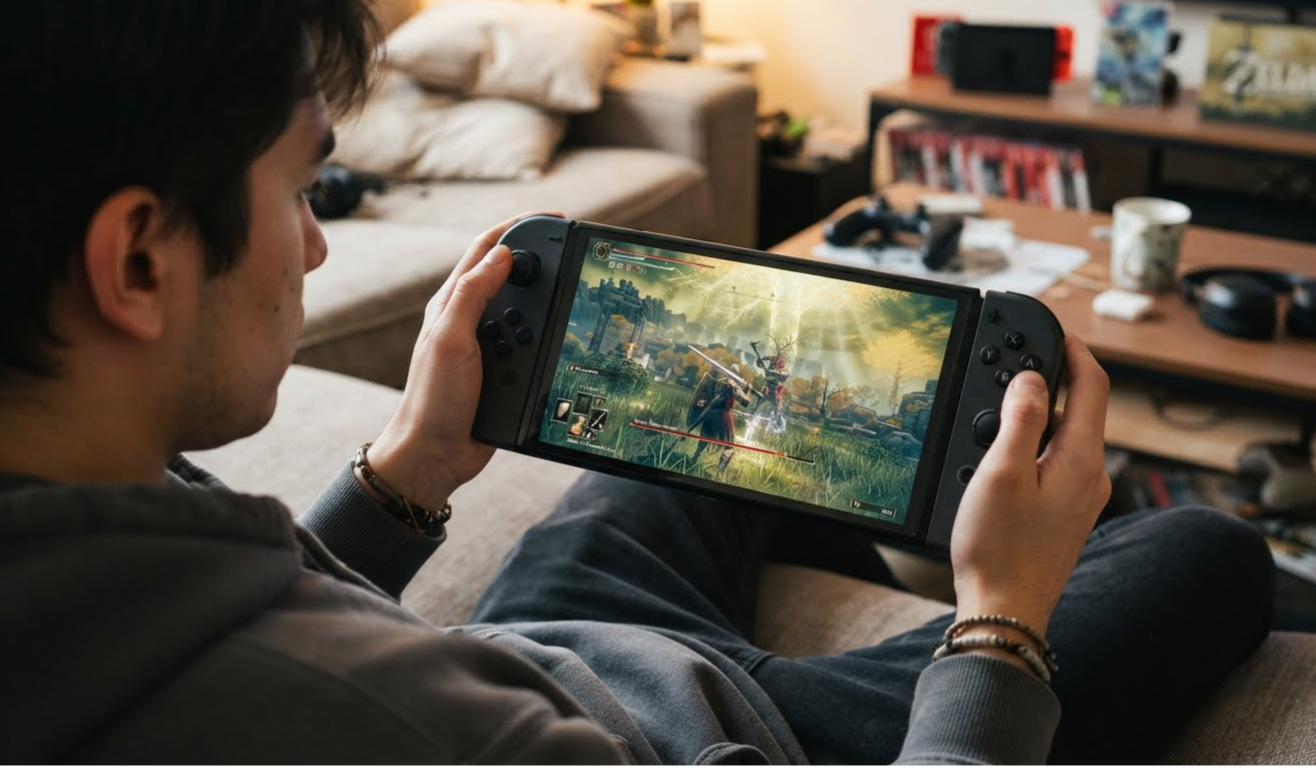
If Elden Ring can be adapted successfully, developers have a much larger target audience for ambitious Switch 2 ports.
Nintendo itself has positioned Switch 2 as a platform capable of handling games such as Cyberpunk 2077, Final Fantasy VII Remake, Street Fighter 6, Hogwarts Legacy, Borderlands 4 and Elden Ring.
That doesn't mean every game will run identically.
Some games will require major compromises.
Others may target 30 FPS instead of 60 FPS.
Some may use aggressive dynamic resolution.
And certain games simply won't scale well to the hardware.
But the ceiling has clearly moved upward.
🎯 The Real Question: Is T239 Enough?
Yes — but with conditions.
The NVIDIA T239 isn't powerful enough to make Switch 2 equivalent to a modern high-end gaming PC.
It doesn't need to be.
Nintendo's strategy is based on efficiency rather than brute force.
The combination of:
- 1,536 CUDA cores
- Ampere architecture
- 12GB memory
- Faster memory bandwidth
- Tensor Cores
- RT Cores
- DLSS
- A stronger CPU
gives developers significantly more flexibility than the original Switch.
The result is a machine capable of running games that previously would have seemed unrealistic for a Nintendo handheld.
⚠️ The Biggest Hardware Limitation
The biggest limitation isn't necessarily the GPU.
It's power and thermals.
A handheld has to operate within a much smaller power envelope than a desktop PC or home console.
That's why Switch 2 has different GPU clock speeds between handheld and docked operation. Detailed specifications show substantially higher GPU and memory performance when docked.
This creates a fundamental trade-off:
Handheld
🔋 Lower power
🎒 Portable
🌡️ Lower thermal budget
🎮 Lower GPU performance
Docked
⚡ Higher performance
🖥️ Larger display
🔥 More thermal/power headroom
🎮 Higher GPU clocks
Developers therefore have to build games that can scale between two very different operating conditions.
🔮 What This Means for the Future of Switch 2
The real significance of Switch 2 isn't simply that it can run Elden Ring.
It's what Elden Ring suggests about the future.
If developers can successfully optimize large open-world games for the platform, we could see more ambitious ports arriving throughout the generation.
The combination of NVIDIA technology and Nintendo's fixed hardware environment gives developers something PCs don't:
A single hardware target.
Once developers understand the system's limitations, they can optimize specifically around them.
That's exactly what happened with previous console generations.
🧠 Switch 2 vs Original Switch
| Feature | Nintendo Switch | Switch 2 |
|---|---|---|
| CPU architecture | ARM Cortex-A57 | ARM Cortex-A78C |
| CPU cores | 4 | 8 |
| GPU architecture | Maxwell | Ampere |
| CUDA cores | 256 | 1,536 |
| RAM | 4GB | 12GB |
| Storage | 32GB / 64GB models | 256GB |
| Handheld display | 720p | 1080p |
| HDR | No | Yes |
| DLSS | No | Yes |
| Hardware ray tracing | No | Yes |
The generational difference is substantial, particularly on the GPU and memory side.
🏆 Final Verdict
The Switch 2 hardware isn't designed to win a raw-performance battle against the PS5, Xbox Series X or high-end gaming PCs.
Instead, Nintendo has built a system around smart efficiency.
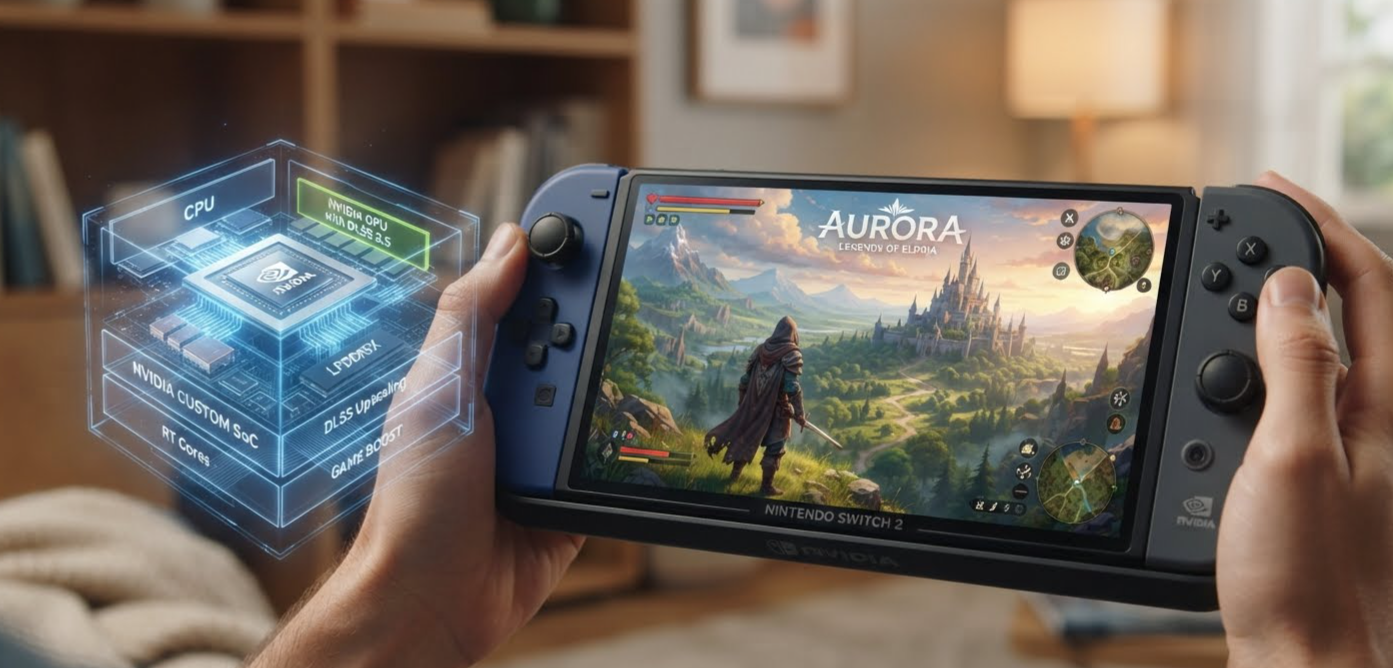
The NVIDIA T239 provides a major GPU and CPU upgrade, while 12GB of memory gives developers far more room for modern games. DLSS adds another important weapon by allowing games to reconstruct higher-resolution images without rendering every pixel at full cost.
And Elden Ring: Tarnished Edition is one of the clearest demonstrations yet of what this strategy can achieve.
The game isn't running without compromises. It targets 30 FPS and makes visual concessions compared with more powerful consoles, with occasional drops in demanding situations. But the fact that the complete open-world RPG and Shadow of the Erdtree can now be played natively on Nintendo's hybrid platform is impressive.
So, is the T239 enough for next-gen ports?
For the right game, absolutely.
The bigger question is how aggressively developers are willing to optimize for it.
And if Elden Ring is any indication, Switch 2 could become one of the most interesting third-party platforms of this generation.
🔗 Recommended Links
Official Nintendo Switch 2 Technical Specifications:
Nintendo Switch 2 Tech Specs
NVIDIA's Switch 2 Technology Breakdown:
NVIDIA — Nintendo Switch 2, DLSS and 4K Gaming
Official Elden Ring: Tarnished Edition:
Nintendo — ELDEN RING Tarnished Edition
Switch 2 Launch & Hardware Overview:
Nintendo — Switch 2 Official Announcement
](/_next/image?url=https%3A%2F%2Fcdn.mos.cms.futurecdn.net%2FeexQizhxGdny87wQtfrswd-1920-80.jpg&w=3840&q=75)
Comments
Sign in to join the conversation
Sign inNo comments yet
Be the first to share your thoughts!