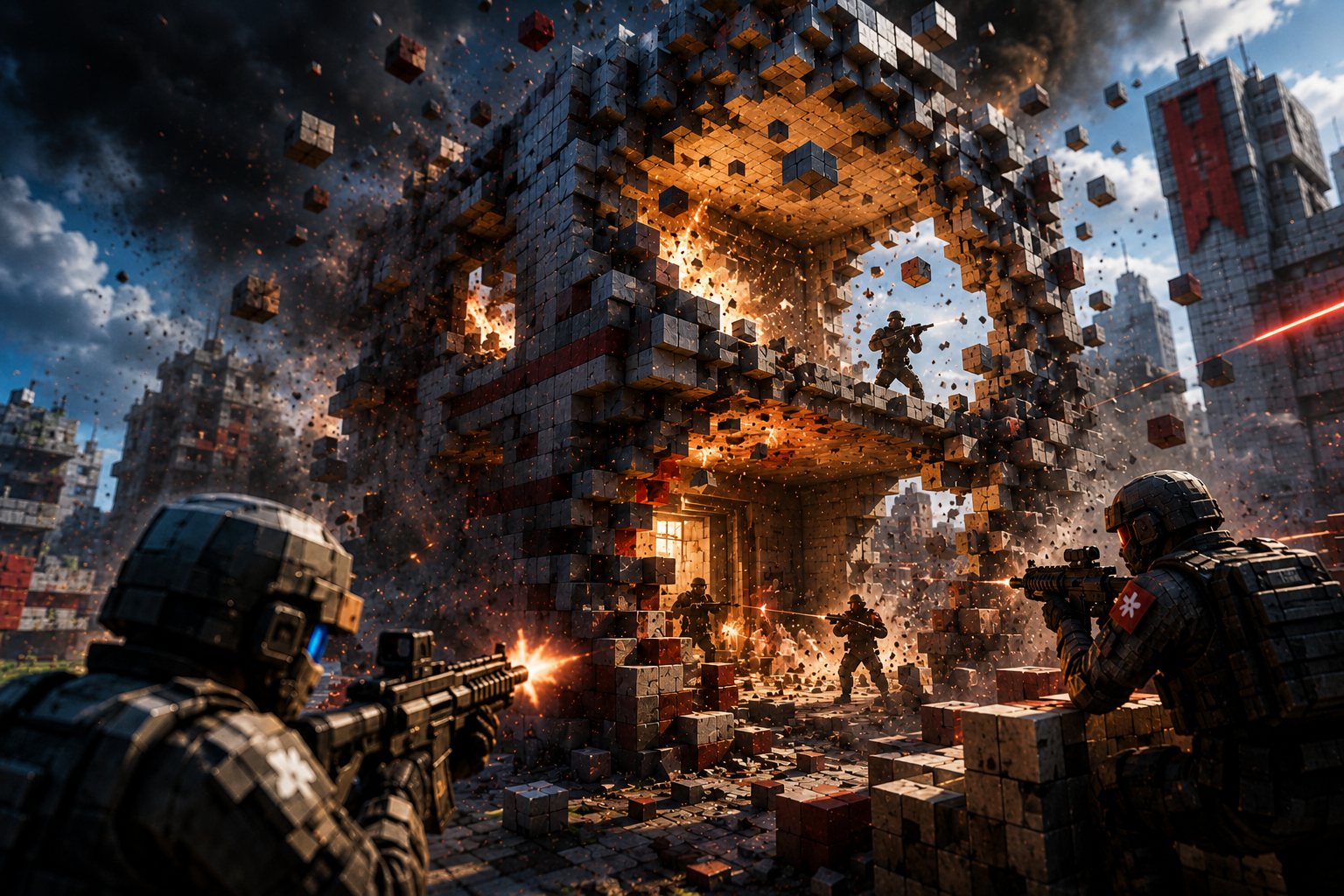

Real-Time Voxel Demolition: Why Competitive Shooters Are Reviving Total Destruction
For years, multiplayer shooters treated their maps like permanent pieces of scenery.
Walls were cover.
Buildings were landmarks.
Floors were floors.
You could shoot through some objects, break a few windows, and occasionally destroy a building during a scripted event—but the battlefield itself rarely changed in meaningful ways.
That philosophy is changing.
Games such as The Finals, Battlefield 6, Teardown, and upcoming voxel shooters are pushing destruction back toward the center of multiplayer design. The Finals, for example, is built around fully destructible arenas, while Battlefield 6 markets its "Tactical Destruction" as a strategic feature.
The bigger shift isn't simply more explosions.
It's the idea that destruction can become part of competitive strategy.
📑 Table of Contents
- What Is Voxel Destruction?
- From Visual Destruction to Gameplay Destruction
- Why Competitive Shooters Want Destructible Maps
- The Finals Changed the Conversation
- Battlefield 6 Takes a More Controlled Approach
- Teardown Brings Destruction Into Multiplayer
- The New Wave of Voxel Shooters
- Why Total Destruction Is Difficult
- Destruction Could Change Competitive Meta
- The Future of Destructible FPS Maps
- Final Thoughts
💡 KEY IDEA: The most important evolution isn't making buildings explode. It's allowing players to change the tactical geometry of a match by destroying cover, opening routes, creating new sightlines, or forcing opponents out of defensive positions.
🧱 What Is Voxel Destruction?
A voxel is essentially a 3D equivalent of a pixel.
Instead of representing an image with individual pixels, voxel-based systems can represent three-dimensional space using small volumetric elements.
In games, this technology can be used to create environments that can be modified or destroyed dynamically.
Instead of:
Wall → Destroyed → Predefined animation
you can potentially have:
Wall → Damaged → Partially destroyed → Collapses → New opening
That distinction is important.
The environment isn't simply playing a destruction animation.
The environment is changing.
💥 From Visual Destruction to Gameplay Destruction
Destruction has existed in shooters for decades.
But there's a huge difference between destruction as spectacle and destruction as gameplay.
A scripted building collapse looks impressive.
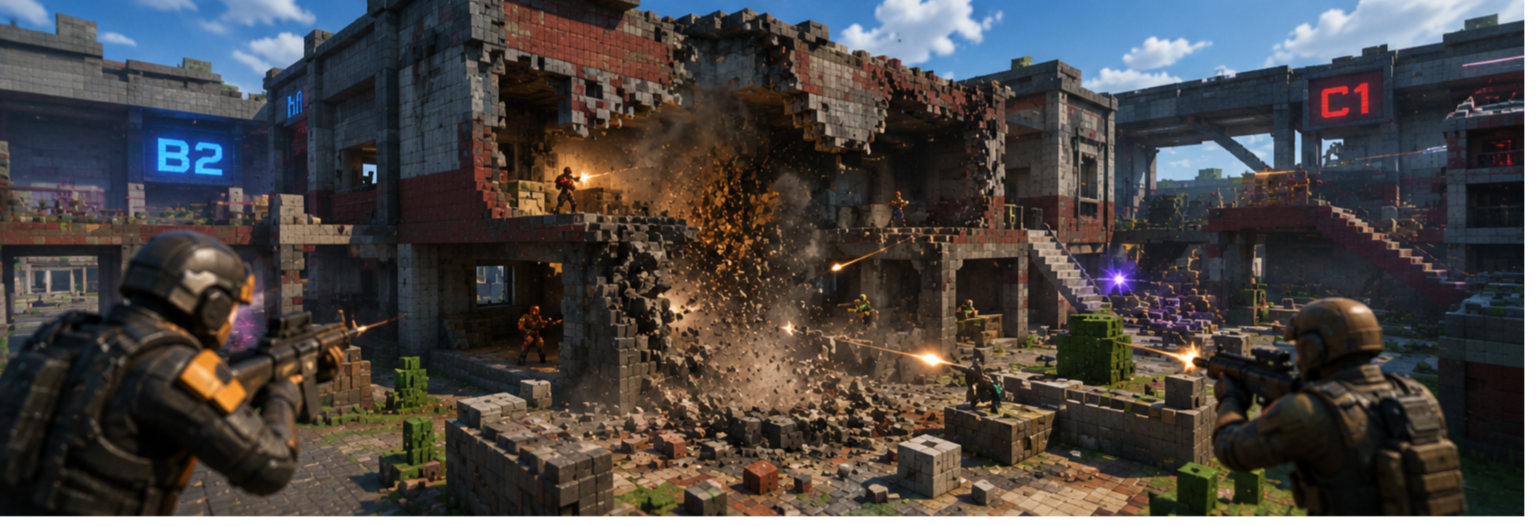
A player destroying a wall because an enemy sniper is hiding behind it is strategically meaningful.
That's the direction modern multiplayer shooters are exploring.
Imagine you're defending an objective.
The enemy team is approaching through the main entrance.
Instead of taking the obvious gunfight, your teammate destroys part of the building.
Suddenly:
- A new entrance appears.
- The enemy's cover disappears.
- A new sightline opens.
- Your squad can attack from another angle.
The destruction has now become a tactical decision.
🎯 Why Competitive Shooters Want Destructible Maps
Competitive shooters are built around information.
Players learn:
- Map layouts
- Choke points
- Sightlines
- Cover positions
- Rotation routes
- Objective locations
- Defensive positions
But highly destructible environments introduce another variable:
The map itself can change.
That makes every match less predictable.
A familiar building might have three entrances at the start of a round.
Five minutes later, it could have:
Six entrances.
Or none.
That creates a constantly changing tactical puzzle.
🏆 The Finals Changed the Conversation
One of the clearest examples of destruction becoming a core multiplayer mechanic is The Finals.
Developed by Embark Studios, the shooter describes itself as a physics-driven FPS built around fully destructible virtual arenas.
That design changes how players think about combat.
A building isn't simply somewhere you fight.
The building itself can become a weapon.
Players can destroy structures to:
- Open new routes
- Remove enemy cover
- Collapse defensive positions
- Create unexpected attacks
- Escape dangerous situations
- Change objective areas
This creates situations that traditional FPS maps simply cannot reproduce.
🏙️ Destruction Creates Emergent Gameplay
The biggest advantage of real-time destruction is emergent gameplay.
Developers don't need to create every possible situation.
Instead, players create their own situations.
For example:
Enemy Squad Holds Building↓Player Destroys Wall↓New Sightline Appears↓Enemy Rotates↓Second Player Destroys Floor↓Objective Becomes Exposed↓Entire Strategy Changes
None of those individual decisions necessarily needs to be scripted.
The environment creates the possibilities.
That's what makes destruction particularly interesting in competitive games.
🪖 Battlefield 6 Takes a More Controlled Approach
Battlefield 6 represents another side of the destruction debate.
Rather than allowing absolutely everything to disappear, Battlefield Studios uses a system called Tactical Destruction.
EA describes it as a more reactive and consistent system designed to let players transform their surroundings for strategic advantages.
The distinction matters.
Complete destruction sounds exciting, but competitive games need some level of predictability.
If every building could disappear instantly, players could potentially destroy entire maps and eliminate the carefully designed lanes that make competitive matches readable.
Battlefield 6 therefore demonstrates an important design philosophy:
Destruction doesn't necessarily need to mean unlimited destruction.
It needs to mean useful destruction.
🧠 Why Predictability Still Matters
Competitive games depend on players being able to understand what's happening.
If a player enters a building, they need some expectation of:
- Where enemies could be
- What routes are available
- What cover exists
- What structures can collapse
Too much randomness can make skill harder to measure.
That's why Battlefield 6's approach focuses on consistent outcomes for its destructible structures. Reporting on the system notes that structures can collapse in predictable ways, allowing players to learn how destruction affects particular areas.
This creates an interesting middle ground:
Dynamic enough to create new strategies.
Predictable enough to reward mastery.
🧨 Teardown Brings Destruction Into Multiplayer
Another important development came from Teardown.
Tuxedo Labs announced an online multiplayer update that allows up to 12 players to experience its fully destructible environments together, including competitive modes and community-created content.
That's significant because Teardown was originally known for turning destruction into a puzzle-solving mechanic.
With multiplayer, the same technology becomes a social and competitive tool.
Players aren't simply destroying buildings for fun.
They're potentially destroying them against other players.
🔫 The New Wave of Voxel Shooters
The trend isn't limited to established franchises.
Several smaller multiplayer projects are experimenting with voxel destruction as their central gameplay identity.
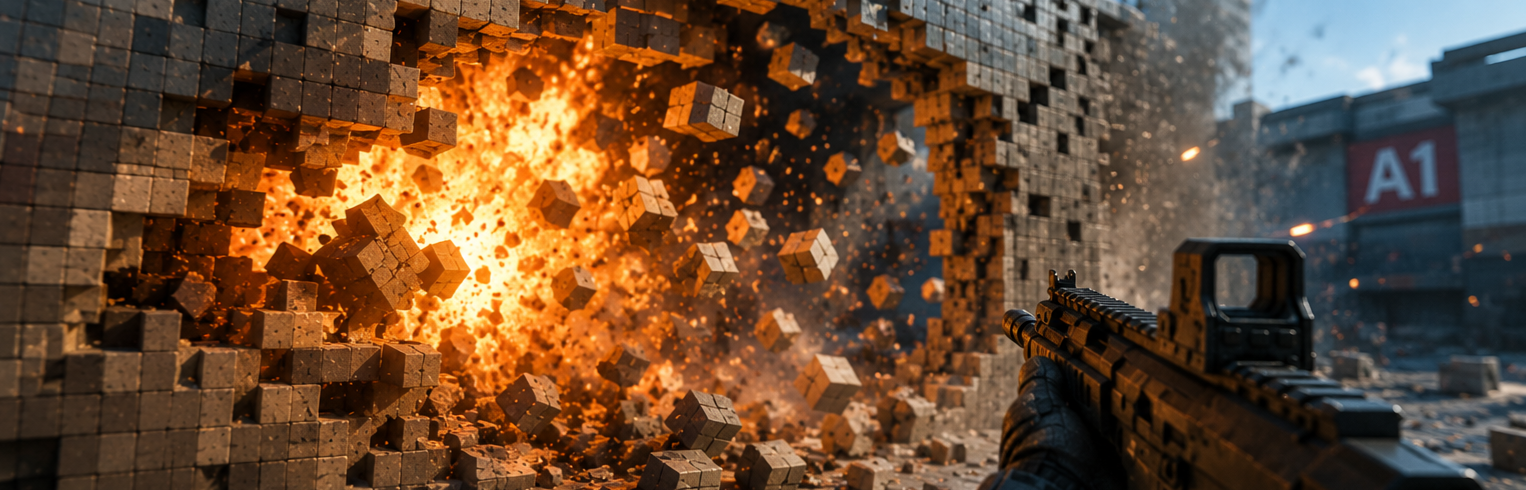
For example, Trenchblocks is planned as a multiplayer FPS where players can build forts, dig trenches, tunnel beneath enemy bases, and destroy terrain during Capture the Flag matches.
That's a very different concept from traditional shooters.
Instead of memorizing a fixed route toward the enemy base, players could potentially:
Build → Dig → Destroy → Attack
The map becomes something players can modify instead of something they simply navigate.
🌍 Why Terrain Destruction Could Be Even Bigger
Buildings are only the beginning.
Voxel technology can potentially affect:
- Dirt
- Sand
- Concrete
- Wood
- Stone
- Metal
- Water
- Terrain
That creates the possibility of shooters where players don't simply destroy buildings.
They reshape the battlefield itself.
Imagine a Capture the Flag match where a team digs a trench around its base.
The opposing team could:
Go over it.
Go around it.
Fill it.
Destroy the defensive wall.
Dig underneath it.
Suddenly, map knowledge becomes only one part of the skill equation.
📊 Destruction vs Traditional FPS Design
Chart Title: How Destruction Changes Competitive FPS Gameplay
| Gameplay Factor | Traditional FPS | Destructible FPS |
|---|---|---|
| Fixed map knowledge | 10 | 7 |
| Dynamic strategies | 5 | 10 |
| Predictability | 10 | 7 |
| Emergent gameplay | 4 | 10 |
| Tactical creativity | 6 | 10 |
| Environmental interaction | 3 | 10 |
Chart description:
Editorial comparison of traditional fixed-map shooters and highly destructible competitive FPS design.
Note: These are editorial scores, not official game statistics.
⚙️ Why Total Destruction Is Technically Difficult
Making a wall disappear in a single-player demo is one thing.
Doing it while 20 players are shooting, moving, exploding and destroying the same environment simultaneously is another.
A multiplayer destruction system has to consider:
Physics
Debris needs to behave convincingly.
Performance
Thousands of objects can't destroy the frame rate.
Networking
Players need to see the same environmental changes.
Collision
New holes and destroyed surfaces must interact correctly with players and projectiles.
Server Synchronization
The server needs to keep everyone on the same version of the battlefield.
This is one reason why large-scale real-time destruction remains relatively rare.
A recent developer discussion around a voxel-based multiplayer project highlighted exactly this challenge: synchronizing destruction changes between players can be one of the hardest technical problems in an extraction-shooter environment.
🌐 The Networking Problem
Imagine Player A destroys a wall.
The server sees:
Wall destroyed.
Player B needs to see:
Wall destroyed.
Player C needs to see:
Wall destroyed.
And every player's collision, bullets, movement and line of sight need to agree.
If those states don't match, competitive gameplay becomes impossible.
This means voxel destruction isn't just a graphics feature.
It's a networking problem.
🧠 Destruction Could Change the Competitive Meta
Traditional FPS metas often revolve around:
Aim + Movement + Positioning + Map Knowledge
Destructible shooters add another skill:
Environmental manipulation.
The strongest players may eventually become experts at recognizing:
- Which walls are worth destroying
- Which structures provide valuable cover
- Where to create new sightlines
- When to collapse a building
- How to trap opponents
- How to manipulate objectives
- How to predict enemy rotations
That could create an entirely new form of competitive expertise.
🏗️ The Rise of "Soft" and "Hard" Destruction
Not every game needs full voxel simulation.
There are several levels of destruction:
Level 1 — Cosmetic
Windows break.
Furniture moves.
Walls receive visual damage.
Level 2 — Tactical
Walls and structures can be destroyed to create new routes.
Level 3 — Structural
Buildings can collapse based on damage and support.
Level 4 — Voxel
Individual sections of terrain or structures can be modified dynamically.
Level 5 — Total Simulation
Buildings, terrain, materials and environmental systems all react to player actions.
The industry appears to be experimenting across this entire spectrum.
🔥 Why Players Keep Coming Back to Destruction
There is also a psychological reason destruction works so well.
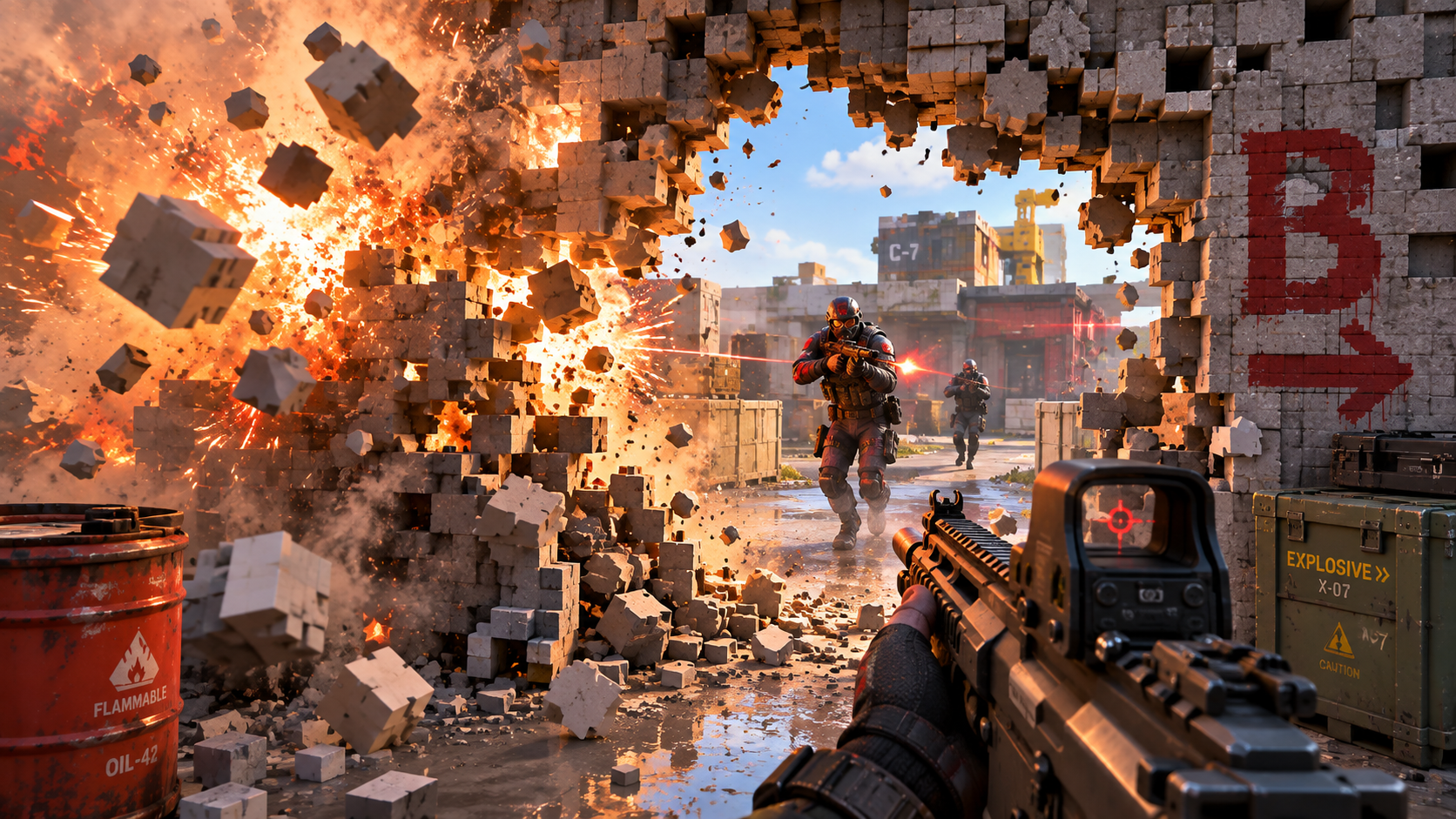
Breaking something feels satisfying.
But breaking something for a reason feels even better.
Destroying a building because it looks cool is fun.
Destroying a building because an enemy squad is hiding inside it?
That's gameplay.
The destruction becomes connected to the player's decision.
And because the environment can react differently depending on what players do, the same match can produce moments that developers never explicitly scripted.
🎮 The Future of Competitive Shooters
The future probably isn't going to be:
Every shooter must have completely destructible maps.
Instead, we're likely to see more games asking:
What if the environment was another gameplay system?
Battlefield 6 demonstrates controlled tactical destruction.
The Finals demonstrates destruction as a fundamental part of competitive arena combat.
Teardown demonstrates how fully destructible environments can move into multiplayer.
And projects such as Trenchblocks show how voxel destruction can be combined with building, digging and PvP objectives.
Together, these games point toward a broader design trend.
🚀 What Total Destruction Could Mean for Esports
If developers solve the technical problems, destructible environments could eventually become a major competitive differentiator.
Imagine an esports match where analysts aren't only discussing:
Which player has the best aim?
They're also discussing:
Which team understands the destruction meta?
Teams could develop specialized strategies around:
- Building collapses
- Destruction timing
- Defensive structures
- Alternative routes
- Environmental traps
- Objective manipulation
Maps would no longer have one permanent competitive layout.
They would have a starting layout.
And the players would determine what happens next.
🎯 Final Thoughts
Real-time voxel destruction is making the FPS environment important again.
For years, competitive shooters became increasingly focused on weapons, operators, abilities and progression systems.
Now, the battlefield itself is becoming part of the gameplay.
The most exciting possibility isn't simply watching a building collapse.
It's realizing that you caused it—and that the collapse changed the entire match.
Games like The Finals, Battlefield 6, Teardown, and upcoming voxel shooters show different approaches to the same idea: destruction can be more than visual spectacle. It can create new routes, remove cover, change objectives and force players to rethink their strategies.
The next generation of competitive shooters may not ask:
"Who controls the map?"
They may ask:
"Who controls what the map becomes?"
🔗 More Gaming Content
Explore more articles in our Gaming, Reviews and Tech sections.
You can also create an internal article about FPS Games to connect this story with your gaming wiki.
](/_next/image?url=https%3A%2F%2Fcdn.mos.cms.futurecdn.net%2FeexQizhxGdny87wQtfrswd-1920-80.jpg&w=3840&q=75)


Comments
Sign in to join the conversation
Sign inNo comments yet
Be the first to share your thoughts!