
Do you remember when playing PC games on the go meant carrying a gaming laptop that was basically a portable radiator?
You'd open it on a train, find a power outlet, balance a mouse somewhere, and hope nobody asked why the fans sounded like a helicopter.
That used to be the price of portable PC gaming.
Not anymore.
The handheld PC market has reached a point where we're no longer asking:
"Can this thing actually run PC games?"
We're asking something much more interesting:
"Why am I still carrying a laptop?"
The answer isn't completely straightforward. A gaming laptop still offers more raw performance, a larger display, better upgrade options, and a much more flexible desktop experience.
But the gap is changing.
And 2026's handhelds are making that gap uncomfortably small.
🎮 The Handheld Has Stopped Being a Compromise
The original Steam Deck changed the conversation.
It proved that a device small enough to hold with both hands could run a huge library of PC games while offering something gaming laptops couldn't:
- Instant portability.
- But there was always a trade off.
- You accepted lower settings.
- Lower resolution.
- Lower frame rates.
- And sometimes a little tinkering.
- The new generation is different.
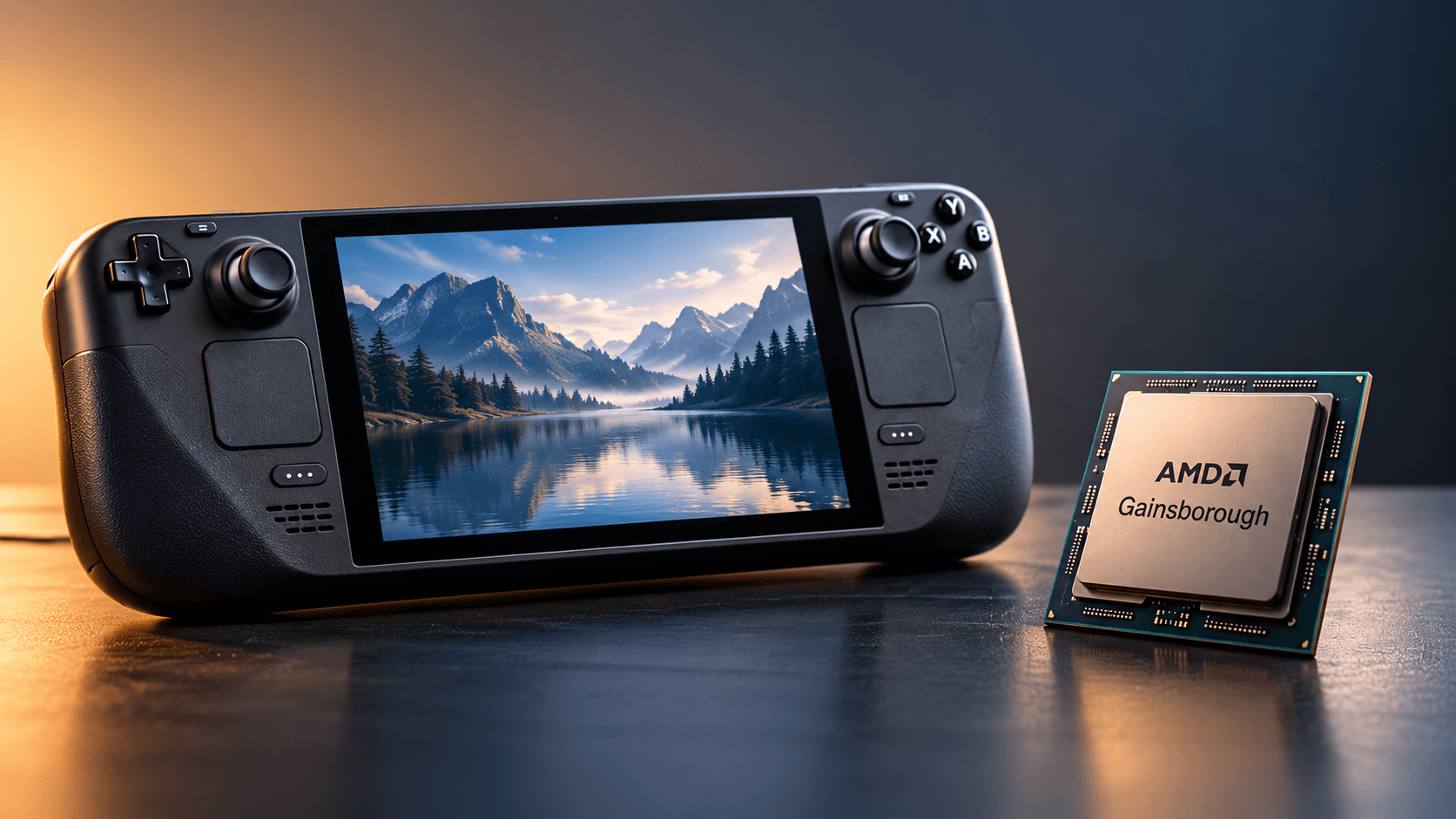
Machines like the ROG Xbox Ally X are being designed around much more powerful modern laptop class silicon, while newer Lenovo and MSI handhelds are pushing screen quality, efficiency, connectivity, and operating-system design much further.
The question is no longer whether handhelds can play big games.
It's how much performance you're willing to sacrifice for portability.
🟢 The ROG Xbox Ally X Is the Handheld Everyone Is Watching
Microsoft's biggest move into handheld gaming isn't actually a traditional Xbox.
It's a partnership with ASUS.
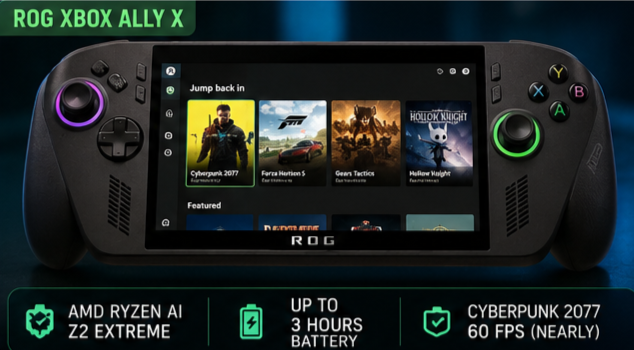
The result is the ROG Xbox Ally X, powered by AMD's Ryzen AI Z2 Extreme.
And this is where handheld gaming starts getting genuinely ridiculous.
ASUS itself lists Cyberpunk 2077 at an average 41 FPS at 1080p in Turbo mode, while its battery testing records up to 2.7 hours of heavy AAA gaming under its specified test conditions.
That's important because those numbers aren't describing a lightweight indie game.
They're describing one of the most demanding mainstream PC games around.
Now, 41 FPS isn't exactly desktop-GPU territory.
But we're talking about a machine you can literally hold in your hands.
And that's the point.
🔋 But Here's the Catch: Physics Still Exists
Let's not get carried away.
Handheld gaming hasn't defeated the laws of physics.
That 2.7 hour heavy gaming figure from ASUS is measured under a specific test configuration. Crank the settings, increase the power budget, turn up brightness, and battery life can fall quickly.
That's the problem every handheld still faces:
Performance requires power.
A laptop can carry a much larger battery.
A desktop doesn't care about battery life at all.
A handheld has to balance:
Performance + heat + noise + battery + weight
inside something small enough to fit in a backpack.
And honestly?
The fact that we're even debating these compromises shows how far the technology has come.
🟡 Lenovo Has a Different Answer
ASUS isn't the only company attacking the problem.
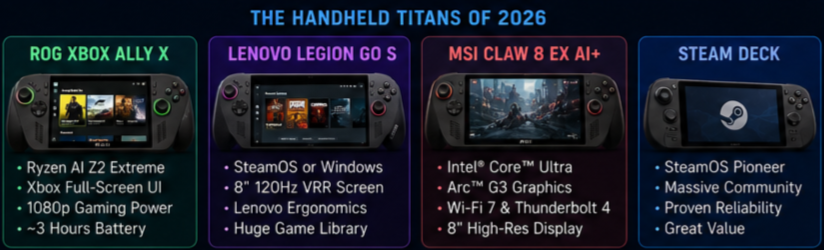
Lenovo has been experimenting with the Legion Go family, and the company's strategy is particularly interesting because it's targeting both Windows and SteamOS users.
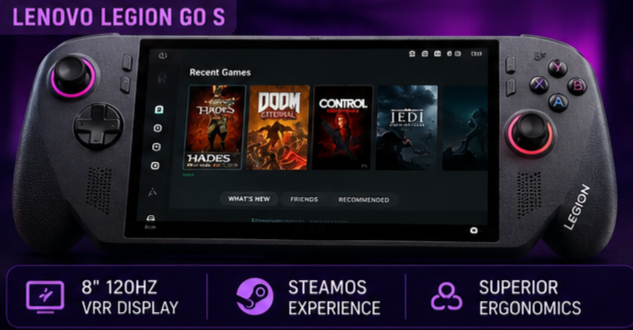
The Legion Go S gives players an 8-inch, 1920×1200 display with a 120Hz VRR panel, while SteamOS models are designed around a much more console-like interface.
And that's a big deal.
Because hardware isn't the only thing holding handheld PCs back.
Software is.
🖥️ Windows Is Powerful. Windows Is Also Windows.
This is one of the biggest differences between a handheld PC and a traditional console.
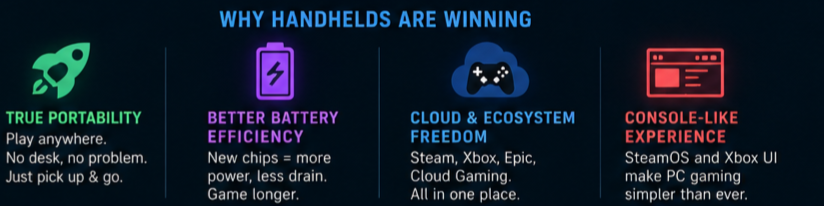
Windows gives you almost unlimited freedom.
- Steam.
- Game Pass.
- Epic.
- Battle.net.
- Launchers.
- Mods.
- Third-party software.
- Desktop applications.
That's fantastic.
Until you're trying to navigate a desktop interface with a controller on an eight-inch screen.
This is where SteamOS has a major advantage.
The interface is built around gaming rather than desktop computing.
Lenovo's SteamOS equipped Legion Go S models provide access to Steam Cloud, Steam Chat, game recording, and the full Steam library through an interface designed specifically for handheld play.
And suddenly the handheld stops feeling like:
"A tiny Windows laptop."
It starts feeling like:
"A console that happens to be a PC."
That's a huge distinction.
🔥 MSI Is Going After Raw Performance Too
Then there's MSI.
The company's Claw 8 EX AI+ is another sign that manufacturers aren't treating handhelds as secondary gaming devices anymore.
MSI says the machine is built around Intel's new Arc G3 Extreme handheld architecture and focuses heavily on performance-per-watt.
And it's not just about the processor.
The Claw 8 EX AI+ also brings features such as:
- An 8-inch high-resolution display
- High refresh rate
- Wi-Fi 7
- Thunderbolt 4 connectivity
- Modern wireless standards
MSI advertises Wi-Fi 7 connectivity with theoretical speeds up to 5.8 Gbps and 2ms latency under ideal conditions.
That kind of specification list sounds less like a traditional handheld and more like a tiny premium PC.
Which is exactly where the market is heading.
🥊 So... Is the Steam Deck Losing?
This is where things get complicated.
Because saying "Steam Deck is dead" would be missing the point.
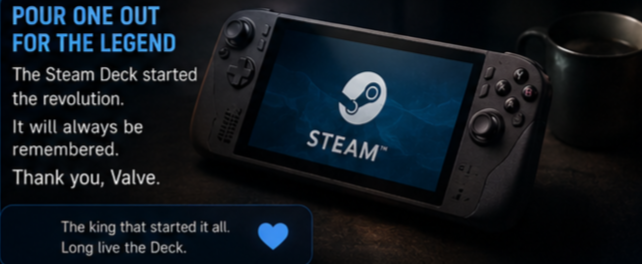
The original Steam Deck created this market.
It proved that millions of players wanted their Steam libraries in handheld form.
But hardware eventually gets old.
And the performance ceiling of the original generation is becoming increasingly obvious compared with modern handheld APUs.
Recent sales data even suggests the Steam Deck has faced stronger competition: Ars Technica reported that Steam Deck sales appeared to decline sharply after Valve's May 2026 price increase.
That doesn't mean Valve's idea failed.
Quite the opposite.
The idea won.
Everyone else just started chasing it.
💻 And That's Why Your Gaming Laptop Is Feeling Weird
Here's the really interesting part.
Imagine you already own a gaming laptop.
Maybe it has an RTX 3050.
Maybe it has a powerful Core i7 or Ryzen processor.
It can absolutely do things a handheld can't.
You have:
- A larger screen
- A real keyboard
- More ports
- Better sustained cooling
- More desktop flexibility
- Potentially much more GPU power
So why would you replace it?
For convenience.
That's the part laptops struggle to compete with.
A handheld can sit beside your television.
It can go into a backpack.
It can wake up almost instantly.
You can play on the couch.
You can continue the same save on a train.
Then connect it to a monitor when you get home.
And suddenly the device isn't just a portable PC.
It's your PC everywhere.
☁️ Then Cloud Gaming Enters the Picture
Hardware isn't the only thing changing.
Cloud gaming is making the idea of device-independent gaming increasingly normal.
Microsoft is pushing the Xbox ecosystem beyond dedicated consoles, while handhelds are becoming capable of accessing multiple storefronts and cloud services.
That creates a future where you aren't necessarily asking:
"What hardware can run this game?"
You're asking:
"Where do I want to play it?"
That's a much bigger shift.
Your local hardware handles what it can.
Cloud hardware handles what it can't.
And your saves move with you.
The boundaries between PC, console, handheld, and cloud become increasingly blurry.
🧠 The Real Battle Isn't Hardware
This is the part I think gets overlooked.
The handheld war isn't really about who has the fastest chip.
It's about friction.
Who gets you from:
Turn on → choose game → play
in the fewest possible steps?
That's where the Xbox Ally X becomes interesting.
That's where SteamOS becomes interesting.
That's where Microsoft's Xbox interface and Valve's software ecosystem become just as important as AMD's silicon.
Because nobody wants a handheld that technically runs everything but makes them fight Windows menus for ten minutes before the game starts.
Performance gets attention.
Convenience creates loyalty.
📊 The Handheld Battlefield
| Handheld | Biggest Advantage | Biggest Question |
|---|---|---|
| ROG Xbox Ally X | Powerful AMD hardware + Xbox experience | Battery life under heavy gaming |
| Lenovo Legion Go S | 8" 120Hz VRR + SteamOS option | Balancing size and performance |
| MSI Claw 8 EX AI+ | New Intel architecture + connectivity | Price and software maturity |
| Steam Deck | SteamOS ecosystem + established library | Aging performance |
The important takeaway?
There is no single winner yet.
They're attacking different problems.
🚂 The Laptop Isn't Dead. It's Just Under Pressure.
This is where I'd push back against the headline a little.
Your gaming laptop isn't obsolete.
Not even close.
A serious gaming laptop can still outperform these handhelds in sustained workloads.
It can run productivity software.
It can handle demanding creative workloads.
It can connect to multiple displays.
It can actually be comfortable for work.
And when you're sitting at a desk plugged into power?
The laptop still makes far more sense.
But the traditional argument that a laptop is automatically the best portable gaming machine is becoming much harder to defend.
Because portability used to mean:
"Take your laptop with you."
Now it can mean:
"Take your entire gaming ecosystem with you."
🚀 What Happens Next?
This is probably the most exciting part.
The hardware we're seeing today isn't the endpoint.
It's the beginning.
Imagine what happens when future handheld chips deliver:
- More GPU performance
- Better efficiency
- Larger batteries
- Better upscaling
- More mature SteamOS/Xbox software
- Faster cloud infrastructure
At that point, the distinction between a handheld and a conventional computer starts becoming difficult to explain.
And that's when gaming laptops could face their biggest challenge yet.
Not because handhelds become more powerful than laptops.
But because they become powerful enough.
🎮 The Bottom Line
The gaming laptop isn't obsolete.
But the reason you bought one might be.
For years, portable PC gaming meant accepting a bulky machine because you had no real alternative.
In 2026, you have alternatives.
The ROG Xbox Ally X is pushing handheld performance.
Lenovo is making SteamOS part of the mainstream handheld conversation.
MSI is pushing new performance and connectivity standards.
And the Steam Deck has already proven that this entire category has a massive audience.
The real revolution isn't that handhelds can finally run demanding games.
It's that they're becoming good enough that you don't care what machine is running the game anymore.
And honestly?
That's a much bigger deal.
The future of PC gaming might not fit on your desk.
It might fit in your backpack.

Comments
6Sign in to join the conversation
Sign in