

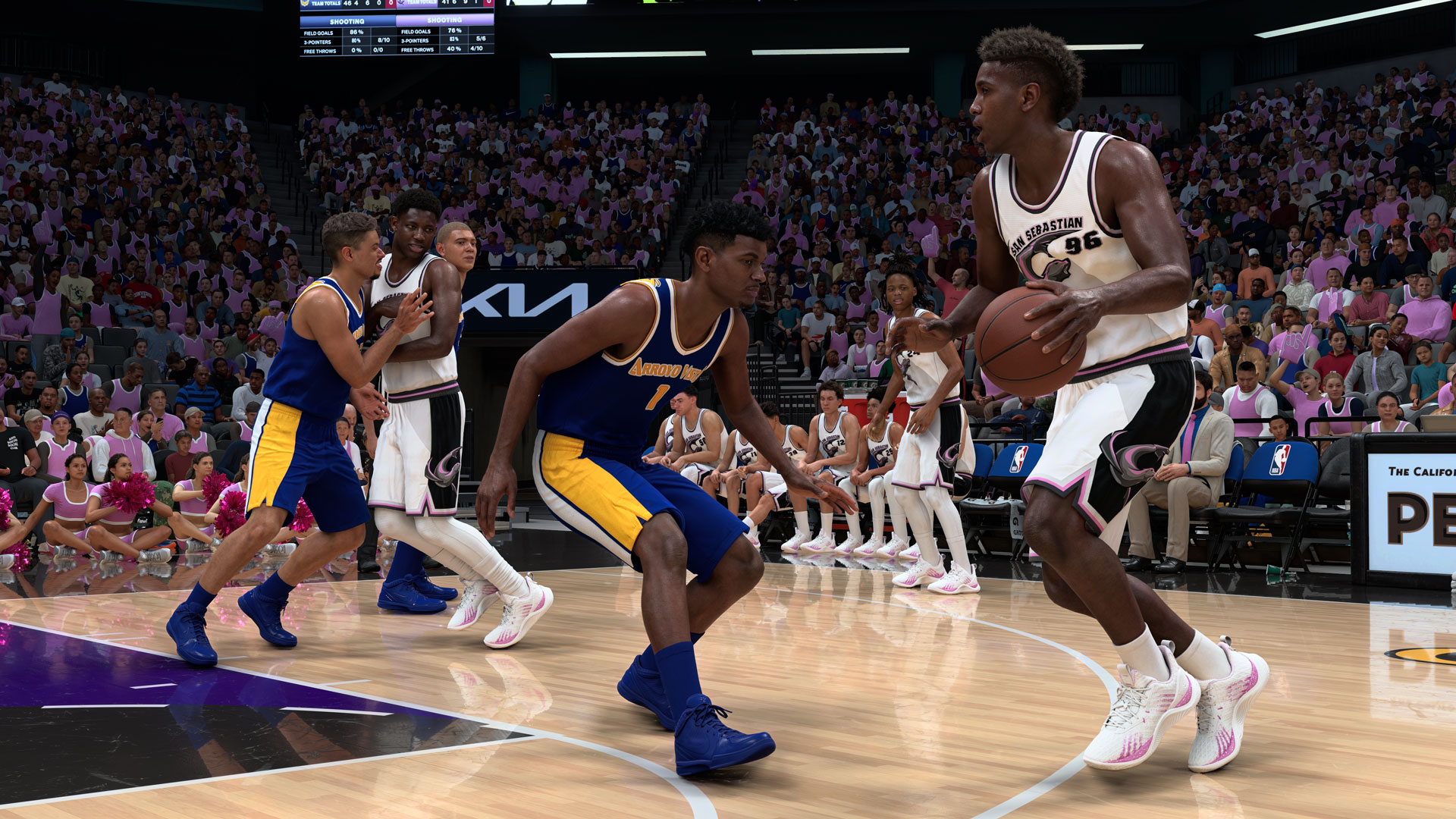
Basketball might be the perfect stress test for AI graphics.
Players rarely stand still. Faces move rapidly under changing arena lights. Jerseys stretch and fold. Hair reacts to movement. A camera can jump from a wide broadcast shot to a close-up of an athlete in seconds.
Now imagine asking an AI system to enhance all of that in real time.
That's exactly what NBA 2K27 is doing with Nvidia's DLSS 5.
The early September launch puts Nvidia's newest neural-rendering technology directly into one of gaming's most visually demanding genres. But basketball creates a unique challenge.
It's not enough for the technology to make a still screenshot look impressive.
It has to work while players sprint, spin, jump, collide, and change direction.
And that raises a fascinating question:
Can AI upscaling actually make a fast-moving sports game look more realistic without getting in the way?
DLSS 5 Isn't Just Another Upscaler
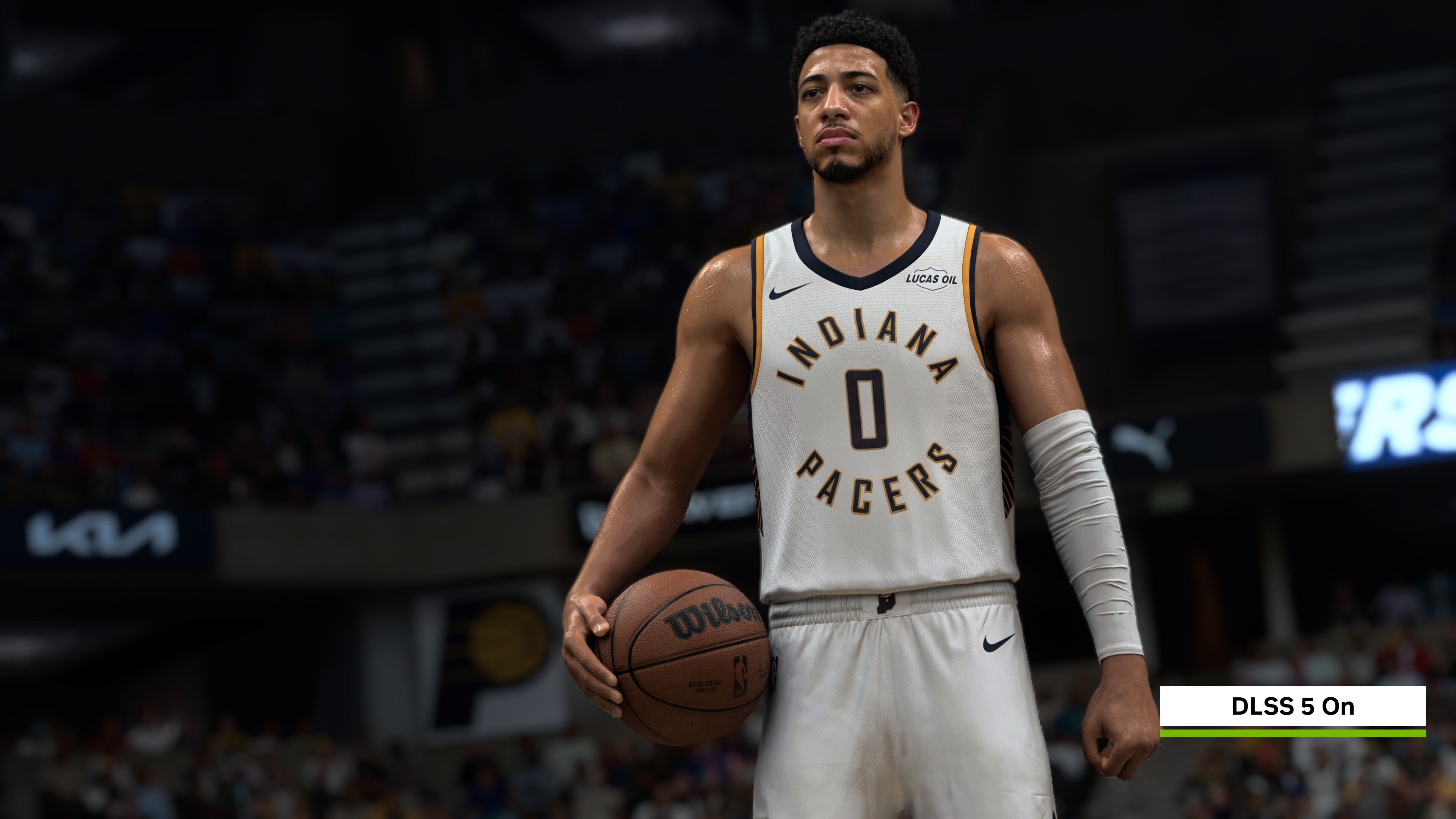
The biggest misunderstanding about DLSS 5 is right there in the word "upscaler."
Traditional upscaling is largely about producing a higher-resolution image from a lower-resolution input.
DLSS 5 goes further.
The technology uses neural rendering to enhance the visual information produced by the game engine. Instead of simply reconstructing missing pixels, the system can contribute additional detail to elements such as lighting, skin, hair, shadows, and materials.
Think of it less like enlarging a photograph and more like giving the rendering pipeline another artist.
The game's engine establishes the foundation.
The neural model then helps refine how that foundation looks.
That can mean:
- More convincing skin lighting
- More realistic hair illumination
- Stronger contact shadows
- Richer material responses
- More natural lighting interactions
- Greater perceived detail in characters and environments
And NBA 2K27 is an especially interesting test of whether that approach works during actual gameplay.
Why Basketball Is Such a Difficult Test
Sports games have a problem that many other genres don't.
Everything moves constantly.
A guard crosses over.
A defender changes direction.
A player jumps for a rebound.
Someone sets a screen.
The camera follows the ball.
The lighting changes as the camera moves.
All of this happens while the player expects the image to remain stable.
That makes temporal consistency incredibly important.
AI-enhanced graphics can't simply look good in individual frames. They have to remain visually consistent as those frames rapidly change.
In basketball, even a tiny visual mistake can become obvious.
A player's face can change as they turn.
A jersey can appear to shimmer.
Hair can behave strangely as the character moves.
Shadows can appear to jump.
The faster the action gets, the harder the AI has to work.
The Real Difference Is in the Details
The most impressive DLSS 5 improvements aren't necessarily the things you'll notice during a fast possession.
They're often the tiny details surrounding the action.
Take a player's face under arena lighting.
With conventional rendering, developers have to balance visual complexity against performance. Neural rendering can potentially supplement that process with more sophisticated lighting and material responses.
That matters because sports games are obsessed with authenticity.
The goal isn't to make players look like movie characters.
It's to make them look like real athletes being filmed under real arena lights.
The same applies to uniforms.
Basketball jerseys have different materials, textures, folds, and reflective properties. The hardwood has its own shine. Arena lights bounce across the court.
When all those elements work together, even small improvements can make the entire presentation feel more convincing.
Fast Player Animations Are the Ultimate Stress Test
Here's where things get interesting.
Imagine a player driving toward the basket.
Their face turns.
Their jersey moves.
Their arm crosses their body.
The basketball changes position.
A defender moves into frame.
The camera tracks the action.
Then the player jumps.
DLSS 5 has to enhance that scene without creating visual information that contradicts the game's underlying animation.
The game engine remains the foundation.
The neural system is effectively asking:
"Given everything the engine says is happening here, how can I make it look more realistic?"
That's very different from allowing an AI image generator to independently invent details.
The goal isn't imagination.
It's visual refinement.
This Could Be Where Sports Games Benefit Most
There is an argument that sports games may actually be among the best environments for this technology.
Why?
Because their visual target is extremely specific.
Developers know what an NBA player should look like.
They know the materials used for the hardwood.
They know how jerseys should behave.
They know what arena lighting is supposed to represent.
They have real-world reference material for virtually everything.
That gives neural rendering a strong foundation.
The more accurate the underlying game assets are, the more useful an enhancement layer can potentially become.
In other words:
AI can't rescue a bad foundation forever.
But when the foundation is already highly detailed, neural rendering has much more to work with.
The Catch: AI Doesn't Come Free
Here's where the DLSS 5 story becomes considerably more complicated.
More advanced rendering requires more computational resources.
And DLSS 5 isn't simply a free visual upgrade that every PC can switch on.
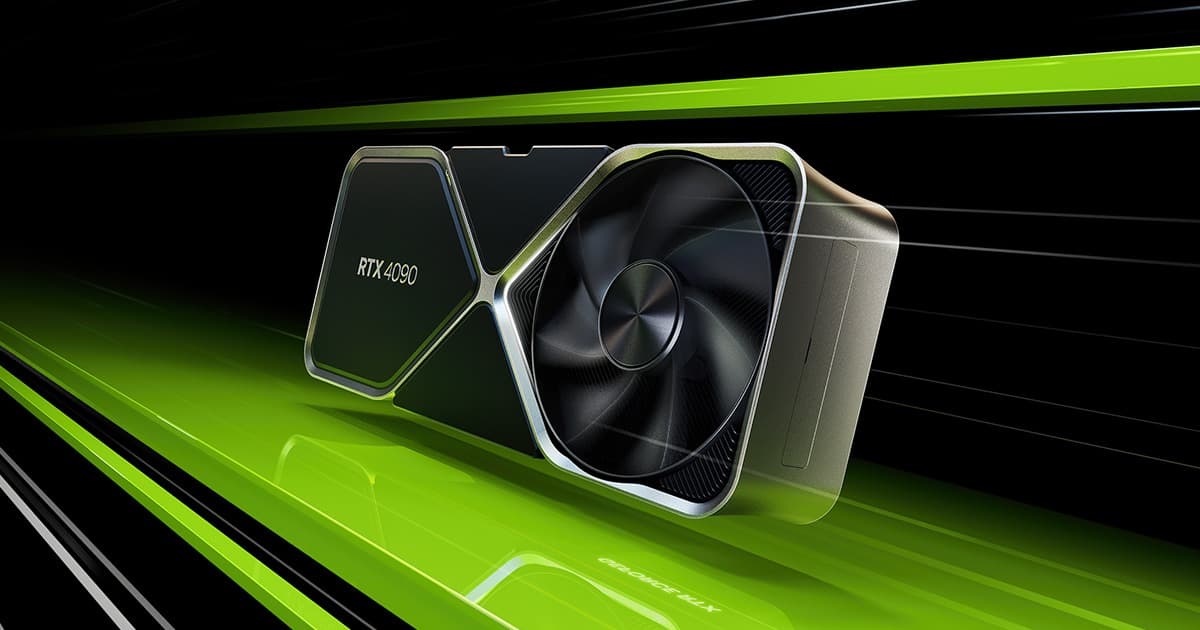
The feature is designed for Nvidia's latest generation of RTX hardware, meaning players need compatible hardware to experience the full implementation.
That creates an obvious divide.
Players with compatible GPUs get access to the neural-rendering experience.
Everyone else continues with the conventional rendering pipeline.
That's not necessarily a problem. Advanced graphics technologies have always pushed players toward newer hardware.
But it raises an important question for the future:
How expensive will photorealism become?
If every major visual leap requires increasingly powerful GPUs, the benefits of AI rendering could come with a significant hardware barrier.
Is More Realism Always Better?
There's another question that doesn't have a simple technical answer.
Do sports games actually need this much realism?
NBA 2K already lives in an uncanny valley of its own.
Players are recognizable. Faces are highly detailed. Broadcast presentation is designed to mimic television. The closer the game gets to reality, the more obvious small mistakes become.
A slightly strange face might have been invisible in an older basketball game.
In an ultra-realistic one, you notice it immediately.
That's why neural rendering could be both powerful and dangerous.
If it gets lighting, materials, and motion right, the effect can be spectacular.
If it gets something subtly wrong, the realism can make the mistake even more distracting.
The closer a game gets to reality, the less room it has for visual errors.
DLSS 5 Could Change What Developers Build
The biggest impact of DLSS 5 might not be what players see today.
It could be what developers decide to build tomorrow.
If neural rendering becomes a reliable part of the graphics pipeline, studios could potentially spend their performance budgets differently.
Instead of manually pushing every lighting interaction as far as possible, developers could rely on neural techniques to enhance certain elements.
That doesn't mean traditional rendering disappears.
It's more likely that the future will involve multiple technologies working together:
Rasterization + ray tracing + AI rendering.
That could become the new normal.
The question is no longer whether AI belongs in graphics.
It's how much of the graphics pipeline AI should handle.
Analysis / Why It Matters
NBA 2K27 is an unusually smart launch vehicle for DLSS 5.
It's visually demanding, highly recognizable, and filled with fast-moving characters. More importantly, players already understand what these athletes are supposed to look like.
That makes visual comparisons much easier.
If an arena looks better, you notice.
If a player's skin reacts more naturally to light, you notice.
If a jersey has better material definition, you notice.
But the real test is whether all of those improvements survive during gameplay.
A technology that looks incredible in a screenshot isn't automatically useful in a sports game.
Sports titles are judged while everything is moving.
That's why DLSS 5's ability to maintain visual consistency could be more important than its ability to produce a stunning still image.
If the system can keep fast-moving players visually coherent while improving lighting and material detail, then sports games could become one of the strongest use cases for neural rendering.
If it struggles with rapid motion, however, the technology risks becoming something players admire in replays but disable during actual games.
What Happens Next?
NBA 2K27 could be the beginning of a much bigger shift.
The obvious next step is seeing whether other sports franchises adopt similar technology.
Football games could use neural rendering to improve helmets, uniforms, grass, and stadium lighting.
Racing games could use it for reflective cars and rapidly changing environments.
Baseball games could benefit from more realistic player faces, stadium lighting, and detailed crowds.
The possibilities are obvious.
But developers will have to prove that the performance cost is worth the visual gain.
And that's probably the biggest question surrounding DLSS 5 right now.
Does the visual improvement justify the hardware and performance requirements?
If players consistently answer yes, AI-assisted rendering could become an expected feature rather than a technical novelty.
🎮 The Bottom Line
NBA 2K27 isn't just another game getting a graphics upgrade.
It's a glimpse at a different idea of what an upscaler can be.
DLSS 5 isn't simply trying to reconstruct what the game failed to render. It's trying to enhance what the game already rendered.
That's a potentially huge shift.
Basketball makes the experiment even more interesting because the technology has to operate while athletes sprint, turn, jump, collide, and constantly change position.
If DLSS 5 can make those moments look more natural without introducing distracting artifacts, sports games could become one of the best showcases for neural rendering.
But there's a catch: photorealism has a price, both in GPU power and in expectations.
NBA 2K27 is therefore less of a final verdict and more of a first experiment.
And if this experiment succeeds, the next generation of sports games may not just simulate how athletes move.
They may use AI to make every movement, shadow, face, and reflection look closer to the real thing.
What do you think? Does DLSS 5 make NBA 2K27 look meaningfully better, or would you rather developers spend that GPU power on gameplay and physics? Let us know in the comments.


Comments
Sign in to join the conversation
Sign inNo comments yet
Be the first to share your thoughts!