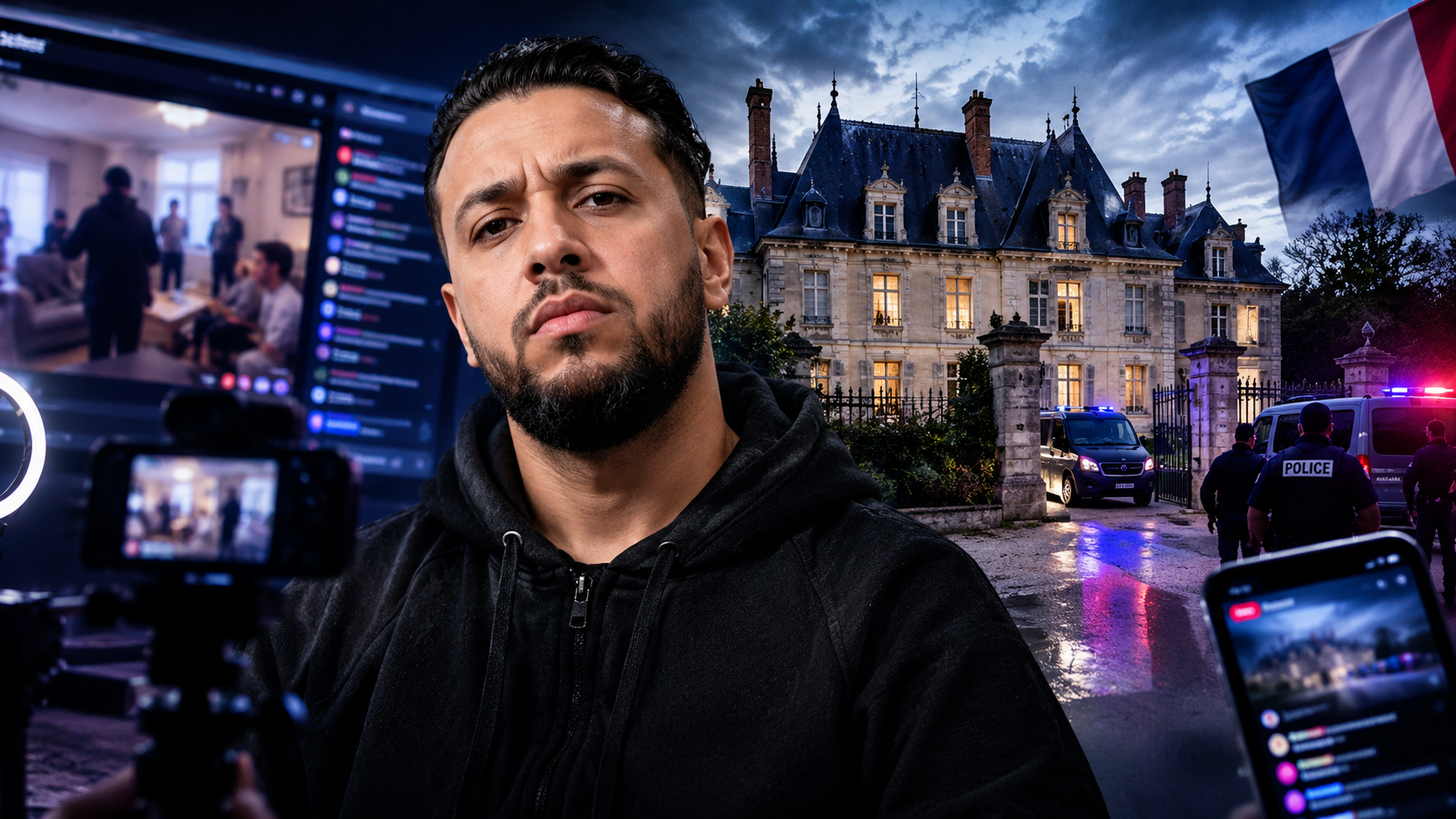

The Arrest of Mounim Sabhi: Why France is Cracking Down on 'Poverty Streaming'
A French livestreaming project that presented itself as a way of helping people in difficult circumstances has become the center of a criminal investigation.
Mounim Sabhi, the creator behind La Team du Château, was arrested on September 21, 2026, at the mansion near Blois where the project was filmed. Two days later, he was placed in pretrial detention while authorities continued investigating allegations involving violence, humiliation and the exploitation of vulnerable people. The case has put an uncomfortable spotlight on a growing problem in livestreaming: what happens when another person's poverty becomes the entertainment?
The case is especially notable because La Team du Château was not simply a conventional influencer channel. Sabhi housed people experiencing homelessness or other forms of vulnerability inside the property and broadcast aspects of their daily lives across TikTok, Kick and Twitch.
French authorities have been investigating the project since April 2026. According to the Blois prosecutor, the investigation concerns numerous alleged and reported acts of violence and humiliation involving people staying at the mansion, most of whom were described as being in a situation of significant vulnerability or precarity.
The allegations remain allegations. Sabhi has not been convicted of the offenses under investigation, and the legal proceedings are ongoing.
────────────────────────────────────────
QUICK TAKE
| Detail | What is currently known |
|---|---|
| Creator | Mounim Sabhi |
| Project | La Team du Château |
| Location | Saint-Gervais-la-Forêt, near Blois, France |
| Platforms | TikTok, Kick and Twitch |
| Investigation opened | April 2026 |
| Arrest / police custody | September 21, 2026 |
| Current status | Pretrial detention |
| Property | Mansion seized by judicial authorities |
| Court date reported | November 19, 2026 |
| Main allegations | Violence, humiliation and abuse of vulnerable people |
────────────────────────────────────────

────────────────────────────────────────
What Was La Team du Château?
La Team du Château began as an unusual social-media experiment built around a mansion outside Blois.
Sabhi presented the project as an attempt to give people in difficult circumstances a place to stay and help them deal with problems including homelessness and addiction. The concept was then turned into a reality-show-style stream in which residents appeared on camera and their interactions were broadcast online.
The project attracted hundreds of thousands of views across social platforms.
That combination is crucial to understanding why the case has attracted so much attention.
This was not simply someone filming a charity project occasionally. The residents' lives became the central content.
The audience could watch arguments, challenges and confrontations involving people living at the mansion, creating a format that blurred the line between social assistance, reality television and livestream entertainment.
A report by Le Parisien published in August described the project as a controversial reality-show format and documented allegations surrounding the treatment of residents.
Sabhi, for his part, had described the initiative as an attempt to help vulnerable people get off the streets and address addiction issues.
────────────────────────────────────────
The Investigation Began Months Before the Arrest
The September arrest did not come out of nowhere.
According to the Blois prosecutor, the investigation had been running since April 2026.
Authorities were examining what prosecutors described as numerous alleged acts of violence and humiliation involving people staying at the mansion.
The individuals involved were described by prosecutors as mostly being in situations of significant vulnerability or precarity.
That distinction matters.
The case is not simply about controversial livestream content.
French investigators are examining whether conduct surrounding the people appearing in those broadcasts crossed into criminal behavior.
Six alleged offenses have been reported in connection with the investigation, including violence against a vulnerable person resulting in an incapacity of no more than eight days, dissemination of recordings depicting intentional attacks on a person's physical integrity, and public incitement to hatred or violence based on disability or sex.
Authorities have also cited an offense involving fraudulent abuse of a person's state of vulnerability or dependency through pressure or methods capable of altering their judgment, including through digital communication.
According to the prosecutor's office as reported by French media, that particular offense can carry a sentence of up to five years in prison and a fine of up to €750,000.
These are allegations and charges being investigated by French authorities, not findings of guilt.
────────────────────────────────────────

────────────────────────────────────────
Why the Case Is Being Called 'Poverty Streaming'
"Poverty streaming" is not the formal legal name of the case.
It is a useful description of the broader content model at the center of the controversy.
Traditional reality television has spent decades putting ordinary people into controlled environments and turning their relationships into entertainment.
Livestreaming changes the equation.
There may be no fixed episode length, no obvious separation between production and audience and no meaningful pause between something happening and thousands of people watching it.
When the people being filmed are homeless, financially insecure, dealing with addiction or otherwise vulnerable, the ethical questions become significantly more complicated.
Who controls the footage?
Who benefits financially?
Can someone genuinely consent to being filmed when their alternative is homelessness?
What happens when embarrassing footage becomes viral?
And where is the line between helping somebody and turning their hardship into content?
Those questions exist independently of the criminal allegations against Sabhi.
The investigation is now forcing French authorities and the wider streaming industry to confront them in a much more concrete way.
────────────────────────────────────────
The Consent Problem Is Bigger Than a Camera
One of the hardest issues surrounding poverty-focused livestreaming is the difference between formal consent and meaningful consent.
A person can technically agree to appear on camera.
But vulnerability can complicate that decision.
Someone experiencing homelessness may desperately need accommodation. Someone dealing with addiction may be financially dependent on the person providing that accommodation. Someone with limited resources may have little understanding of how permanent internet content can become.
That does not automatically mean consent is invalid.
It does mean that consent deserves greater scrutiny when there is a significant power imbalance between the person filming and the person being filmed.
That distinction is particularly relevant to the legal investigation surrounding La Team du Château because prosecutors have specifically referenced alleged abuse of a person's state of vulnerability or dependency.
The legal process will determine whether the evidence meets the requirements of those offenses.
For the broader creator economy, however, the question is already important.
A camera does not remove a power imbalance.
In some situations, it can amplify it.
────────────────────────────────────────

────────────────────────────────────────
Why the Mansion Was Seized
The legal action went beyond Sabhi himself.
On September 23, the judge ordered the mansion in Saint-Gervais-la-Forêt to be seized.
According to the prosecutor, the property was considered an instrument involved in several of the alleged offenses.
That is significant because the mansion was not simply a background location.
It was the central production environment for La Team du Château.
The residents lived there.
The streams were filmed there.
The online reality-show concept revolved around the property.
By seizing the location, authorities effectively removed the physical environment around which the project had been built.
It also demonstrates how seriously the investigation has progressed.
Sabhi was initially placed in police custody after being arrested on September 21.
By September 23, a judge had ordered pretrial detention.
His partner was reportedly placed under judicial supervision while awaiting proceedings.
A court hearing has been reported for November 19.
────────────────────────────────────────
France Already Has a Recent Streaming Precedent
The Sabhi case has emerged only weeks after another French livestreaming controversy reached the courts.
In August 2026, streamers known as Naruto and Safine were given suspended prison sentences in connection with violence and humiliation broadcast online during streams involving the late streamer Jean Pormanove.
That case generated significant discussion about the responsibilities of streaming platforms and creators when abusive behavior becomes entertainment.
The two cases are not identical.
There is no claim that the legal facts are the same, and the Sabhi investigation concerns a different set of alleged conduct.
But the timing is notable.
French authorities and courts are dealing with multiple cases in which humiliating or violent behavior has been connected to livestream entertainment.
That creates a wider conversation about whether online creators can treat livestreams as though they exist outside traditional rules governing violence, exploitation and vulnerable people.
They do not.
────────────────────────────────────────

────────────────────────────────────────
What Makes La Team du Château Different From Traditional Reality TV?
The fundamental difference is the speed of livestreaming.
Traditional reality television is heavily edited.
Producers choose what viewers see.
Hours of footage can be reduced to a carefully structured episode.
Livestreaming reverses much of that process.
A confrontation can happen and reach an audience almost immediately.
A humiliating moment can be clipped, reposted and viewed independently from its original context.
And unlike a television broadcast, livestreams can involve audience participation in real time.
That creates a feedback loop.
The more dramatic the situation becomes, the more people may watch.
More viewers can mean more engagement.
More engagement can encourage more content.
And the cycle can potentially reward increasingly extreme situations.
That does not prove that every creator deliberately engineers abuse for views.
But it explains why livestreaming can create incentives that traditional television has historically managed through editors, producers and broadcasting standards.
La Team du Château sits directly inside that difficult territory.
────────────────────────────────────────
The Platform Question
The project was distributed across TikTok, Kick and Twitch.
That means the controversy also raises questions for the platforms themselves.
Social networks generally have rules concerning harassment, violence, exploitation and dangerous behavior.
But enforcement becomes more difficult when content exists as a constant stream rather than a single uploaded video.
A problematic clip may remain live for only minutes.
Another stream can replace it.
Viewers may record and redistribute material before moderation systems respond.
The platform therefore becomes part of a larger ecosystem involving the creator, the people being filmed and the audience.
The French investigation does not mean every platform involved has been found legally responsible.
It does, however, demonstrate why moderation of livestreaming is increasingly difficult.
The content is not simply being uploaded.
It is happening in front of an audience.
────────────────────────────────────────

────────────────────────────────────────
What Happens Next for Mounim Sabhi?
The immediate legal process is now more important than speculation about the future of La Team du Château.
Sabhi has been placed in pretrial detention while the investigation proceeds.
The mansion used for filming has been seized.
His partner has been placed under judicial supervision.
And a November 19 court proceeding has been reported.
The investigation also exists alongside other legal matters involving Sabhi.
French authorities previously reported that he was facing separate proceedings concerning domestic violence, while another investigation concerning an allegation of rape was ongoing. He had also previously been placed under judicial supervision in connection with separate financial and business-related investigations.
Those matters should not be conflated with the La Team du Château investigation.
Each case involves its own allegations and legal process.
The central issue in the current case remains the alleged treatment of vulnerable people housed and filmed at the mansion.
────────────────────────────────────────
This Is Bigger Than One Creator
The Mounim Sabhi case is receiving attention because it touches several trends that have collided inside the modern creator economy.
Livestreaming is becoming more influential.
Reality television has moved onto social platforms.
Creators increasingly build entire communities around unscripted personal content.
Audiences can watch people continuously rather than waiting for weekly episodes.
And vulnerable people can become content without necessarily having the same power or resources as the creators filming them.
That combination creates a difficult environment.
The most important question is not simply whether shocking content gets views.
It is whether the people at the center of that content have meaningful control over what happens to them.
If the answer is no, a livestream can become something very different from entertainment.
────────────────────────────────────────
The Future of 'Poverty Streaming'
The phrase "poverty streaming" may become more common as creators continue experimenting with reality-style content involving people in difficult circumstances.
But the French case demonstrates why this format is unlikely to remain an unregulated curiosity.
There is a fundamental difference between documenting poverty and turning poverty into a recurring entertainment format.
A documentary can give people context and agency.
A charity project can provide assistance.
A reality show can create entertainment.
A livestream can combine all three, but the boundaries between them can become extremely difficult to maintain.
That is where the controversy surrounding La Team du Château becomes important.
The authorities are not simply investigating what viewers saw.
They are investigating what happened behind the content, how the people involved were treated and whether their vulnerability was exploited.
Those questions cannot be answered by view counts.
────────────────────────────────────────
Final Takeaway
The arrest and subsequent pretrial detention of Mounim Sabhi have turned La Team du Château from a controversial livestream project into the subject of a major French criminal investigation.
The project was presented as an initiative that housed people experiencing homelessness and precarious circumstances. Their lives were then filmed and broadcast through TikTok, Kick and Twitch in a reality-show format that attracted hundreds of thousands of views.
Since April 2026, French authorities have investigated alleged violence and humiliation involving people staying at the mansion.
Sabhi was taken into police custody on September 21 and placed in pretrial detention two days later. The mansion where the broadcasts were filmed has also been seized.
The allegations remain subject to the French judicial process, and detention or investigation should not be treated as a conviction.
But the case has already exposed a much larger issue.
Livestreaming has created an environment where real people's most vulnerable moments can become instantly accessible entertainment. When those people depend on the creator for housing, money or other forms of assistance, the ethical and legal questions become even more complicated.
France's response to La Team du Château therefore matters beyond one mansion near Blois.
It raises a question that the entire streaming industry will increasingly have to answer:
When does documenting someone's hardship stop being content and start becoming exploitation?
────────────────────────────────────────
FAQ
Who is Mounim Sabhi?
Mounim Sabhi is a French content creator known for La Team du Château, a social-media reality project filmed at a mansion near Blois.
What is La Team du Château?
La Team du Château was a livestreaming project in which people experiencing homelessness or other forms of vulnerability were housed at a mansion and their lives were broadcast on platforms including TikTok, Kick and Twitch.
Why was Mounim Sabhi arrested?
French authorities placed Sabhi in police custody on September 21, 2026, as part of an investigation into alleged violence and humiliation involving people staying at the mansion.
Has Mounim Sabhi been convicted?
No. The investigation and judicial proceedings are ongoing. He was placed in pretrial detention on September 23, 2026.
What charges are being investigated?
French authorities have cited six alleged offenses, including violence against a vulnerable person, dissemination of recordings depicting intentional attacks on physical integrity, public incitement to hatred or violence based on disability or sex, and fraudulent abuse of a person's state of vulnerability or dependency through pressure or digital communication.
What happened to the mansion?
A judge ordered the mansion in Saint-Gervais-la-Forêt to be seized. The prosecutor said the property was considered an instrument involved in several of the alleged offenses.
When is the next court proceeding?
French reporting indicates that proceedings involving Sabhi and his partner are scheduled for November 19, 2026.
What does "poverty streaming" mean?
"Poverty streaming" is an informal description of livestream or reality-style content centered on people experiencing poverty, homelessness or severe vulnerability. It is not the formal name of the criminal investigation against Sabhi.