

Intel's Binary Optimization Tool: How Translation Layers Are Changing PC Gaming
PC gaming performance has traditionally been about one thing: more CPU power.
Higher clock speeds, more cores and newer architectures have helped processors become dramatically faster over the years.
But Intel is exploring another way to improve performance:
Make the software itself run more efficiently.
The company's Binary Optimization Tool (BOLT) technology is designed to optimize existing x86 binaries, potentially improving how instructions are executed without requiring developers to completely rewrite their games.
For older or poorly optimized PC games, that could be particularly interesting.
Instead of waiting for developers to patch decades-old code, optimization technology can potentially help the processor extract more performance from the software that already exists.
📑 Table of Contents
- What Is Intel's Binary Optimization Tool?
- Why Legacy PC Games Have Performance Problems
- The Core Ultra 200HX Plus Series
- How Binary Optimization Works
- Improving Instructions Per Cycle
- Why Translation Layers Matter
- What This Means for PC Gaming
- The Difference Between BOLT and Traditional Optimization
- Potential Benefits for Older Games
- What the Technology Can't Fix
- The Future of CPU Optimization
- Final Verdict
💡 KEY TAKEAWAY: The interesting idea behind Intel's Binary Optimization Tool is simple: instead of only making the CPU faster, optimize how existing software uses the CPU. That could be especially valuable for older games that were never designed for today's processors.
🧠 What Is Intel's Binary Optimization Tool?
Intel's Binary Optimization Tool is part of a broader approach to improving software performance through binary-level optimization.
Normally, developers optimize a game by modifying its source code.
That requires access to the game's codebase, development tools and engineering resources.
Binary optimization takes a different approach.
The basic concept is:
Existing program
↓
Analyze machine code
↓
Identify inefficient execution patterns
↓
Reorganize or optimize instructions
↓
Execute the improved code
The advantage is that the original application doesn't necessarily need to be completely rewritten.
For PC gaming, that is potentially important because the industry contains thousands of older titles that are still popular but were never optimized for modern CPU architectures.
🎮 Why Legacy PC Games Can Be Difficult to Optimize
A game released 10 or 15 years ago was designed around the processors available at the time.
Developers made assumptions about:
- CPU architecture
- Cache behavior
- Instruction scheduling
- Memory latency
- Threading
- Compiler technology
- Available CPU cores
Modern processors work very differently.
A newer CPU may have enormous amounts of theoretical processing power, but an old game may not know how to take advantage of it.
That's why you can sometimes see a strange situation:
Modern CPU → Very powerful
Old game → Still CPU-limited
The bottleneck isn't always the hardware.
Sometimes it's the way the software is written.
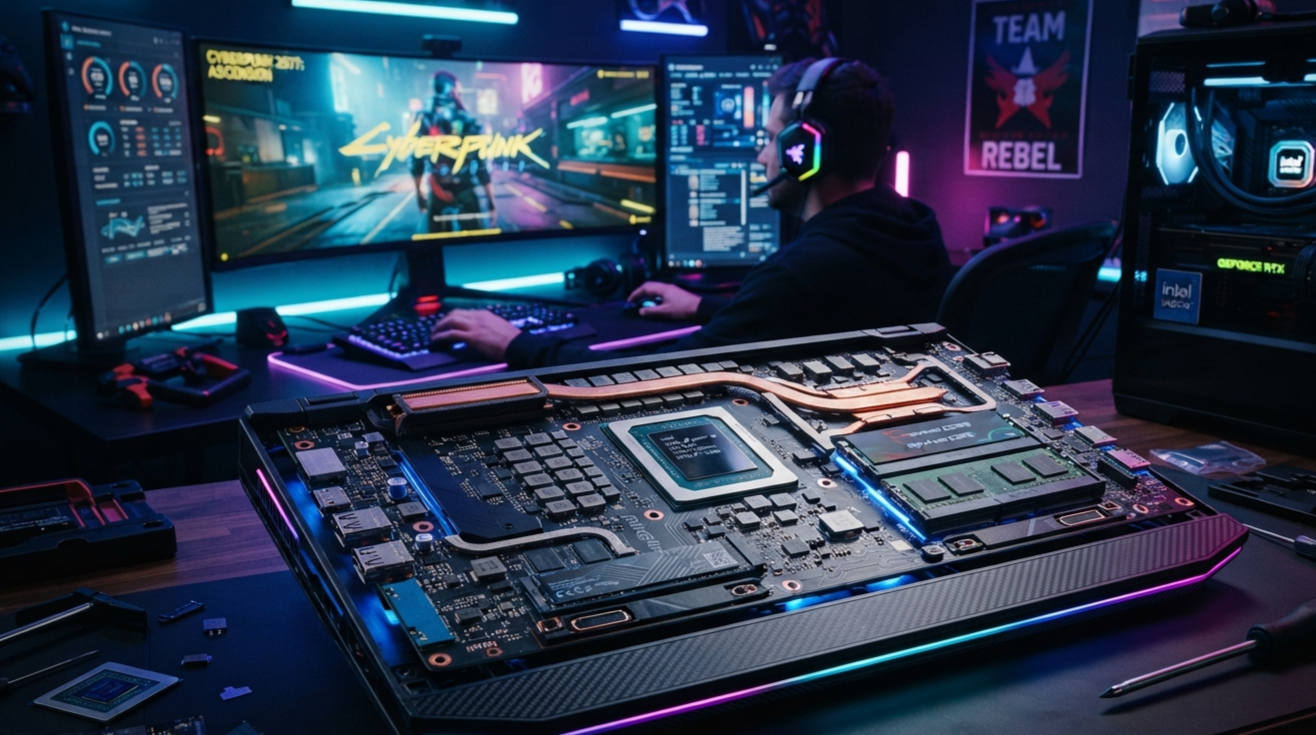
⚙️ The Core Ultra 200HX Plus Series
Intel's Core Ultra 200HX Plus family represents the company's high-performance mobile CPU platform aimed at gaming laptops and performance-focused notebooks.
The important part of Intel's strategy isn't simply adding more processing power.
It's combining modern CPU architecture with technologies designed to make existing software execute more efficiently.
That becomes particularly interesting for games that were built around older x86 assumptions.
🔄 How Binary Optimization Works
Traditional compilation generally looks like this:
Source Code
↓
Compiler
↓
Machine Code
↓
CPU
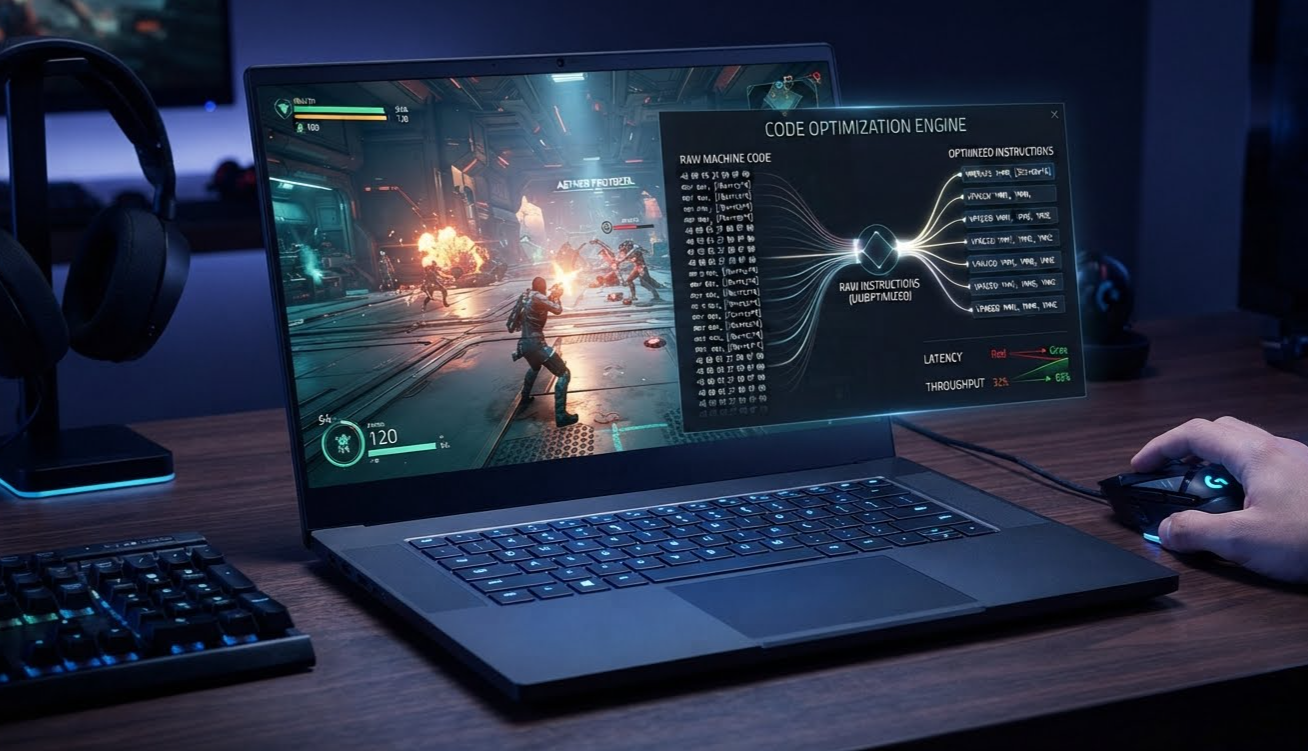
Binary optimization adds another opportunity to improve the process:
Existing Machine Code
↓
Binary Analysis
↓
Optimization
↓
Improved Machine Code
↓
CPU
The optimizer can examine how instructions interact with one another and attempt to arrange them more efficiently.
That can involve things such as:
- Better instruction ordering
- Improved code layout
- More efficient branch behavior
- Reduced unnecessary work
- Better use of CPU execution resources
The goal is straightforward:
Get more useful work out of every CPU cycle.
📈 Improving Instructions Per Cycle
One of the most important concepts here is IPC — Instructions Per Cycle.
IPC describes how much useful instruction work a CPU can complete during each clock cycle.
A simple example:
CPU A
3.5 GHz
2 instructions per cycle
CPU B
3.5 GHz
3 instructions per cycle
Even though both processors run at the same clock speed, CPU B can potentially complete more work per cycle.
This is why increasing clock speed isn't the only way to improve performance.
Binary optimization attempts to make the existing workload friendlier to the CPU's execution engine.
🧩 Why Instruction Scheduling Matters
Modern CPUs are extremely complicated.
They don't simply execute instructions one after another.
Instead, they use techniques such as:
- Out-of-order execution
- Branch prediction
- Instruction-level parallelism
- Multiple execution ports
- Speculative execution
- Large caches
Poorly arranged code can make it harder for the processor to keep these resources busy.
A binary optimizer can potentially reorganize code so that the CPU spends less time waiting and more time executing useful work.
That's where the IPC improvement comes from.
🕹️ Why This Could Matter for PC Gaming
Games are particularly interesting because many older titles have CPU-heavy sections that were written around previous generations of hardware.
Examples include:
- Simulation-heavy strategy games
- Large open-world games
- Older MMOs
- Physics-heavy titles
- CPU-limited shooters
- Emulation workloads
- Games with inefficient legacy engines
A GPU upgrade won't necessarily fix these bottlenecks.
But improving CPU-side code efficiency potentially could.
🧪 Translation Layers Are Changing Computing
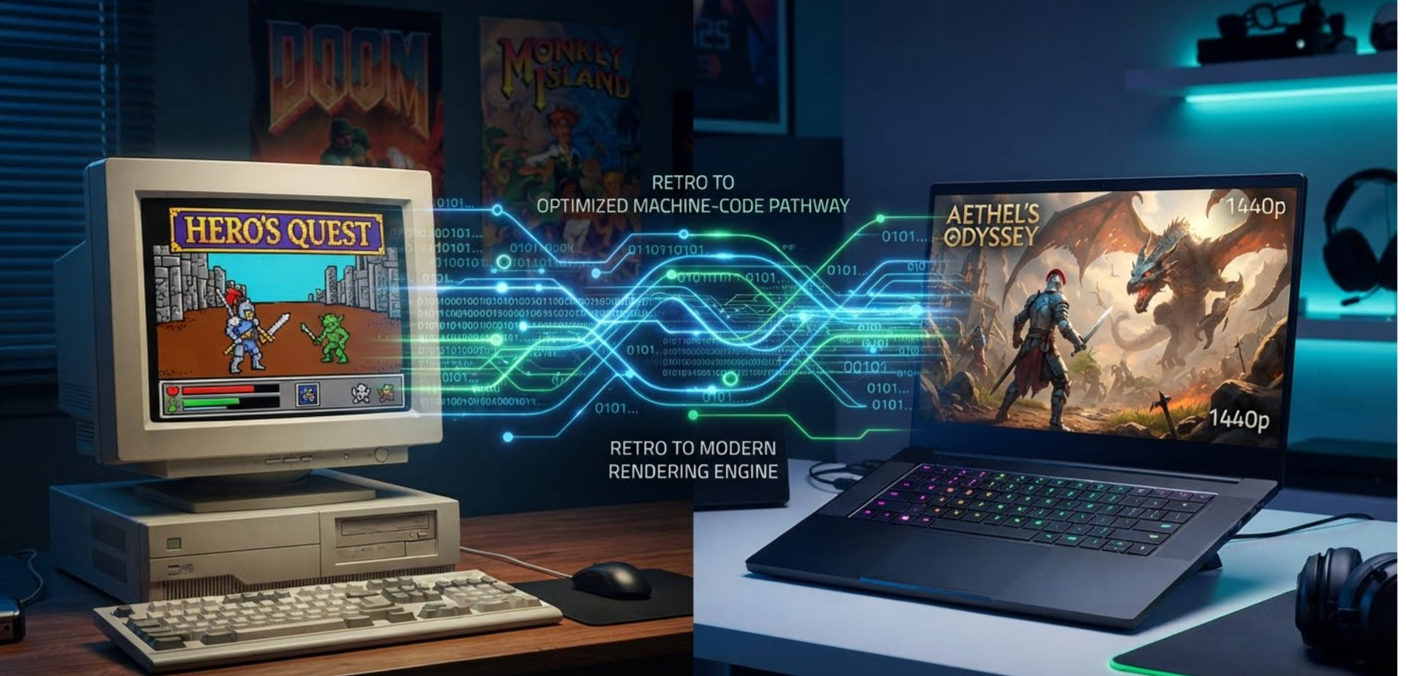
This technology also fits into a much larger trend in modern computing.
Software is increasingly being separated from the exact hardware it was originally designed for.
We already see this concept in:
- x86-to-ARM translation
- Emulation
- Compatibility layers
- Dynamic recompilation
- JIT compilation
- Virtual machines
- Binary translation
The basic idea is always similar:
Make software written for one environment work efficiently in another.
Intel's approach is particularly interesting because the goal isn't necessarily to translate between completely different instruction sets.
Instead, the focus can be on transforming existing machine code into a more efficient form.
🔥 BOLT vs Traditional Game Optimization
| Traditional Optimization | Binary Optimization |
|---|---|
| Requires source code | Can work with compiled code |
| Developer makes changes | Optimization system analyzes binaries |
| Requires game update | Potentially works with existing software |
| Long development cycle | Potentially automated |
| Game-specific | Can target broader workloads |
| Manual testing required | Algorithm-driven optimization |
This doesn't mean binary optimization replaces developers.
Instead, it can potentially provide another layer of performance optimization.
🚀 The Biggest Advantage: Old Games
The most exciting use case may not be brand-new games.
It could be old games.
Imagine installing a decade-old PC title on a modern Intel laptop.
Normally, you're limited by whatever optimization the original developers included.
A binary optimization system could potentially identify inefficient code and improve its execution on modern hardware.
That creates an interesting possibility:
Your old game doesn't necessarily need a remaster to benefit from modern CPU optimization.
The improvement would depend heavily on the individual game's code and workload, but the concept is powerful.
📊 Where Binary Optimization Could Help
| Workload | Potential Benefit |
|---|---|
| Legacy PC games | ⭐⭐⭐⭐⭐ |
| CPU-heavy simulations | ⭐⭐⭐⭐⭐ |
| Older game engines | ⭐⭐⭐⭐ |
| Emulation | ⭐⭐⭐⭐ |
| Modern optimized games | ⭐⭐⭐ |
| GPU-bound games | ⭐⭐ |
| Extremely poorly coded software | Variable |
Editor's note: These ratings represent potential usefulness, not measured Intel benchmark results.
⚠️ What Binary Optimization Can't Fix
It's important not to treat the technology as a magic performance button.
If a game is limited by its GPU workload, optimizing CPU instructions won't suddenly double frame rates.
For example:
GPU bottleneck → Binary optimization has limited impact
CPU bottleneck → Potentially much greater impact
Similarly, optimization cannot automatically solve every fundamental problem in an old game engine.
Some limitations may come from:
- Poor threading
- Memory bandwidth
- GPU rendering
- Asset streaming
- Engine architecture
- Game logic
- Storage performance
The technology is therefore best understood as another optimization layer, not a replacement for proper game development.
🎯 CPU-Limited vs GPU-Limited Gaming
A simple way to understand the difference:
CPU-Limited
GPU usage: 60%
CPU usage: High
Potential optimization benefit: HIGH
GPU-Limited
GPU usage: 99%
CPU usage: Moderate
Potential optimization benefit: LOW
This distinction will determine whether binary optimization produces a noticeable frame-rate improvement in a particular game.
🧠 Why This Is Bigger Than One Intel Processor
The underlying concept isn't limited to a single Core Ultra generation.
As CPUs become more complicated, software optimization becomes increasingly important.
Modern processors have enormous amounts of hardware capability.
But developers can't always rewrite every piece of software to exploit every new feature.
That's where automated optimization becomes attractive.
Instead of asking:
"How do we rewrite this game?"
the industry can increasingly ask:
"How can the hardware make this existing game run better?"
🎮 Could This Change PC Gaming?
Potentially, yes.
PC gaming has a unique problem compared with consoles:
There are decades of software.
A modern Windows gaming PC can run games released in:
2026
2016
2006
1996
and sometimes even earlier.
Compatibility is one of PC gaming's greatest strengths.
But maintaining performance across generations is incredibly complicated.
Technologies that automatically optimize older software could make that ecosystem even stronger.
🔮 The Future of CPU Optimization
The future of CPU performance may not simply be about adding more cores.
Instead, we could see a combination of:
Better architectures
Higher IPC
AI-assisted optimization
Binary translation
Dynamic optimization
Better compilers
The result could be processors that become more capable not only because they are physically faster, but because they are better at understanding the workloads running on them.
📊 The New Performance Formula
Traditional thinking:
Performance = Clock Speed × IPC × Cores
Modern computing is becoming more complicated:
Performance = Hardware × Compiler × Runtime × Optimization × Workload
That is why technologies such as binary optimization deserve attention.
The CPU isn't operating in isolation.
Software determines how effectively hardware can be used.
🏆 Final Verdict
Intel's Binary Optimization Tool represents an interesting direction for PC performance.
Rather than depending entirely on developers to update old games, binary-level optimization could potentially make compiled software more efficient on modern processors.
For gaming, the biggest opportunity is legacy and CPU-limited titles.
A decade-old game doesn't suddenly become modern because you install a new CPU.
But if the processor and software stack can identify inefficient instruction patterns and reorganize them, some of that old code may be able to run more efficiently.
That's the real promise.
Not simply a faster CPU.
A smarter way of using the CPU you already have.
And as Intel's Core Ultra platform continues evolving, binary optimization could become an increasingly important part of the company's strategy for closing the gap between modern hardware and legacy software.
🔗 Recommended Links
Intel: Intel Official Website
Intel Core Ultra: Intel Core Ultra Processors
Intel Developer Resources: Intel Developer Zone
](/_next/image?url=https%3A%2F%2Fcdn.mos.cms.futurecdn.net%2FeexQizhxGdny87wQtfrswd-1920-80.jpg&w=3840&q=75)


Comments
Sign in to join the conversation
Sign inNo comments yet
Be the first to share your thoughts!