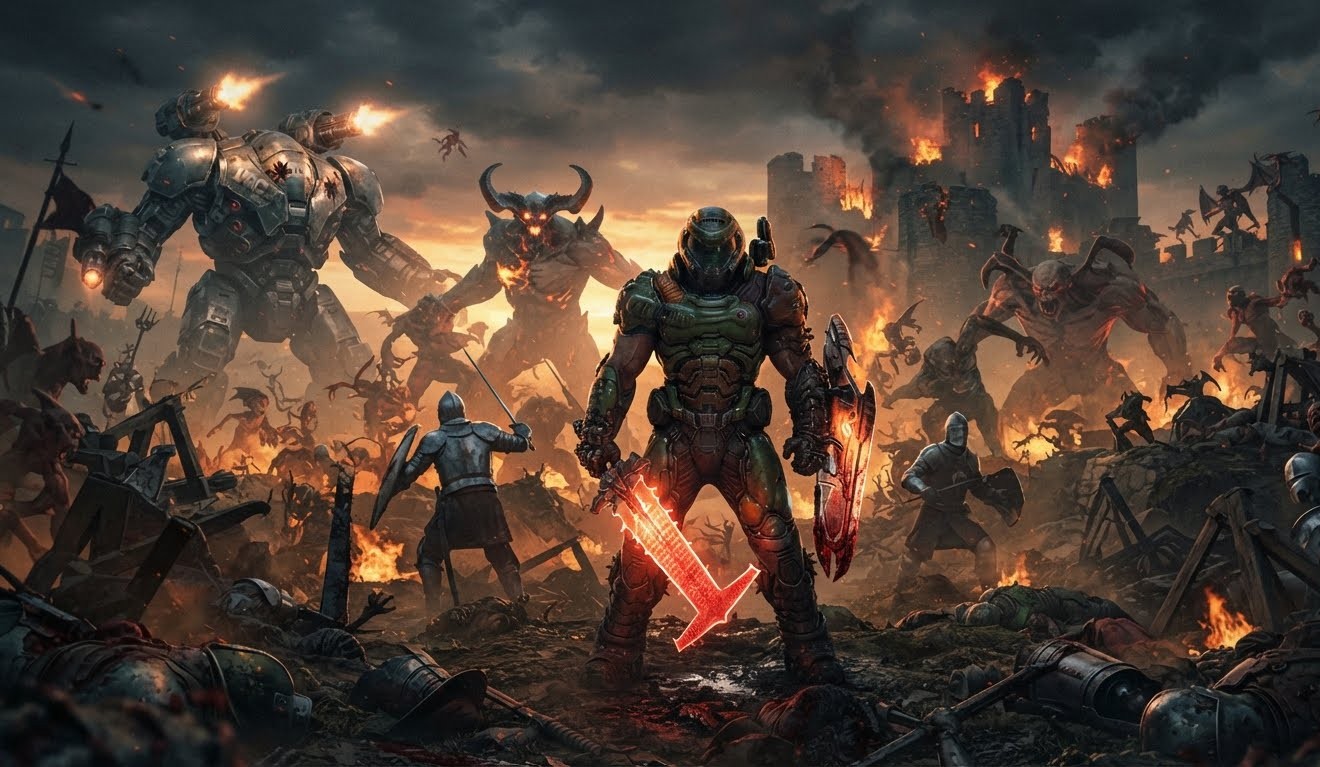

DOOM: The Dark Ages Hands-On: Why the Shield Saw Is So Satisfying
DOOM: The Dark Ages takes one of gaming's most recognizable first-person shooters and completely changes how it feels to fight.
Instead of relying primarily on the lightning-fast movement and constant weapon switching of DOOM Eternal, id Software's prequel puts more emphasis on standing your ground, blocking attacks, parrying projectiles, and smashing demons at close range.
And at the center of that new combat philosophy is one ridiculous piece of equipment:
The Shield Saw.
It is part shield, part buzz saw, part projectile-deflection tool, and one of the most satisfying additions to the modern Doom arsenal.
📑 Table of Contents
- The New Philosophy Behind DOOM: The Dark Ages
- The Shield Saw Changes Everything
- Why Parrying Feels So Good
- Throwing the Shield Saw
- Shield Charge and Aggressive Movement
- The Atlan Mech
- Fighting Massive Demons
- How Combat Compares With DOOM Eternal
- What Makes the Combat So Satisfying
- Final Verdict
💡 Combat Tip: Don't treat the Shield Saw as a defensive weapon that you only pull out when you're in trouble. Its parry, charge, blocking, and throwing abilities are designed to make it part of your normal offensive rhythm. Bethesda specifically highlights all of these uses as core techniques.
🛡️ The New Philosophy Behind DOOM: The Dark Ages
The biggest change in DOOM: The Dark Ages isn't simply the medieval setting.
It's the way id Software wants players to approach combat.
DOOM Eternal encouraged players to constantly move, jump, dash, swap weapons, and manage resources while attacking enemies from different angles.
The Dark Ages takes a heavier approach.
The Slayer feels more grounded and powerful.
Instead of always running away from attacks, you're often encouraged to stand your ground and fight through them.
The official game description specifically emphasizes this grounded combat philosophy, describing the Slayer as a weapon of gods and kings equipped with the new Shield Saw.
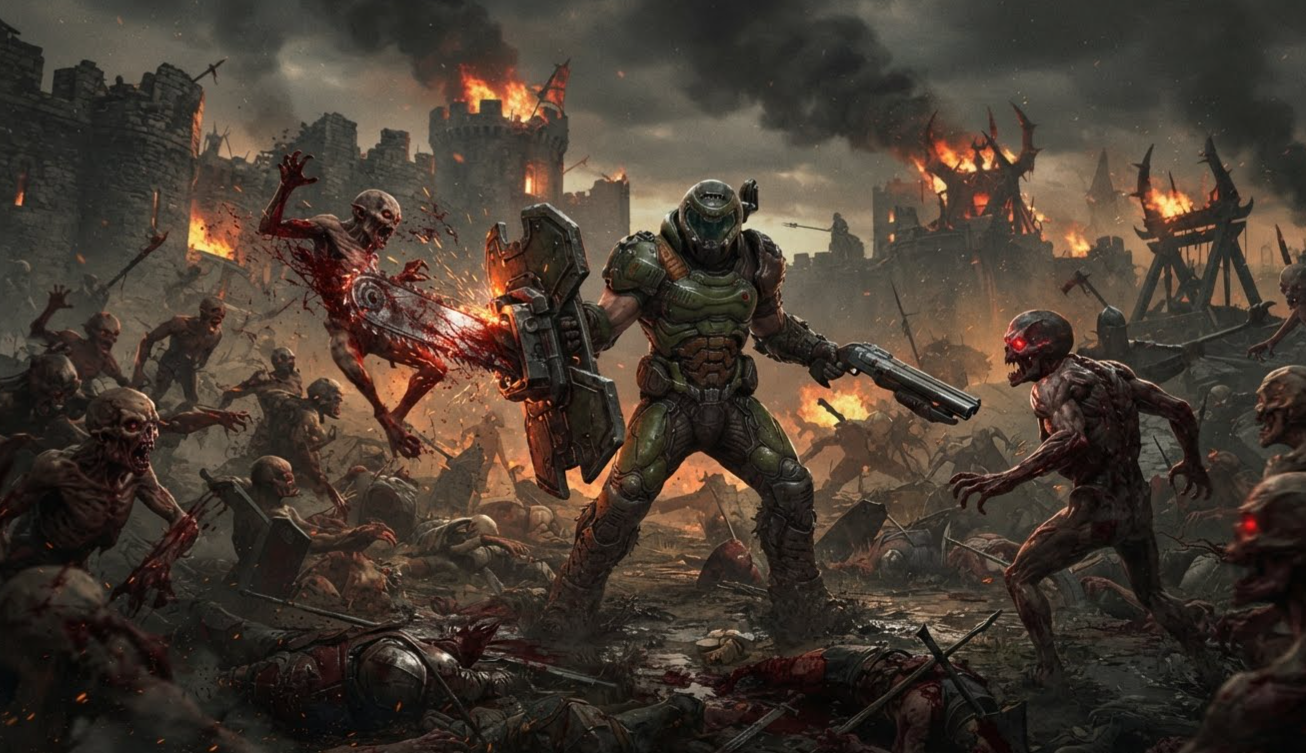
⚙️ The Shield Saw Changes Everything
At first, putting a shield into Doom sounds strange.
This is a franchise built around shotguns, rockets, chainsaws and overwhelming firepower.
But the Shield Saw quickly proves that it belongs.
The weapon allows the Slayer to:
- Block incoming attacks
- Parry specific enemy attacks
- Throw the shield
- Stagger enemies
- Destroy certain armor
- Charge toward enemies
- Create openings for follow-up attacks
Bethesda describes the Shield Saw as a versatile weapon that can be used both inside and outside combat.
That versatility is what makes it different from a conventional FPS shield.
You're not just protecting yourself.
You're attacking with it.
⚔️ Why Parrying Feels So Good
The parry mechanic is probably the biggest adjustment for returning Doom players.
Certain incoming attacks are marked by a distinctive green glow.
Instead of simply dodging them, players can raise the Shield Saw at the correct moment and send the attack back toward the enemy.
The timing creates a satisfying rhythm:
Enemy attacks → Green flash → Raise Shield → Parry → Counterattack
Successful parries can also help expose enemy defenses.
The audiovisual feedback makes the mechanic particularly satisfying. Reviews noted the generous timing window and the dramatic slowdown and sound effects that accompany successful parries.
This changes the feeling of combat.
Instead of thinking:
"I need to get away from that attack."
You're thinking:
"Hit me. I dare you."
🪚 Throwing the Shield Saw
The Shield Saw isn't stuck to the Slayer's arm.
You can throw it.
And this is where the weapon starts feeling completely ridiculous—in the best possible way.
The spinning blades can cut through weaker enemies and can even lodge themselves into tougher demons, creating opportunities for follow-up attacks. Bethesda also notes that the thrown Shield Saw can destroy superheated metal armor after players heat it up.
So the weapon creates another simple combat loop:
Throw → Damage → Stagger → Close Distance → Finish
It's a great example of how The Dark Ages combines defensive mechanics with aggressive gameplay.
🏃 Shield Charge and Aggressive Movement
The Shield Saw also doubles as a movement tool.
The Slayer can target an enemy and perform a Shield Charge, rapidly closing the distance.
This is important because it prevents the shield from turning the game into a slow defensive shooter.
Instead, you can use it to aggressively reposition yourself.
For example:
Enemy across arena
↓
Shield Charge
↓
Close the distance
↓
Melee attack
↓
Parry incoming attack
↓
Counterattack
The result is a combat system that feels heavier than DOOM Eternal while still maintaining Doom's signature aggression.
🏰 The Medieval Setting Actually Matters
The medieval-inspired setting isn't simply a visual theme.
The environments are filled with:
- Ancient castles
- Huge battlefields
- Dark forests
- Hellish landscapes
- Giant fortifications
- Mechanical structures
- Demonic armies
Bethesda describes The Dark Ages as a dark fantasy/sci-fi experience with some of the largest levels in the series.
The result is a Doom world that feels more like a gigantic war between armies than a traditional corridor shooter.
🤖 The Atlan Mech
Then there are the Atlans.
These massive mechanical war machines let the Slayer step away from standard first-person combat and enter enormous battles against gigantic demons.
The official game description specifically highlights the ability to stand tall in a massive Atlan mech and fight Hell's forces on a much larger scale.
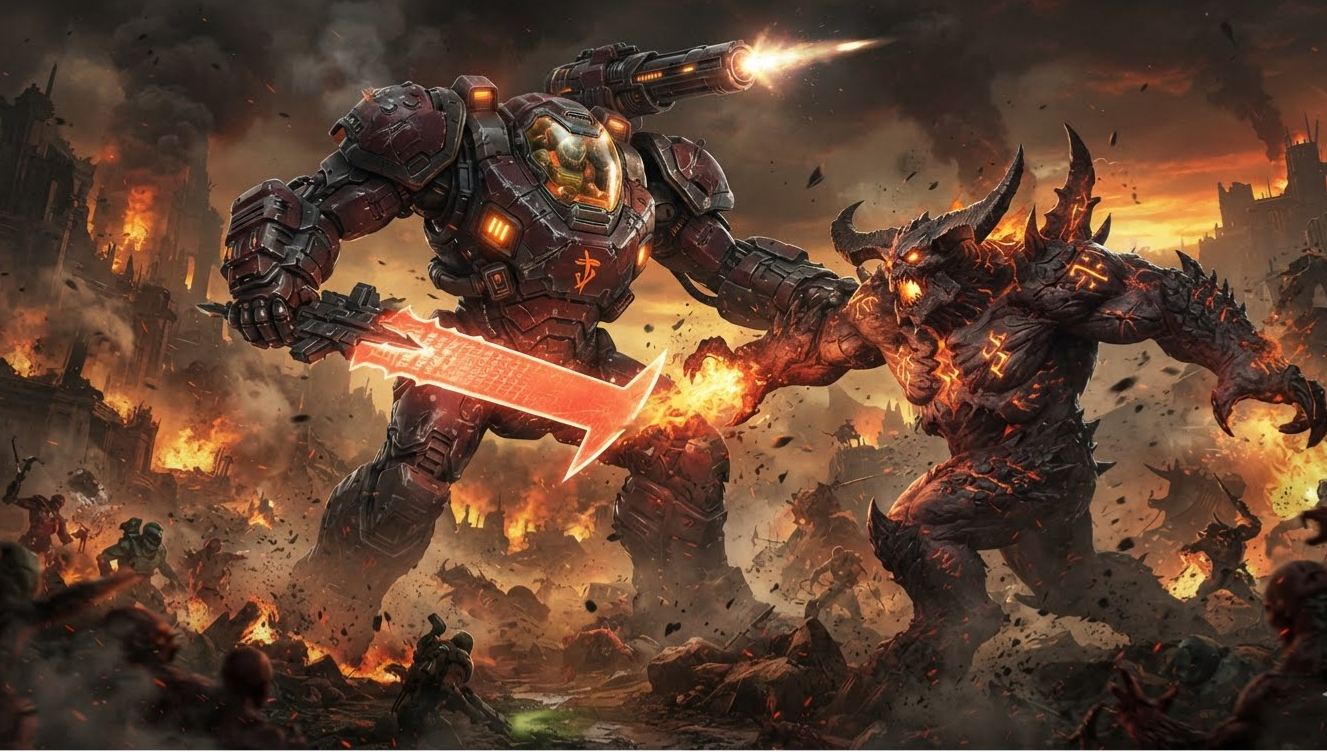
🐲 From Shield Saw to Giant War Machines
One of the most interesting things about The Dark Ages is the scale.
One minute you're fighting demons with a shield and shotgun.
The next, you're controlling an enormous mech.
The game also introduces a Mecha Dragon, giving the campaign another way to expand beyond traditional first-person combat.
These sections aren't the main combat system, but they help reinforce the game's larger theme:
This is Doom as a medieval war.
Instead of simply being a lone soldier clearing rooms, the Slayer feels like a superweapon dropped directly onto an enormous battlefield.
👹 Fighting Kaiju-Sized Demons
The biggest battles are where the scale of The Dark Ages becomes most obvious.
Huge enemies dominate the battlefield while smaller demons surround them.
That creates a layered combat structure:
Small Demons
Fast targets that can overwhelm you in groups.
Heavy Demons
Armored enemies that require more deliberate attacks.
Elite Enemies
Powerful opponents designed around specific combat mechanics.
Giant Demons
Massive threats that change the scale of the entire encounter.
The Slayer needs to move between these threats while managing attacks, parries, weapons and positioning.
📊 DOOM Combat Evolution
Chart Title: How Modern DOOM Combat Has Changed
| Combat Element | DOOM (2016) | DOOM Eternal | DOOM: The Dark Ages |
|---|---|---|---|
| Movement emphasis | High | Very High | Medium |
| Parrying | Low | Low | Very High |
| Melee focus | Medium | Medium | High |
| Shield mechanics | No | No | Very High |
| Large-scale battles | High | High | Very High |
| Environmental scale | High | High | Very High |
| Heavy combat feeling | Medium | Low | Very High |
Chart note: These are editorial comparisons, not official statistics.
This shift is what makes The Dark Ages feel different even though the core Doom identity remains intact.
🔥 What Makes the Combat So Satisfying?
The answer is feedback.
Every successful action feels heavy.
A parry has a distinct visual and audio response.
A Shield Saw throw has physical impact.
A Shield Charge closes the gap immediately.
A melee attack feels brutal.
A giant demon getting hit by a massive weapon feels appropriately destructive.
Reviews have particularly praised the weight of the combat and the satisfaction of the new shield mechanics, although some critics felt the repeated parry encounters could become predictable later in the campaign.
That criticism is worth mentioning because the Shield Saw is both the game's biggest innovation and one of the mechanics that can dominate encounters.
⚖️ The Shield Saw Is Powerful — But That's the Point
The Shield Saw changes the balance of Doom combat.
You're no longer simply managing:
Health + Armor + Ammo
You're also thinking about:
Blocking + Parrying + Positioning + Shield Charges
That adds another layer of decision-making.
A green projectile isn't simply something to avoid.
It's potentially an opportunity.
A distant enemy isn't simply a target.
It's potentially a destination for a Shield Charge.
A heavily armored enemy isn't simply a damage sponge.
It may be a target for the thrown Shield Saw.
🎮 DOOM: The Dark Ages vs. DOOM Eternal
The two games aren't trying to accomplish exactly the same thing.
DOOM Eternal
Fast
Vertical
Highly mobile
Weapon-management focused
DOOM: The Dark Ages
Heavy
Grounded
Parry-focused
Melee-oriented
Battlefield-focused
That doesn't necessarily make one better than the other.
It makes The Dark Ages a fascinating experiment in changing the formula without abandoning what makes Doom recognizable.
The Guardian-style shield mechanics and heavier combat were repeatedly identified by reviewers as major differences from Eternal.
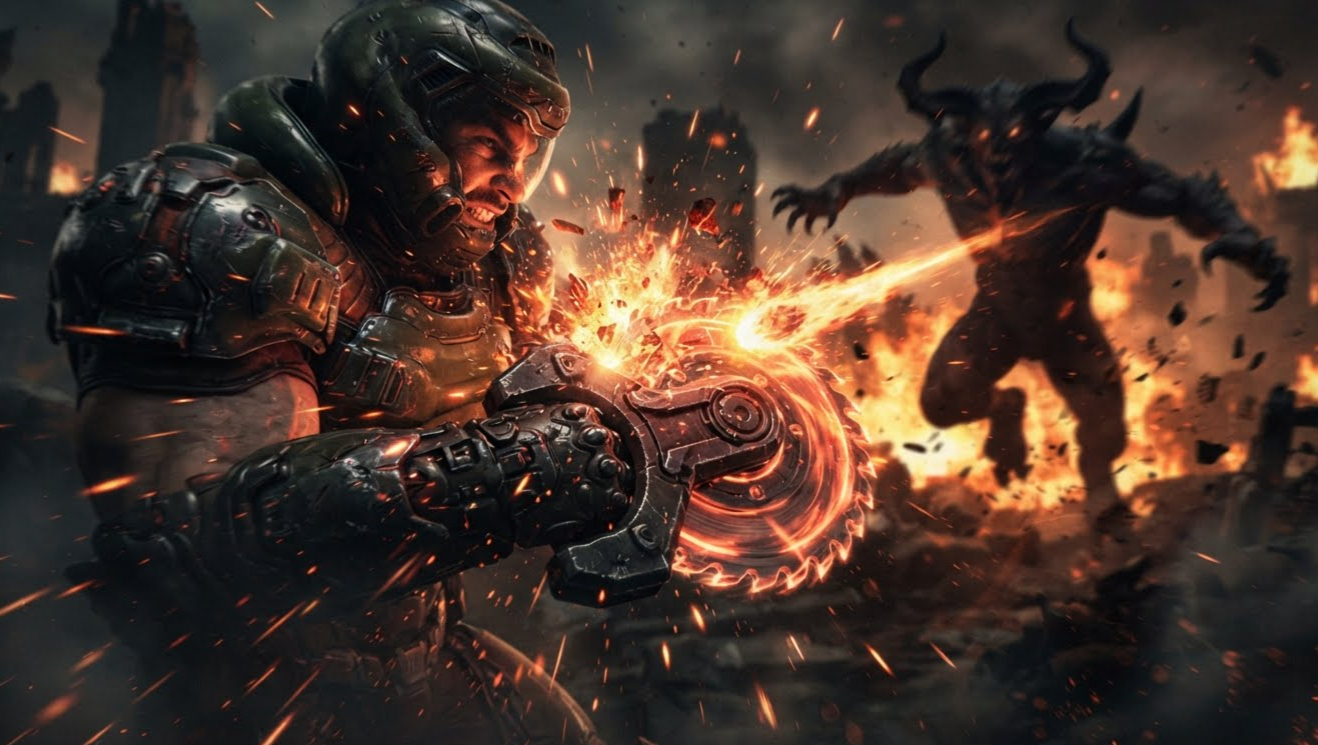
🧠 Why id Software Took This Risk
After DOOM Eternal, id Software could have simply made a bigger version of the same game.
Instead, the studio changed the combat philosophy.
The goal was to make the Slayer feel more like an unstoppable tank than an acrobatic superhero.
That meant reducing the emphasis on constant aerial movement and increasing the importance of blocking, parrying and direct confrontation.
It's a risky choice.
But it's also what gives The Dark Ages its own identity.
💡 Editor's Take
The Shield Saw works because it doesn't feel like a defensive weapon added to Doom. It feels like Doom found a way to turn defense into another form of violence.
That's the clever part.
You block an attack so you can attack.
You parry a projectile so you can counter.
You throw the shield so you can create an opening.
You charge toward an enemy instead of retreating.
Defense becomes aggression.
🚀 Final Verdict
DOOM: The Dark Ages is one of id Software's boldest attempts to reshape its own formula.
The medieval setting provides the atmosphere, the massive battlefields provide the scale, and the Atlan mech provides some spectacular moments.
But the Shield Saw is the real star.
It changes how players approach combat by turning blocking, parrying, throwing and movement into one interconnected system. Bethesda itself emphasizes the weapon's ability to block, parry, charge and fly through enemies as a central part of the experience.
The result isn't simply another Doom game.
It's Doom with weight.
And when the Slayer catches a projectile with the Shield Saw, sends it back at a demon, charges across the battlefield and follows it with a brutal counterattack, the design makes one thing very clear:
Sometimes the best way to survive Hell is to hit it harder.
🔗 Explore More Gaming Content
Read more from our Gaming section, explore Gaming Reviews, or check out our Tech articles for more gaming technology and development stories.
For more Doom coverage, you can also link this article to a dedicated DOOM Games Guide once that wiki page is created.
](/_next/image?url=https%3A%2F%2Fcdn.mos.cms.futurecdn.net%2FeexQizhxGdny87wQtfrswd-1920-80.jpg&w=3840&q=75)

Comments
1Sign in to join the conversation
Sign in