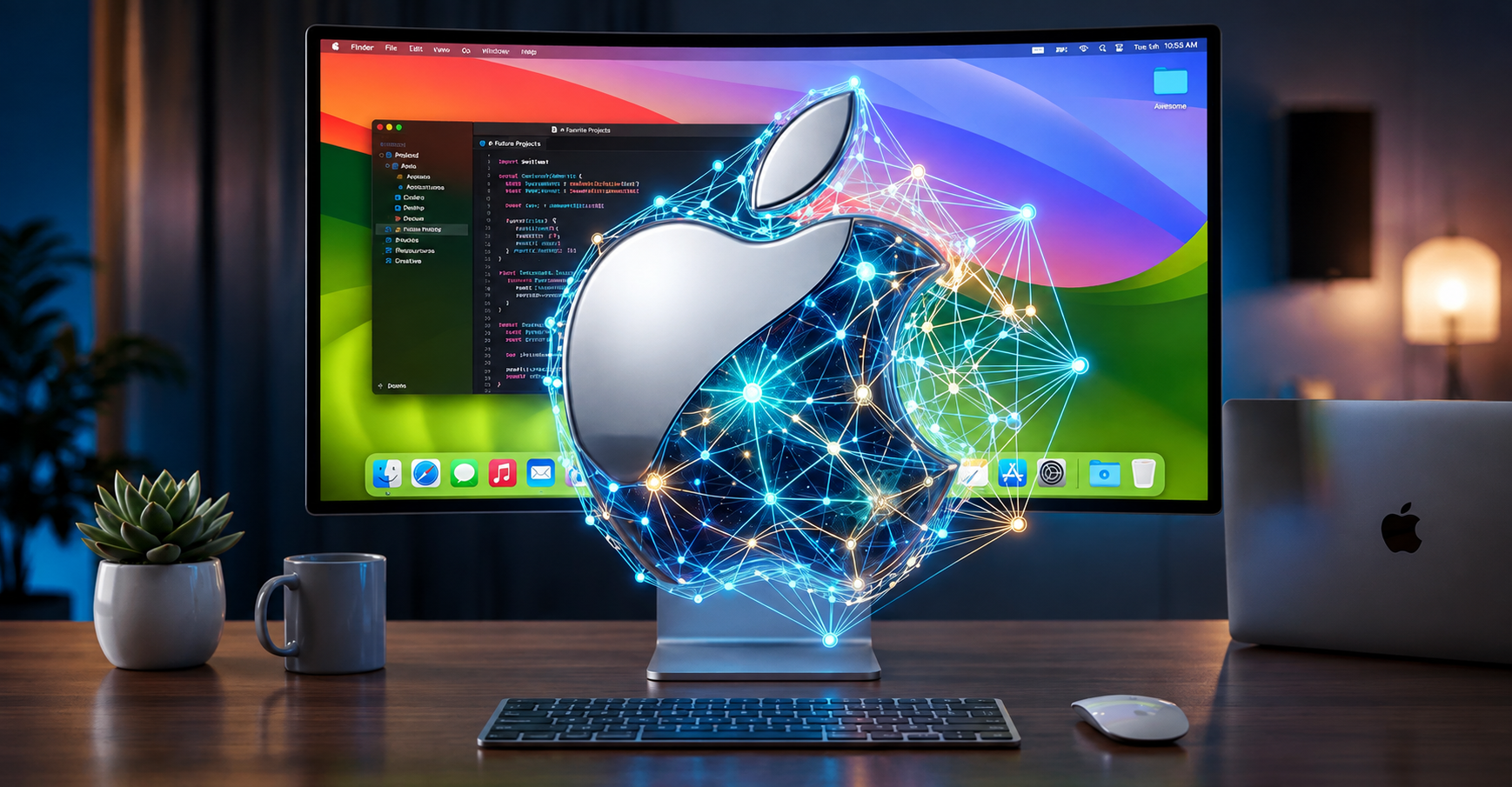

What Is Apple's New AI Playbook, Exactly?
On January 12, 2026, Apple and Google jointly announced a multi-year partnership giving Apple access to a custom Gemini model built specifically for Siri and Apple Intelligence. Bloomberg's Mark Gurman estimated the deal's value at roughly $1 billion per year, and in a joint statement, Apple said "Google's technology provides the most capable foundation for Apple Foundation Models," adding it was excited about the new experiences the partnership would unlock.
The deal isn't exclusive — Apple remains free to work with other AI providers — but it's easily the most consequential AI decision Apple has made to date. The rebuilt system went fully public at WWDC 2026, where Apple unveiled "Siri AI" alongside a new version of Apple Intelligence — the biggest overhaul of Siri and Apple's on-device AI system since the assistant first launched in 2011.
Analysts have called it one of the most significant strategic realignments the tech industry has seen since the smartphone era began, given that Apple now pays an estimated $1 billion annually to bring Gemini's capabilities to an ecosystem of more than 2 billion active devices.

How the New Siri Architecture Actually Works
Apple didn't simply hand Siri over to Google — it built a hybrid system designed to protect the privacy reputation it's spent over a decade building. According to reporting, the architecture splits into three parts: a query planner, a knowledge search system, and a summarizer. Gemini handles the planning and summarization work, while Apple keeps personal data processing on the device rather than sending it to external servers. Gadget Hacks

The scale of the underlying model is enormous. Reports describe a custom 1.2-trillion-parameter Gemini model — about eight times larger than Apple's existing 150-billion-parameter cloud models — built on a mixture-of-experts architecture optimized for summarization, planning, and natural language understanding.
The upgrade isn't limited to how Siri thinks — it changes how you interact with it, too. Apple gave the assistant a dedicated standalone app, similar to ChatGPT, Claude, or Gemini's own apps, with conversation history synced privately across devices through iCloud, making it feel less like a voice command tool and more like a full AI chatbot woven into the OS. TechCrunch reports that Google Gemini gets the credit internally for lifting Siri's conversational ability and overall capability. Quartz
Beyond Siri itself, Apple Intelligence also picked up a new second-generation on-device model, improved voice-to-text, a smarter Spotlight search index, wider world knowledge, and better personal-context understanding — all running across a mix of on-device and Private Cloud Compute processing to preserve Apple's privacy commitments.
Why Google — Not OpenAI or Anthropic?
This is the detail that caught much of the industry off guard. Apple already had a working integration with OpenAI, using ChatGPT inside Siri for complex, world-knowledge queries. Yet the Gemini deal only came together after Apple spent significant time testing rival AI technology from both OpenAI and Anthropic before choosing Google's models instead. TechCrunch
Just as notably, Apple didn't rip out its existing partnership to make room for the new one. The company told CNBC it isn't making any changes to its existing ChatGPT agreement, meaning the two AI relationships currently run in parallel. That's arguably the real headline of Apple's "new playbook": rather than betting the company on a single AI partner, Apple is treating foundation models the way it treats chip suppliers or display panels — pick the best available option for each job, and stay flexible enough to switch later.
The move also lands amid a broader shift in the AI power rankings. Google logged its best year since 2009 in 2025 and briefly overtook Apple in market capitalization for the first time since 2019, a sign of just how much leverage Google's AI comeback has bought it in Silicon Valley boardrooms.
What This Means for Your iPhone
None of this comes free on the hardware side. Running Gemini-powered "agentic" AI workloads — tasks where Siri plans multi-step actions rather than just answering a single question — requires meaningfully more processing power than the old Siri ever needed.
To support that, Apple raised its baseline specs for the 2026 product cycle: the iPhone 17 Pro lineup now standardizes 12GB of RAM, up from 8GB in the iPhone 16, and the A19 chip's redesigned neural accelerators in every core deliver roughly a 40% increase in on-device AI throughput compared to the prior generation. Apple says those gains are essential for features like Writing Tools and Visual Intelligence, which lean on fast prompt processing and high-fidelity image generation.
The practical takeaway: if you're hoping to run the full Siri AI experience, older iPhones — particularly anything below the 17 series — may not deliver it at full capability.

The Bigger Pattern: Apple's "Late, Then Own It" Strategy
Zoom out, and this isn't really a new Apple move — it's a familiar one applied to a new category. As one industry analysis put it, Apple Maps launched broken in 2012 and is now competitive, and Apple Silicon leaned on years of chip acquisitions before it came to dominate laptop performance — the Gemini-powered Siri is simply the AI-era version of that same playbook: buy the capability now, internalize it later.
There's real business pressure behind the strategy. Siri AI's early engagement reportedly lags well behind ChatGPT's 900-million-plus weekly users, and simply being the default assistant on billions of devices won't be enough on its own to close that gap — Apple's real win is expected to show up in customer retention and services revenue rather than dethroning ChatGPT outright. Tech Insider
Even leadership change hasn't slowed the rollout. Apple posted record March-quarter revenue of $111.2 billion, and CEO Tim Cook said in April that the Google Gemini collaboration "is going well," even as Cook prepares to step down, with hardware engineering chief John Ternus set to take over as CEO on September 1.
Frequently Asked Questions
Is Siri now powered by Google?
Partially. Google's Gemini model handles cloud-based reasoning, planning, and summarization, while Apple keeps personal data processing on-device to maintain its privacy stance. Gadget Hacks
How much is Apple paying Google for this?
Neither company has officially confirmed a figure, but multiple outlets — including Bloomberg and TechCrunch — estimate the deal is worth around $1 billion annually.
Does this replace Apple's ChatGPT integration?
No. Apple has said it isn't changing its existing OpenAI/ChatGPT agreement, so the two AI partnerships currently run side by side.
When did Siri AI actually launch?
It was unveiled publicly at WWDC 2026 and is rolling out as part of iOS 27, macOS 27, and iPadOS 27.
Do I need a new iPhone to use it?
For the full experience, most likely — Apple raised RAM and neural-engine requirements starting with the iPhone 17 Pro lineup specifically to support the heavier AI workloads Gemini requires.
Is my personal data being sent to Google?
Not for personal context. Reporting indicates Apple's architecture is designed so personal data processing stays on-device, with Gemini used for external reasoning and knowledge tasks rather than accessing your private information directly.
The Takeaway
Apple's new AI playbook isn't really about Siri at all — it's about Apple admitting, for one of the first times in its history, that it doesn't have to build everything itself to keep its ecosystem feeling like Apple. By renting Google's AI brainpower while keeping data, design, and the user experience under its own control, Apple is betting that integration — not invention — is what will keep 2 billion devices loyal through the AI era.
Want to see how this compares to Google's own on-device AI roadmap or Microsoft's Copilot strategy? Check out our related breakdown https://www.technewsworld.com/story/apples-new-ai-playbook-180389.html.

Comments
Sign in to join the conversation
Sign inNo comments yet
Be the first to share your thoughts!