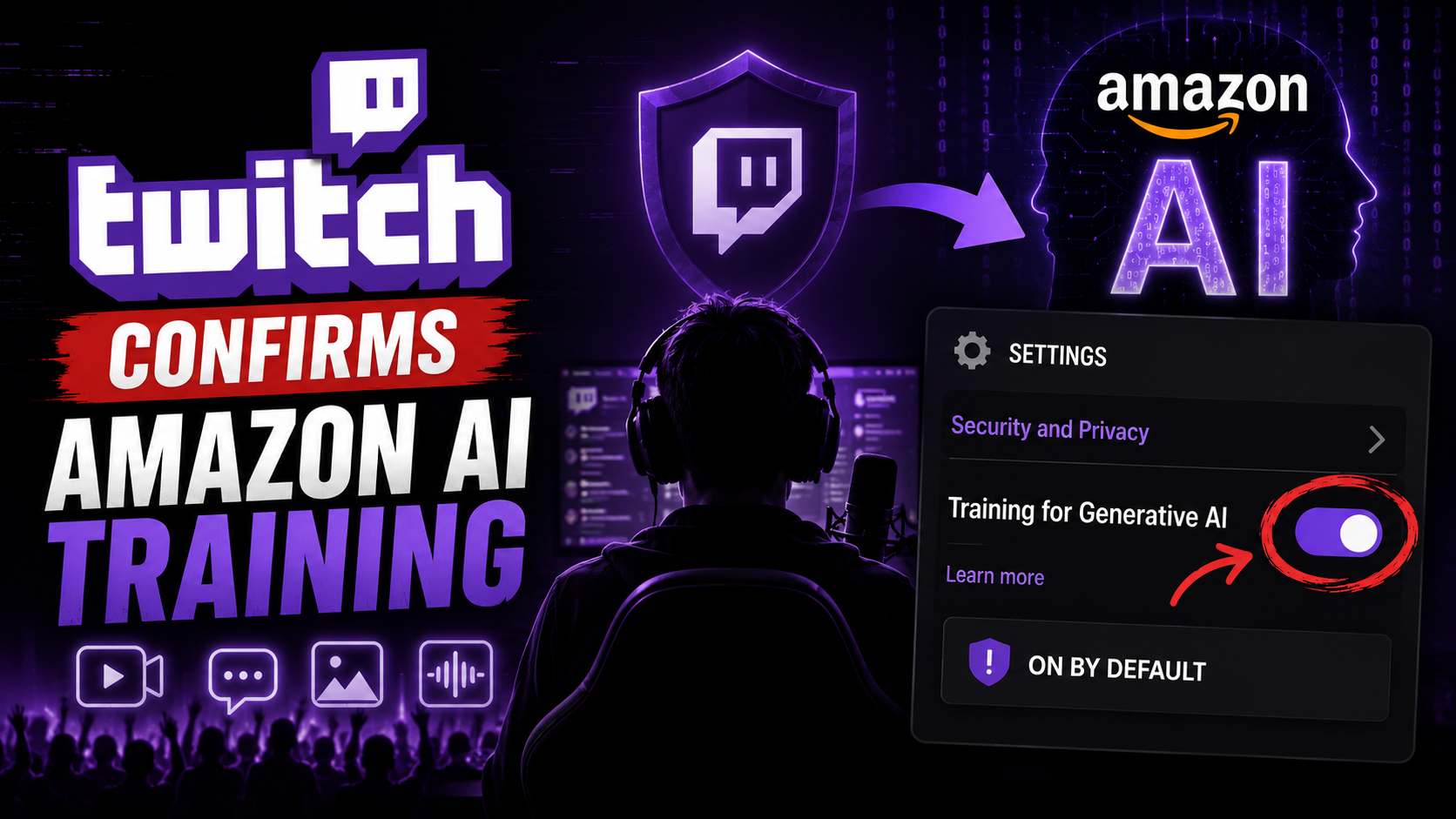

Twitch streamers have suddenly found themselves at the center of a major AI privacy debate.
On August 12, 2026, Twitch confirmed that creators can opt out of having their content used to train Amazon's generative AI models.
The controversy isn't simply about AI training.
It's about the default setting.
Creators are automatically included unless they manually switch the setting off.
That decision has triggered an immediate backlash from parts of the Twitch community, with creators questioning why permission isn't required before their content is used for generative AI training.
🤖 What Is Twitch Using for AI Training?
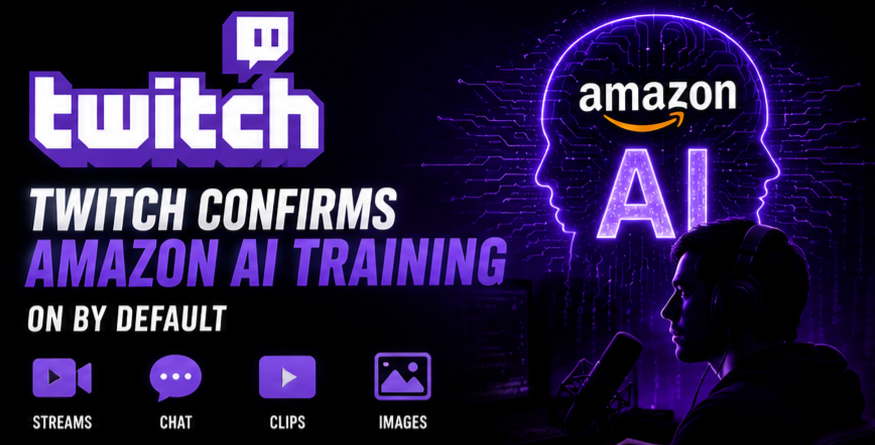
Twitch's new setting covers content that can be used to train generative AI systems capable of producing or synthesizing media such as:
- Text
- Images
- Audio
- Video
The material covered includes content associated with Twitch channels, including streams, clips, chats, and channel materials.
However, Twitch distinguishes this generative-AI training from other uses of AI on the platform.
For example, Twitch already uses AI and automated systems for functions such as captions, recommendations, moderation, and safety tools.
Turning off the generative-AI training setting does not mean Twitch stops using your content for those other platform functions.
⚠️ Why Is Everyone Angry?
The biggest problem for creators isn't necessarily the existence of AI training.
It's the fact that the setting is opt-out rather than opt-in.
In other words:
Opt-in
Nothing happens unless you explicitly agree.
Opt-out
You're included automatically unless you specifically disable it.
Twitch chose the second approach.
That immediately caused criticism from creators who argued that using their work to train generative AI should require explicit permission.
The controversy spread quickly across Twitch's own community discussions and social media.
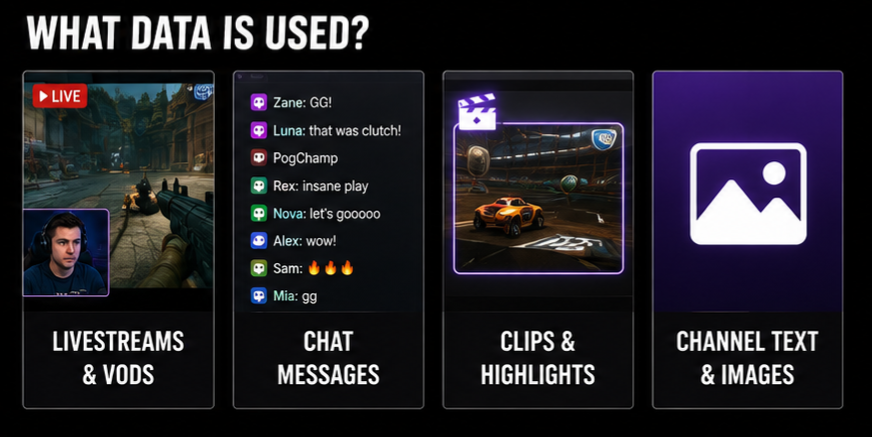
🎙️ Twitch's Chief Product Officer Responds
The backlash became particularly intense during a Twitch livestream on August 12.
Twitch Head of Community Mary Kish and Chief Product Officer Mike Minton addressed questions from viewers while thousands of people watched.
One question repeatedly appeared in the chat:
Why isn't AI training opt-in?
Minton gave a remarkably direct answer.
"If this was opt-in, nobody would opt in."
He explained that this was the reason Twitch had chosen the opt-out approach.
The comment immediately became one of the most discussed parts of the announcement because it appeared to acknowledge that Twitch expected very few creators to voluntarily agree to AI training.
🔥 The Community Pushback
The response was swift.
Creators and viewers began sharing instructions explaining how to disable the setting.
The main criticism focused on consent and control.
Many creators spend years building recognizable:
- Voices
- Personalities
- Visual styles
- Video archives
- Communities
- On-camera identities
The possibility of that material being used to develop generative AI models has therefore raised questions about ownership, compensation, and creative control.
The debate also reflects a much larger argument happening across the internet:
Should creators have to opt out of AI training, or should companies have to ask for permission first?
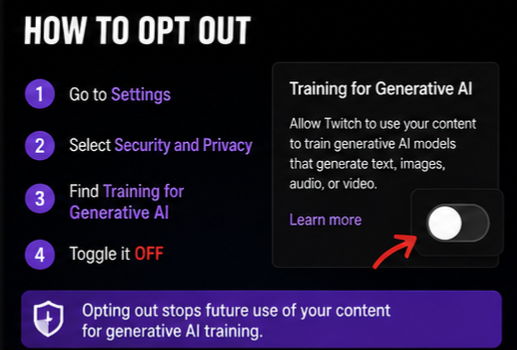
🛠️ How to Opt Out of Twitch AI Training
If you don't want your Twitch channel content used for future generative-AI training, you can disable the setting.
On Desktop
- Open Twitch Settings.
- Select Security and Privacy.
- Scroll toward the bottom of the page.
- Find Training for Generative AI.
- Switch the setting off.
The setting currently appears enabled by default.
On Mobile
The setting can be reached through:
Profile → Settings → Security and Privacy
Then look for the Training for Generative AI option.
⏳ What Happens After You Opt Out?
Turning the setting off prevents your content from being used for future generative-AI training under this particular program.
However, this does not mean Twitch stops processing your content entirely.
Your streams and other content may still be used for other purposes covered by Twitch's privacy policies, including platform functionality, moderation, recommendations, and safety systems.
That's an important distinction.
Opting out ≠ deleting your Twitch content
The setting specifically concerns generative-AI training.
It isn't a master switch that prevents Twitch from processing your content in every possible way.
🕰️ What About Old Streams?
This is one of the biggest unanswered questions.
During the August 12 discussion, Mike Minton was asked about whether older Twitch content had already been used to train AI models.
He did not provide a definitive answer about the extent of Amazon's previous use of Twitch data.
That means creators shouldn't assume that switching the setting off will somehow erase or reverse any previous model training.
The safest interpretation is:
Opting out protects future content from this generative-AI training program, but it isn't a retroactive deletion mechanism.
🧠 Why Does Amazon Want Twitch Data?
Twitch contains an enormous amount of naturally occurring human interaction.
Every day, creators generate:
- Spoken conversations
- Gaming commentary
- Reactions
- Interviews
- Tutorials
- Entertainment
- Chat interactions
- Long-form video
- Short clips
That makes Twitch content potentially valuable for training systems that need to understand real-world language, conversations, images, and video.
For Amazon, Twitch also represents a massive library of content generated by millions of creators.
The company has been aggressively expanding its AI efforts, making Twitch an obvious potential source of training material.
🎮 Twitch Is Already Using AI in Other Ways
It's important not to confuse the new training program with all AI-related features on Twitch.
The platform already uses automated and AI-powered systems for various functions.
These can include:
Automatic Captions
Systems can analyze speech and generate captions.
Moderation
Automated systems can help detect potentially problematic content.
Recommendations
Machine-learning systems can help determine which streams and channels users may be interested in.
Safety Tools
Automated technology can assist Twitch's Trust & Safety operations.
The new Training for Generative AI setting is specifically about allowing content to be used to train models designed to generate or synthesize media.
💰 Will Streamers Be Paid?
This is another major point of concern.
The announcement does not mean that individual creators will suddenly receive royalties every time their content contributes to an AI model.
The current system is structured around permission to use content for training, rather than a per-creator compensation program.
That has led to criticism from creators who believe their work has significant commercial value.
The debate is therefore moving beyond privacy.
It is becoming a question of:
Who owns the value created from AI training data?
🌐 This Is Bigger Than Twitch
Twitch isn't operating in isolation.
YouTube, Meta, Reddit, X, publishers, music companies, and other platforms have all faced versions of the same fundamental question:
Can publicly available or platform-hosted content be used to train AI?
The answer differs depending on the platform, its terms, the type of content, and applicable laws.
But Twitch's decision is particularly interesting because it involves creators whose entire careers can be built around their voices, appearances, personalities, and livestream archives.
That makes the question of AI training especially personal.
⚖️ The Consent Debate
There are two fundamentally different approaches to AI training.
The Platform Approach
A company provides an opt-out mechanism and allows creators to remove themselves from future training.
The Creator-First Approach
A creator must explicitly grant permission before their work can be used.
The Twitch controversy demonstrates why the difference matters.
With an opt-out model, the default answer is:
Yes.
With an opt-in model, the default answer is:
No.
Twitch's decision to choose the first approach is what has caused much of the current backlash.
🔒 Should You Turn It Off?
That ultimately depends on your preferences.
If you're comfortable with your Twitch content being used to train Amazon's generative AI models, you don't need to change anything.
If you don't want your streams, clips, chats, and channel materials included in future generative-AI training, disabling the setting is the simplest option.
The process only takes a few seconds.
Settings → Security and Privacy → Training for Generative AI → OFF
🚨 Why This Story Matters
The Twitch controversy highlights a much bigger change happening across the creator economy.
For years, creators worried about:
Who watches my content?
Now they're increasingly asking:
What can AI learn from my content?
And perhaps the most important question:
Who gets to decide?
Twitch has given creators a choice, but it has made that choice opt-out by default.
That decision has sparked immediate backlash and could influence how other platforms approach creator consent for AI training.
For now, if you're a Twitch creator and don't want to participate, the solution is straightforward:
Check your settings.

Comments
1Sign in to join the conversation
Sign in