

A 16-inch laptop already gives you a lot of screen.
So naturally, ASUS decided to put two of them in one machine.
The 2026 ROG Zephyrus Duo takes the familiar dual-screen laptop idea and turns the dial to maximum. Instead of pairing a conventional 16-inch display with a small secondary panel, ASUS has created what it calls the world's first dual-16-inch-screen gaming laptop.
And both screens are 3K OLED touchscreens.
That sounds ridiculous.
It also starts making an alarming amount of sense once you imagine actually using it.
ASUS pairs the displays with an Intel Core Ultra 9 386H processor and configurations reaching an NVIDIA GeForce RTX 5090 Laptop GPU with up to 150W maximum TGP. The machine is only around 2.82 kg and 1.9 cm thick, making the hardware challenge even more interesting.
The real question isn't whether two screens are cool.
It's whether a laptop can keep two enormous displays, a high-end CPU and a 150W-class GPU running without turning into a portable space heater.
Two 16-Inch 3K OLED Displays. Seriously.
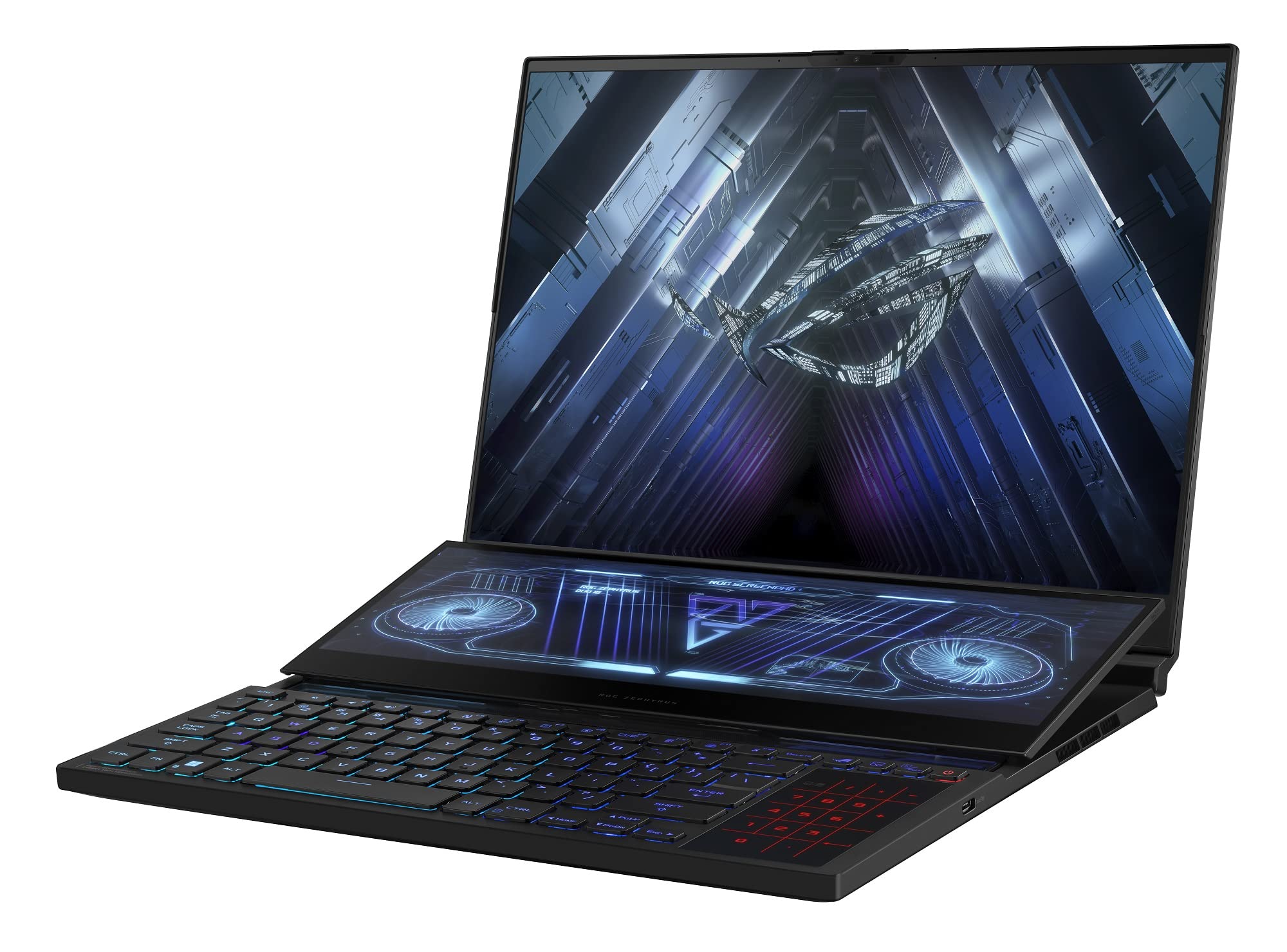
The first thing that makes the Zephyrus Duo unusual is also the easiest thing to understand.
There are two 16-inch 3K OLED panels, each running at 2880 × 1800, with a 120Hz refresh rate, 0.2ms response time, 100% DCI-P3 coverage and touchscreen support
That's not a little secondary display hiding above the keyboard.
It's effectively a second full-size workspace.
Open the laptop and you can use the upper screen for your main game, editing timeline or browser while the lower display handles everything else.
Think:
- Game on the upper screen, Discord and Twitch chat below.
- Premiere Pro timeline underneath your video preview.
- Photoshop tools and reference material on the lower panel.
- Code on one screen, documentation and terminal windows on the other.
- Spreadsheet on one display, browser research on the other.
- Game walkthrough underneath the game you're actually playing.
The difference is important.
Traditional laptops force you to divide one screen into windows. The Duo lets you divide your physical workspace instead.
That's a subtle distinction, but after using multiple monitors, it's easy to understand why it matters.
The Second Screen Isn't Just a Gimmick
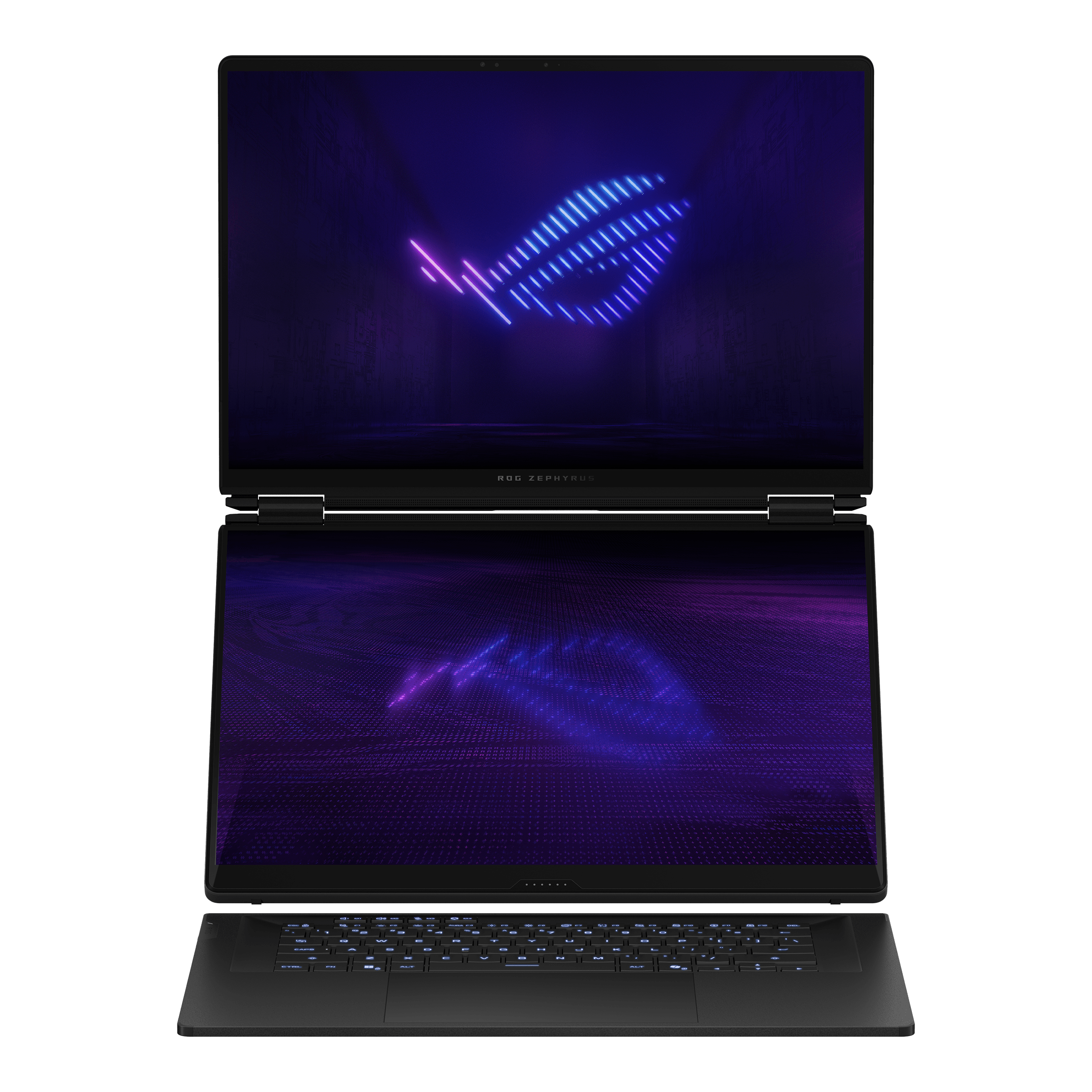
Here's where the Zephyrus Duo becomes more interesting than a flashy CES-style concept.
ASUS has built the second display into the laptop's physical architecture.
When the machine opens, the secondary screen lifts and moves toward the primary display. This creates a dedicated opening beneath it for airflow. Earlier Zephyrus Duo designs used the Active Aerodynamic System Plus mechanism to create a 28.5mm air intake and increase airflow by up to 30%.
That means the second screen is simultaneously:
a display, a productivity surface and part of the cooling strategy.
That's clever engineering.
It also explains why ASUS couldn't simply cram another panel into a conventional laptop chassis and call it a day.
The Thermal Problem Is the Real Story
Dual displays are impressive.
Cooling the computer driving them is the difficult part.
The 2026 Duo can be configured with an RTX 5090 Laptop GPU rated at up to 150W maximum TGP. That's serious graphics hardware for something barely two centimeters thick.
And remember: this isn't a desktop sitting inside a large case.
It's a laptop with:
- Two OLED panels
- A high-performance CPU
- A potentially 150W GPU
- Multiple fans
- Storage
- Memory
- Battery
- And a hinge mechanism connecting everything
ASUS' answer is a surprisingly elaborate thermal system.
The Duo combines liquid metal on the CPU, a custom vapor chamber, redesigned dual fans, graphite nano-insulated film and dual exhaust heatsinks. ASUS says the vapor chamber covers 45% of the motherboard.
The graphite film has another particularly important job.
Because there's a display sitting directly above the motherboard, ASUS needed to manage heat transfer between the internal components and that OLED panel. The graphite nano-insulated film sits between the heat-generating hardware and display area to help keep the touchscreen cooler.
In other words, ASUS didn't just have to cool the computer.
It had to cool the computer without cooking the screen sitting on top of it.
Why the Fans Are Doing More Work Than Usual
Most gaming laptops have one obvious advantage: they can pull air through the bottom of the machine.
The Zephyrus Duo complicates that.
Its second display occupies the space where conventional designs can use airflow, so ASUS redesigned the cooling system around the unusual chassis.
The dual fans pull fresh air through the opening created by the lifted display, circulate air through the chassis and push hot air through the exhaust system. Dust filters are also included to help keep debris from reducing cooling efficiency over time.
There's an interesting side effect here.
The strange-looking hinge isn't just there to make the laptop look futuristic.
The laptop's physical design is part of its cooling solution.
That's arguably the most impressive engineering trick in the entire machine.
And Somehow, It Can Still Be Silent
Here's another slightly absurd detail.
When you're doing something lightweight like watching video or browsing the web, ASUS says the Zephyrus Duo can use 0dB ambient cooling, with the fans completely disabled under light loads.
Obviously, demanding games and creative workloads are a completely different story.
But that's exactly the point.
The cooling system isn't designed merely to survive maximum performance. It's designed to scale depending on what the laptop is doing.
Light workload?
Stay quiet.
Heavy workload?
Open the cooling system and let the fans work.
Long gaming or rendering session?
The vapor chamber, liquid metal, graphite insulation, fans and heatsinks all become part of the equation.
The Multi-Tasking Potential Is Completely Different
Gaming performance gets most of the attention because this is an ROG machine.
But the second screen might actually make more sense for work.
Imagine editing a video.
Your 3K OLED primary display shows the footage you're working on. The second 3K OLED display contains the timeline, effects, media browser and audio controls.
No tiny panels.
No constantly rearranging windows.
No external monitor.
Or imagine streaming.
ASUS specifically highlights the ability to keep OBS Studio, chat, alerts, music and system monitoring on the secondary screen while the game stays on the primary display.
That changes the laptop from a gaming machine into something closer to a portable two-monitor workstation.
And unlike carrying two monitors, you can theoretically close the lid and put the entire setup into a backpack.
The Hardware Matches the Ambition
The displays would be impressive on their own.
But ASUS clearly isn't treating the Duo as a productivity laptop with an unusual screen.
The 2026 model uses an Intel Core Ultra 9 386H with 16 cores and 16 threads, while GPU configurations include the RTX 5070 Ti Laptop GPU and RTX 5090 Laptop GPU. Memory goes up to 64GB LPDDR5X-8533, depending on configuration.
There's also a 2TB PCIe NVMe SSD option, dual Thunderbolt 4 ports, HDMI 2.1, USB-A and a UHS-II SD card reader.
That matters because dual-screen productivity can become meaningless if you're constantly fighting for ports or performance.
The Duo is trying to eliminate those compromises.
But Is Two 3K Screens Actually Better?
Here's the uncomfortable question.
Do we really need this?
No.
Not everyone needs two 16-inch OLED displays.
For someone who primarily plays games, the second screen could spend most of its life showing Discord, Spotify or hardware monitoring. A cheaper laptop plus an external monitor can accomplish much of the same thing at a desk.
There's also the obvious tradeoff: power consumption.
Two high-resolution OLED touchscreens are inherently more demanding than one display, particularly if both are active at high brightness and refresh rates. ASUS does allow the secondary display to be dimmed or disabled to save battery when it isn't needed.
And then there's price.
ASUS lists the 2026 ROG Zephyrus Duo starting at ₹569,990 in India at the time of writing, with the U.S. store listing starting at $4,499.99. Prices and configurations can change.
This isn't an impulse-buy gaming laptop.
It's a statement.
Why the Duo Matters Anyway
The important thing isn't that everyone should buy a dual-screen laptop.
The important thing is that ASUS is demonstrating something manufacturers have been reluctant to embrace:
Laptop displays don't have to follow the old rules.
For decades, laptops essentially evolved around one assumption: one rectangular screen above one keyboard.
Then came touchscreens.
Then 16:10 displays.
Then OLED.
Now ASUS is asking a different question:
What if the laptop itself could become a multi-monitor workstation?
The Zephyrus Duo provides one possible answer.
It's not necessarily the final form of the idea. Maybe future laptops will use thinner flexible panels, detachable screens or completely different form factors.
But the Duo makes the concept tangible.
You can actually open the machine and get two enormous workspaces immediately.
What Happens Next?
The most interesting development may be what happens if dual-screen laptops become less exotic.
Right now, the Duo's hardware complexity makes it a premium product.
But as display technology improves and hinge mechanisms become cheaper and thinner, some of the ideas could eventually filter down.
We could see:
- More laptops with full-size secondary displays.
- Better software designed specifically for dual-screen workflows.
- More gaming interfaces built around a second screen.
- AI tools living on a dedicated secondary display.
- Creator-focused laptops using the lower screen as a permanent control surface.
- Better battery management for multiple OLED panels.
The biggest obstacle isn't whether people can find uses for a second screen.
It's convincing laptop manufacturers that users will pay for one.
The Zephyrus Duo is ASUS' argument that some of us absolutely will.
🎮 The Bottom Line
The ASUS ROG Zephyrus Duo is absurd.
Two 16-inch 3K OLED touchscreens in a laptop sounds like something designed specifically to win an engineering competition rather than something you'd actually put in a backpack.
Yet the more you look at it, the less ridiculous it becomes.
The second display isn't merely decoration. It changes how you can game, stream, edit, code and multitask. And the thermal system shows just how much engineering is required to make the idea work: liquid metal, vapor chamber cooling, dual fans, graphite insulation and a chassis designed around airflow.
It's expensive. It's unusual. It's probably overkill for most people.
But that's exactly why it's exciting.
Sometimes the best laptops aren't the ones that make the smallest change.
They're the ones that make you look at the laptop you've been using for years and wonder:
Why have we been doing it this way?
What do you think? Would you actually use two full-size 3K screens on a laptop, or would you rather have one excellent display and a cheaper machine? Let us know in the comments.
Comments
Sign in to join the conversation
Sign inNo comments yet
Be the first to share your thoughts!