

For years, there has been an easy rule for laptop gaming:
If you want serious graphics performance, buy a laptop with a dedicated GPU.
Intel is now trying to make that rule considerably less obvious.
The company's new Core Ultra Series 3, code-named Panther Lake, puts a substantially more powerful Xe3-based integrated GPU into the processor package while moving the platform to Intel's 18A process technology.
And the headline number is difficult to ignore.
Intel claims the flagship Core Ultra X9 388H can deliver up to 77% better gaming performance than the previous-generation Core Ultra 9 288V.
That's not a minor generational bump.
It's the kind of number that makes you ask a much bigger question:
How far can integrated graphics actually go?
Panther Lake Is More Than a New CPU
The easiest mistake would be to look at Panther Lake as simply another processor generation.
It isn't.
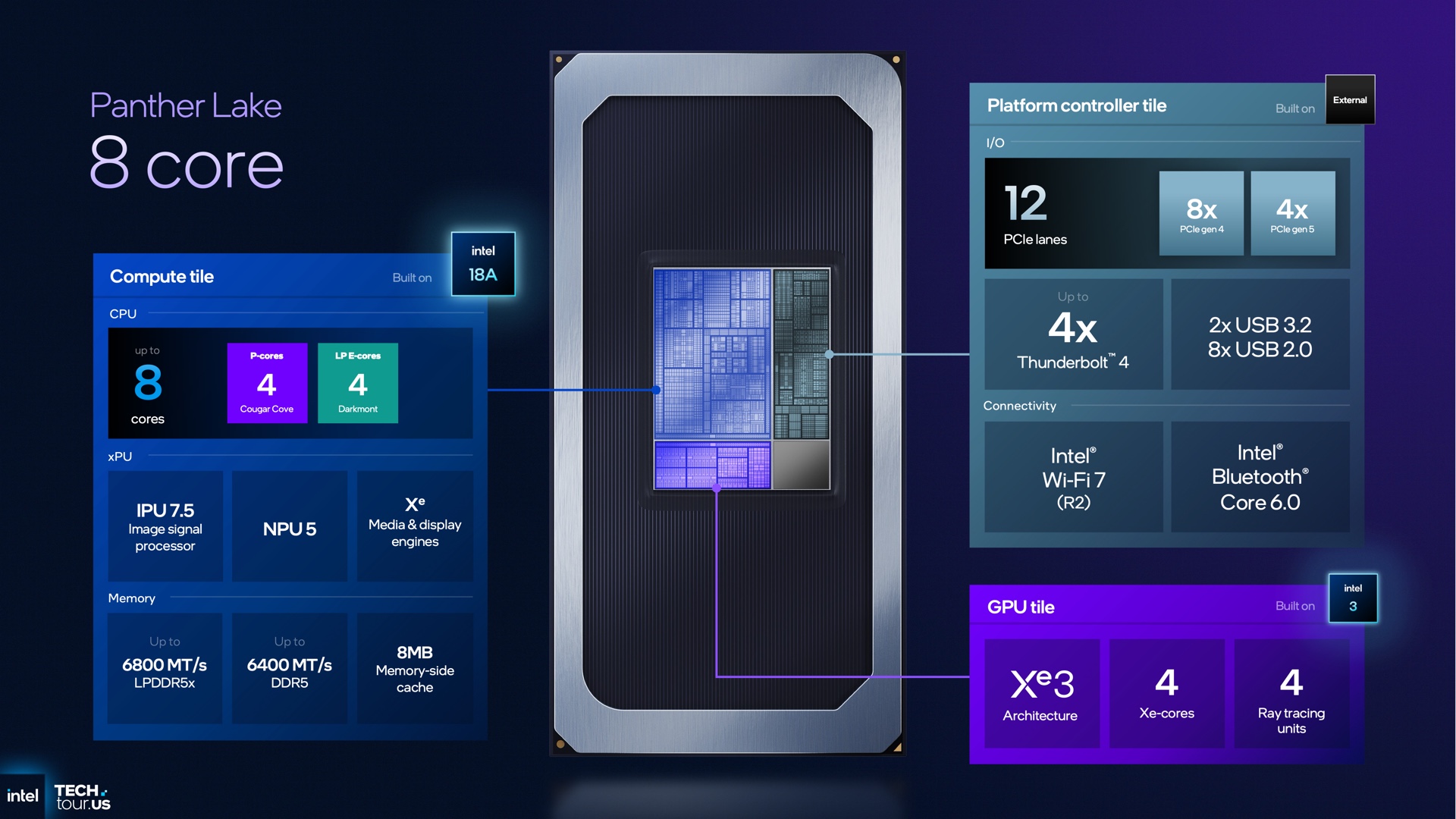
Intel designed Core Ultra Series 3 as a scalable, multi-chiplet system-on-chip, combining CPU, GPU, NPU and other platform components into a package designed for everything from mainstream laptops to gaming systems.
It is also Intel's first major client platform built around the company's 18A process technology.
The flagship configurations go considerably further than the previous generation:
- Up to 16 CPU cores
- Up to 12 Xe3 GPU cores
- Up to 50 NPU TOPS
- Up to 180 platform TOPS across the system
- Support for modern AI and graphics workloads
Intel is effectively trying to balance three different worlds at once:
CPU performance + integrated gaming graphics + AI acceleration.
That's important because modern laptops increasingly need all three.
The 77% Gaming Number Needs Context
Let's talk about the number everyone will quote.
77% faster gaming.
It sounds like Intel suddenly created an integrated GPU that is nearly twice as fast as Lunar Lake.
That's not quite what the claim means.
The comparison comes from a broad gaming benchmark covering dozens of titles at 1080p High, with upscaling used where supported.
So this isn't a promise that every game will run 77% faster.
Some games will gain more.
Some will gain less.
And performance will depend heavily on laptop cooling, memory configuration, power limits, drivers and the particular game.
But the underlying trend is still significant.
A performance increase of this scale across a broad gaming suite means Intel has substantially increased the amount of graphics horsepower available inside the processor.
That's the part worth paying attention to.
Xe3 Is the Real Star
The CPU cores get the branding.
The Xe3 graphics architecture might be the more interesting upgrade for gamers.
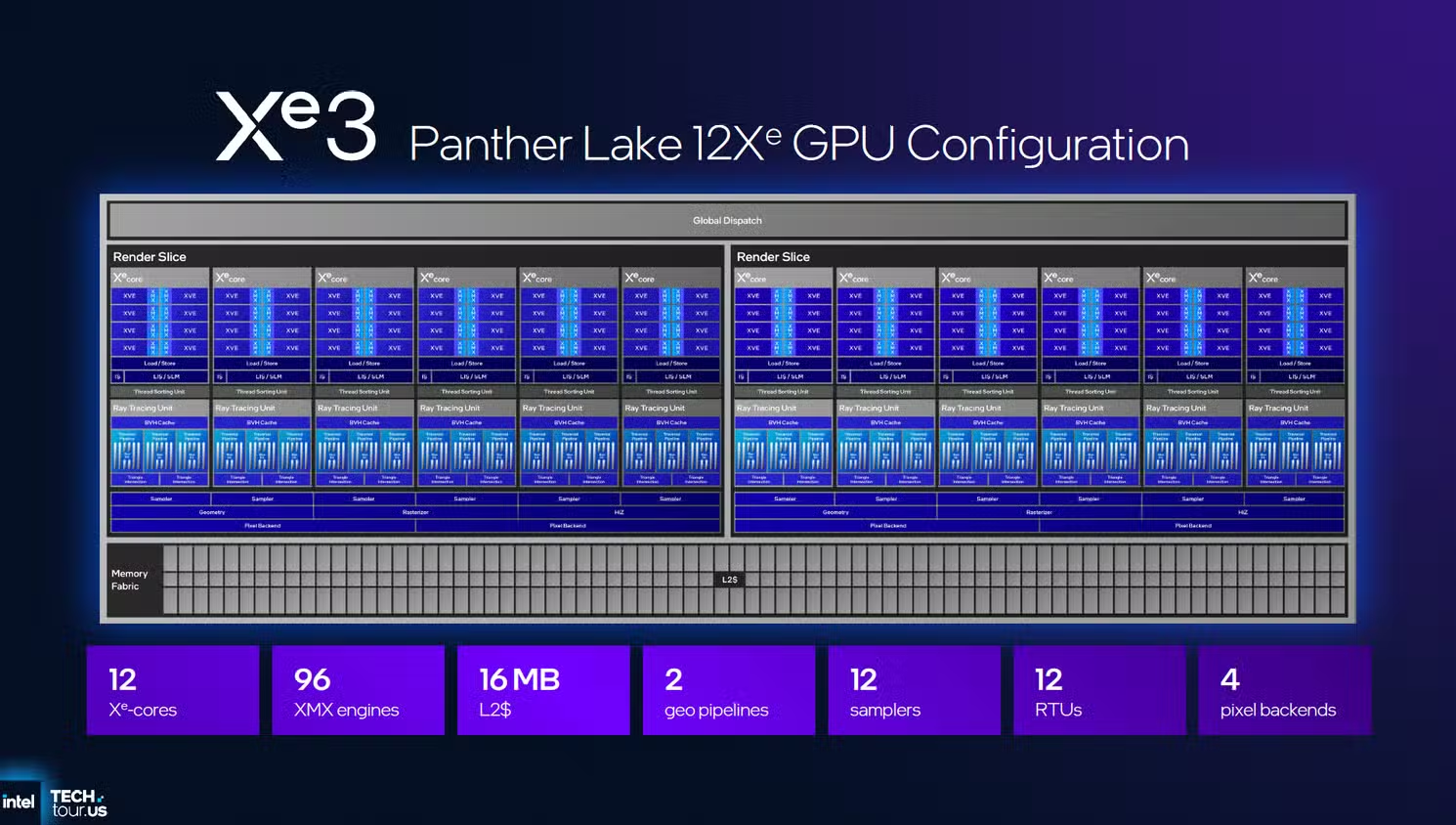
Panther Lake's integrated GPU scales to 12 Xe3 cores, representing a major step forward for Intel's integrated graphics strategy.
The architecture is designed around dedicated resources for:
- Rendering and geometry
- Media processing
- Display
- 3D compute
There's also additional cache designed to improve graphics and media performance while supporting modern hardware-accelerated workloads.
This is important because integrated graphics have traditionally been constrained by more than just the number of graphics cores.
They need efficient memory access.
They need strong drivers.
They need good power efficiency.
And they need enough graphics resources to avoid constantly fighting with the CPU for system resources.
Xe3 represents Intel trying to address the whole package rather than simply adding more graphics hardware.
Why 18A Matters
Then there's the manufacturing technology.
Panther Lake is built on Intel 18A, making it a major milestone for Intel's next-generation processor manufacturing.
That matters because laptop processors live in an unusually difficult environment.
A desktop CPU can consume enormous amounts of power if the motherboard and cooler can handle it.
A laptop can't.
Every watt affects:
- Fan noise
- Battery life
- Surface temperatures
- Chassis thickness
- Sustained performance
The goal isn't simply to make a faster chip.
It's to make more performance possible within a laptop's limited thermal budget.
And that's where Panther Lake could become especially interesting.
The CPU Side Gets a Major Upgrade Too
It would be easy to focus entirely on gaming graphics and miss what Panther Lake does to the CPU.
The flagship Series 3 chips can scale to 16 cores, while Intel is also targeting major improvements in multithreaded performance over the previous generation.
That matters for exactly the workloads modern gaming laptops increasingly handle alongside gaming.
Think:
- Game + Discord
- Game + streaming software
- Game + browser tabs
- Video editing
- 3D rendering
- Compiling code
- AI-assisted applications
The CPU isn't being designed in isolation from the GPU.
Panther Lake is becoming a general-purpose performance platform where the CPU, GPU and NPU can each handle workloads they are best suited for.
And Then There's AI
Intel obviously isn't building a modern laptop processor without talking about AI.
Panther Lake includes an NPU capable of handling dedicated AI workloads, while the CPU and GPU can contribute additional acceleration.
For gamers, that might initially sound like marketing noise.
But AI is increasingly showing up inside games and gaming software.
Upscaling.
Frame generation.
Voice processing.
Content creation.
Background removal.
Streaming tools.
Image and video generation.
The GPU's role is no longer simply:
"Draw the game."
And that makes a powerful integrated graphics engine more useful even when you're not playing a game.
What Makes This Different From Old Integrated Graphics?
Remember the integrated GPUs of a decade ago?
They were mostly about answering the question:
"Can this laptop display a video and run Minecraft?"
That isn't the target anymore.
Intel is now positioning its integrated Arc graphics as a legitimate performance component.
The company is pushing toward a future where integrated graphics can handle increasingly demanding games at playable settings without automatically requiring a discrete GPU.
Of course, discrete GPUs aren't going away.
An RTX-powered gaming laptop will still have a massive advantage in demanding AAA games, particularly at high resolutions and settings.
But the interesting change is happening underneath that market.
If Panther Lake can deliver good 1080p gaming without a discrete GPU, manufacturers can build laptops that are:
lighter, thinner, quieter and potentially cheaper.
That could be the real victory.
The Benchmark Number That Actually Matters
The 77% figure makes the headline.
But performance per watt could matter more.
Imagine two laptops.
One needs a discrete GPU, a large cooling system and a substantial power adapter to provide playable gaming performance.
The other gets there using an integrated GPU inside the processor.
The second machine doesn't necessarily have to outperform the first.
It just needs to be good enough.
If Panther Lake can reach that threshold, a huge number of laptops that previously needed entry-level discrete graphics may no longer need them.
That changes laptop design.
And potentially, it changes what manufacturers consider a "gaming laptop."
But There Is a Catch
There is always one.
Intel's benchmark claims are Intel's own measurements, and the exact configuration matters.
The 77% gaming claim comes from a specific processor comparison, test platform and settings.
Real-world laptops can perform differently depending on cooling, memory configuration, firmware, power limits and drivers.
That's why independent testing is going to be crucial.
The questions reviewers should be asking aren't simply:
"What's the average FPS?"
They should be asking:
- How does performance hold after 30 minutes of gaming?
- How much power does the system consume?
- How loud are the fans?
- What happens on battery?
- How much does RAM configuration affect the GPU?
- How does Xe3 compare with competing integrated graphics?
- How close does it get to entry-level discrete GPUs?
- Does upscaling or frame generation materially improve the experience?
Those answers will determine whether Panther Lake is genuinely disruptive or simply impressive on a presentation slide.
Why Mobile Gaming Could Be the Biggest Winner
The desktop PC market doesn't necessarily need this technology.
Laptop users absolutely do.
Every watt saved is valuable.
Every gram removed from the chassis matters.
Every component eliminated potentially creates room for a larger battery or better cooling.
That's why integrated graphics improvements are disproportionately important for mobile computing.
A desktop gamer can simply install a bigger GPU.
A laptop designer doesn't have that luxury.
Panther Lake's approach is therefore fascinating because Intel is effectively asking:
What if the processor itself becomes good enough that you don't always need another GPU?
That could produce a new generation of compact gaming machines.
What Happens Next?
The next stage will be about separating the architectural promise from real-world performance.
As Panther Lake-powered laptops reach consumers, the interesting comparisons are no longer theoretical.
We can finally see how the processors behave inside different chassis.
Watch for:
- Independent gaming benchmarks
- Battery-life testing
- Sustained performance results
- Xe3 driver improvements
- Comparisons against competing integrated graphics
- Comparisons against entry-level discrete GPUs
- Thin-and-light gaming laptops using Panther Lake
- Whether manufacturers actually reduce the size and weight of gaming systems
If Intel's claims hold up outside controlled testing environments, the biggest impact may not be a faster gaming laptop.
It could be a different kind of gaming laptop altogether.
🎮 The Bottom Line
Intel Panther Lake is interesting because the headline isn't really about a CPU.
It's about how much computer Intel can fit into a mobile power and thermal envelope without requiring a separate graphics chip.
The Core Ultra Series 3 combines Intel's 18A manufacturing technology, a new Xe3 integrated GPU with up to 12 Xe cores, up to 16 CPU cores and substantial AI acceleration.
The headline gaming claim—up to 77% faster performance over the previous generation—is impressive, even if it needs to be treated as a vendor benchmark rather than a universal real-world guarantee.
The bigger story is what happens if the performance is good enough.
Because "good enough" integrated graphics could mean thinner gaming laptops, smaller chargers, quieter machines and fewer compromises.
For years, integrated graphics were the thing gamers tolerated.
With Panther Lake, Intel is trying to turn them into the thing gamers actually want.
And if Xe3 delivers outside the benchmark charts, the era of automatically needing a discrete GPU for serious mobile gaming may finally be coming to an end.
What do you think? Would you buy a gaming laptop with powerful integrated Xe3 graphics instead of a discrete GPU, if the real-world performance was good enough? Let us know in the comments.

Comments
1Sign in to join the conversation
Sign in