

Discord has found a way to make age verification feel less like age verification.
Instead of asking every user to upload an ID or scan their face, Discord is increasingly using machine learning to infer whether an account belongs to a teen or an adult.
The company says the system is designed to be more private and less intrusive. But that solution creates a different question:
How comfortable should users be with a platform deciding their age from the way they behave online?
That question has become especially important after Discord's 2025 third-party security incident, in which approximately 70,000 users may have had government-ID photos exposed.
Discord Is Now Trying to Guess Your Age
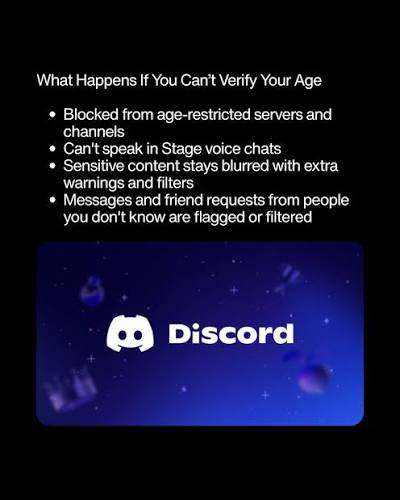
Discord's new system uses an age-inference model developed by the company.
Rather than reading private messages, Discord says the model looks at broader patterns associated with an account. These can include how long an account has existed, the communities and servers it belongs to, connected games, payment information, and general activity patterns.
The goal isn't necessarily to determine someone's exact age.
Instead, Discord wants to classify accounts into broad groups such as:
Teen: 13–17
Adult: 18+
Unconfirmed: Discord doesn't have enough confidence to make the determination
Discord says it does not use message content, calls, or conversations to make the prediction.
That distinction is important.
But it doesn't eliminate the underlying privacy debate.
The Privacy Problem Isn't Just About ID Scans
The obvious privacy nightmare with online age verification is the database.
Give a company a driver's license, passport, or facial scan, and there is always a question about where that information goes, who processes it, how long it is stored, and what happens if the system is compromised.
Discord experienced exactly the kind of incident that makes those concerns difficult to dismiss.
In September 2025, an unauthorized party compromised 5CA, a third-party customer-service provider used by Discord. Discord said approximately 70,000 users may have had government-ID photos exposed, alongside other information connected to customer-support interactions.
The incident was not a breach of Discord's own core systems, according to the company. But for users, the distinction may offer limited reassurance.
The sensitive information still existed within a service ecosystem connected to Discord.
And that history is now part of the conversation surrounding Discord's new age-assurance system.
The EFF's Broader Privacy Argument
The Electronic Frontier Foundation has raised broader objections to online age-verification requirements.
The organization's argument is bigger than Discord specifically.
Age verification creates another opportunity for sensitive personal information to be collected, transferred, stored, or exposed.
That makes Discord an interesting test case.
The company is essentially trying to solve the privacy problem by moving the verification process upstream: instead of asking users to prove their age every time, its systems attempt to determine an age group automatically.
The question becomes whether behavioral inference is preferable to identity-based verification—or simply a different form of surveillance.
Discord's Defense: Less Data, Less Friction
Discord's argument is straightforward.
The company says most users won't need to manually verify their age because its model can determine an age group with sufficient confidence.
Discord says more than 90% of users won't be asked to manually confirm their age under the new approach.
For users who do need additional confirmation, Discord has introduced multiple options, including facial age estimation, ID checks, credit-card-based checks, and other methods depending on region and availability.
Discord also says facial age estimation can be performed on the user's device, meaning the facial scan itself isn't necessarily sent to Discord or its verification vendors.
Discord's stated philosophy is therefore:
Don't collect someone's identity if all you need is their age group.
That's a meaningful privacy improvement over building a giant centralized database of identity documents.
But it doesn't answer every concern.
So What Does Discord Actually Know?
This is where the new model gets interesting.
Discord says its age-inference system doesn't read messages or calls. Instead, it learns patterns from account behavior.
That can include things such as:
How long an account has existed
Which communities it belongs to
General activity levels
Connected games
Other account-level signals
Discord says no individual server determines someone's age and that the system looks at patterns across multiple signals.
That distinction matters.
A behavioral model can operate without reading the contents of private conversations while still making inferences about the person behind an account.
And machine-learning systems can make mistakes.
The False-Positive Problem
No age-estimation system is perfect.
Discord acknowledges that its model can get an age classification wrong and provides additional verification options when that happens.
Imagine an adult who is incorrectly categorized as a teenager.
The consequences could include restrictions on:
Age-restricted servers
Age-restricted channels
Sensitive content
Certain safety settings
An incorrectly classified teenager could face the opposite problem.
This is one reason Discord separates age inference from definitive identity verification.
The model makes a prediction. When confidence is insufficient or when a user needs access to an age-restricted feature-additional confirmation may be required.
Why the 2025 Breach Still Matters
This is where Discord's history makes the current rollout particularly sensitive.
Discord has acknowledged that the 2025 third-party incident contributed to skepticism surrounding its age-assurance plans. The company says the vendors now used for age assurance were not involved in that incident and that it no longer works with the compromised customer-service provider.
Discord has also introduced stricter requirements around data minimization and deletion.
According to the company's current approach, age-assurance vendors are expected to collect only what is necessary and delete verification data after the check is completed. Discord says it receives an age signal rather than the underlying identity documents or biometric information.
Those safeguards are important.
But the breach remains relevant because it demonstrates the fundamental problem privacy advocates worry about:
Every additional company or vendor that handles sensitive verification data becomes another potential point of failure.
What Happens Next?
Discord's age-assurance system is now being rolled out more broadly.
The most important things to watch aren't simply whether the model works.
They're how often it gets users wrong, how transparent Discord becomes about its signals, and what happens when users challenge an incorrect classification.
Discord has indicated that it plans to provide additional information about the system, including its signal categories and privacy constraints.
That transparency could become increasingly important as more platforms experiment with behavioral age estimation.
The larger industry question is also becoming unavoidable:
Should proving that you're an adult require revealing who you are or should platforms be allowed to infer your age from how you behave?
Discord is betting on the second option.
🎮 The Bottom Line
Discord's new age-inference system represents a major shift in how online age verification can work.
Instead of routinely asking users for IDs or facial scans, Discord is using machine learning and account behavior to predict whether someone is a teen or an adult. The company says it doesn't inspect private messages or calls and has designed its system to minimize the personal information it receives.
But the privacy debate hasn't disappeared, it has changed shape.
The 2025 third-party breach involving potentially 70,000 affected users is a powerful reminder of why people are wary of handing sensitive information to verification systems.
Discord's new approach may reduce the need for those uploads, but it also puts behavioral prediction at the center of the age-verification debate.
Would you rather Discord estimate your age from your account behavior, or would you prefer to verify it directly with an ID or selfie? Let us know in the comments.