
AMD Ryzen 9 PRO 9965X3D: Why AMD Is Bringing V Cache to Workstations
The Ryzen 9 PRO 9965X3D is where AMD’s gaming technology officially starts crossing into serious professional computing.
With 16 Zen 5 cores, 32 threads, up to 5.5 GHz boost and a massive 128 MB of L3 cache, the new PRO flagship is not simply another workstation CPU. It is AMD’s clearest attempt yet to bring its successful 3D V Cache technology into commercial desktops.
And that raises an interesting question.
Why does a workstation CPU need the same cache technology that made AMD’s X3D gaming chips so popular?
🧠 From Gaming Hardware to Professional Workstations
For years, AMD’s 3D V Cache technology was closely associated with gaming.
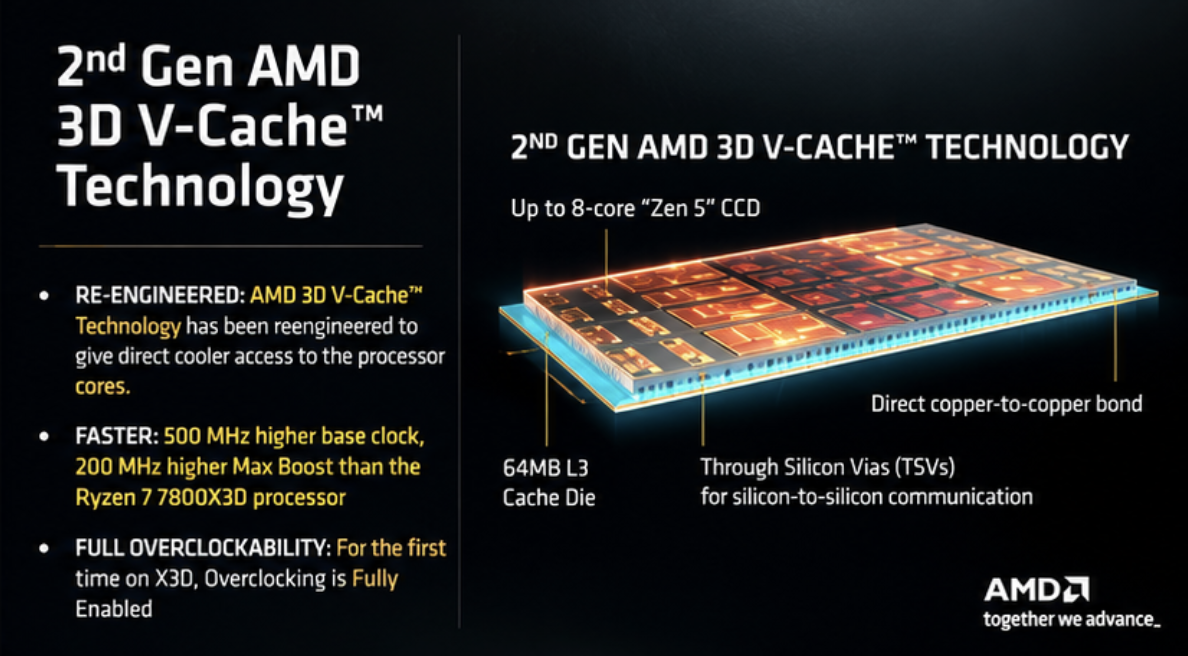
The basic idea is simple. Instead of relying only on the cache built directly into the CPU chiplet, AMD stacks additional cache on top of it. This gives the processor much more high speed data storage without requiring a larger conventional CPU design.
The Ryzen 9 PRO 9965X3D takes that idea into AMD’s commercial workstation lineup for the first time. AMD says select Ryzen PRO 9000 processors are its first commercial desktop chips to feature 3D V Cache.
That is a significant change in direction.
Gaming technology → larger cache → professional workloads
The reason is that modern workstation applications can also benefit when the CPU can access frequently used data without constantly going back to system memory.
⚡ What Makes the Ryzen 9 PRO 9965X3D Different?
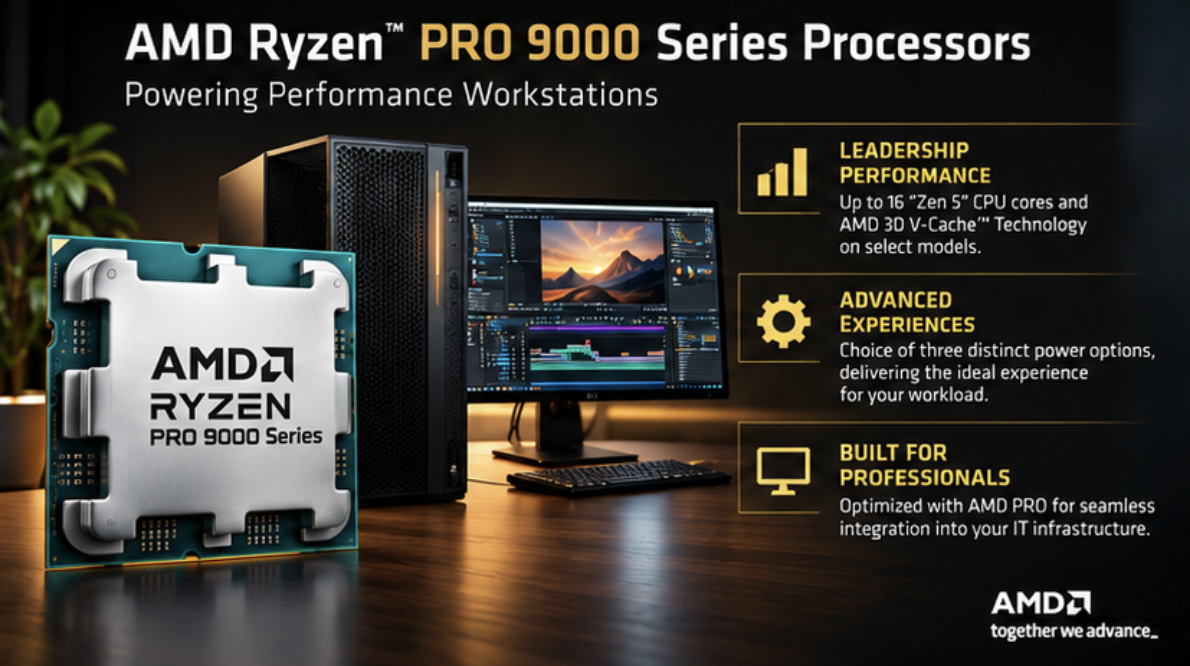
The specifications immediately put it near the top of AMD’s desktop workstation lineup.
| Specification | Ryzen 9 PRO 9965X3D |
|---|---|
| Architecture | Zen 5 |
| Cores | 16 |
| Threads | 32 |
| Base Clock | 4.3 GHz |
| Boost Clock | Up to 5.5 GHz |
| L3 Cache | 128 MB |
| TDP | 170W |
| Socket | AM5 |
| Memory | DDR5 |
| ECC | Supported |
| PCIe | PCIe 5.0 |
AMD lists the processor with 128 MB of L3 cache and a 170W default TDP, while maintaining support for up to 256 GB of DDR5 memory.
This is also a major step for the PRO family because the flagship model pushes workstation Ryzen PRO processors beyond the traditional lower power configurations.
🚀 Why 128 MB of Cache Actually Matters
More cache does not automatically make every application faster.
That is the important distinction.
Cache becomes valuable when software repeatedly works with datasets that can benefit from staying close to the CPU. In those situations, having more L3 cache can reduce expensive trips to system memory.
AMD specifically positions its new Ryzen PRO 9000 processors for workloads including:
- Simulation
- Rendering
- Real time visualization
- CAD and engineering
- Software development
- AI assisted workflows
- High resolution content creation
AMD says the additional cache can accelerate data access in complex, data intensive workloads such as simulation, rendering and real time visualization.
That makes the X3D approach much more interesting outside gaming.
🎮 The Gaming DNA Is Still Visible
The 9965X3D is essentially an example of AMD taking a technology proven in enthusiast hardware and adapting it for business machines.
The closest consumer comparison is the Ryzen 9 9950X3D, although the PRO model has a lower maximum boost clock.
The 9965X3D reaches 5.5 GHz, while AMD's consumer Ryzen 9 9950X3D can reach 5.7 GHz. The PRO chip trades some enthusiast focused features for enterprise requirements and platform management.
It is also not unlocked for overclocking, and AMD does not support EXPO or Precision Boost Overdrive on the PRO model.
That tells you exactly who this processor is designed for.
Not the person tweaking voltages at 2 AM.
The target is the professional workstation sitting on an engineer's, developer's or creator's desk every day.
🏢 Why AMD Wants X3D in Enterprise PCs
The workstation market is changing.
Professional applications increasingly involve massive datasets, real time visualization, local AI workloads and increasingly complex simulations.
At the same time, companies want systems that remain stable and manageable across large deployments.
That is where AMD PRO technology becomes important.
The Ryzen PRO platform adds enterprise focused security, manageability and long term platform support alongside the raw CPU performance.
So AMD is effectively combining two different philosophies:
X3D = maximum data proximity
PRO = enterprise reliability and management
Zen 5 = high compute performance
Together, they create a workstation CPU that looks surprisingly similar to a gaming flagship under the surface.
🧩 The Bigger Strategy
This launch is bigger than one processor.
AMD is clearly becoming more comfortable moving technologies between its consumer and professional product lines.
3D V Cache started as a major advantage for gaming CPUs. Now AMD is arguing that the same fundamental idea can help professional workloads.
That could influence how future workstation processors are designed.
Instead of simply adding more cores, manufacturers can increasingly focus on how quickly those cores can access the data they need.
And for certain applications, that can be just as important as raw core count.
🔥 Where the 9965X3D Fits
The Ryzen 9 PRO 9965X3D is not intended to replace Threadripper PRO.
AMD's Threadripper PRO 9000 WX series goes dramatically further in core count, reaching up to 96 cores and 192 threads with up to 384 MB of L3 cache.
Instead, the 9965X3D occupies an interesting middle ground.
You get:
16 powerful Zen 5 cores
↓
128 MB L3 cache
↓
170W workstation platform
↓
AMD PRO security and manageability
↓
AM5 desktop ecosystem
For professionals who do not need dozens of CPU cores, this could be a much more balanced workstation solution.
🏁 The Real Reason AMD Is Doing This
The Ryzen 9 PRO 9965X3D shows that AMD no longer sees 3D V Cache as purely a gaming feature.
The company is taking one of its most recognizable enthusiast technologies and adapting it for professional workloads where cache capacity can influence responsiveness and data intensive performance.
The interesting part is not simply that AMD built a 128 MB cache workstation CPU.
It is that the boundary between gaming hardware and professional hardware is becoming increasingly blurred.
The same technology that helps a gaming CPU keep more game data close to its cores can also help engineers, developers and creators work with demanding datasets.
AMD's message is clear: if extra cache can make a gaming CPU faster, there are professional workloads that can benefit from it too.
And the Ryzen 9 PRO 9965X3D is the first major PRO processor to put that idea into practice.