
EVE Frontier is a weird game. It's had an uphill battle winning goodwill from EVE Online's infamously dedicated community, running into a refrain of, "Why should I play this crypto spinoff thing?" It's gone through traditionally closed, often unsightly stages of early development in full public view, with players offering feedback along the way.
It has justified its blockchain integration, to my eye, by repeatedly demonstrating a freeform, server-side modding system unlike anything I've seen in an MMO—or really any game—and it's stuck with the controversial tech base well after the early 2020s crypto gaming gold rush ended.
At this year's EVE Fanfest, I spoke to members of the dev team and tried Frontier's new gamepad support for myself. Promises that were once cool but abstract are starting to crystalize into a hardcore space sim I can see myself playing. Frontier is a game that promises to combine the emergent economy of EVE, the sense of exploration in No Man's Sky or Elite, and two things I've never seen before: The aforementioned server-side modding at runtime, and a Rust-like survival experience that trades tree punching and bedrolls for asteroid mining and space stations.
Fragging out
My latest hands-on was night and day from my experience almost exactly a year prior: Frontier was built on the same Carbon engine as EVE Online, and until recently had similarly zoomed-out, mouse, menu, and hotkey-centric gameplay. This was a two-pronged problem, as Frontier needed to differentiate itself from what EVE fans already had and also make itself more approachable for new players.
Even as a lover of crusty old CRPGs with way too many stats and classes, the first build of Frontier I tried was tough to get my arms around. Luckily, it's a problem the dev team was aware of. "Let's go back a year ago. Get into the game, so you think Q or W or something, right? And nothing happens," Frontier product manager Scott McCabe told me. "You're like, 'Okay, so how do I move?' There's a disconnect, so it's about making the thing more natural."
Fenris Creations (formerly CCP) had demo stations set up on the Fanfest show floor, and the Frontier team was offering a combat arena slice of the game, with show goers trying to frag each other on a 10-minute timer. On two runs through, I think I scored three kills total—the record on the floor was four in a single run, to give you an idea of the slow time to kill—and it's shocking how good of a space shooter it was given Frontier's origins as an RTS-scale MMO.
It was slow—not in a bad way, but weighty and chunky like a survival horror game. McCabe stressed that they weren't trying to make a zippy starfighter sim, but rather a big boys-only experience, one where the smallest vessels you could use were corvette-scale.
The free-for-all took place among debris and ruins in a moody nebula, and the close-in perspective gave me a new appreciation for Frontier's art direction and sound design. The thrum of your ship and the distant sound of fire being exchanged were substantial but muffled, like being underwater.
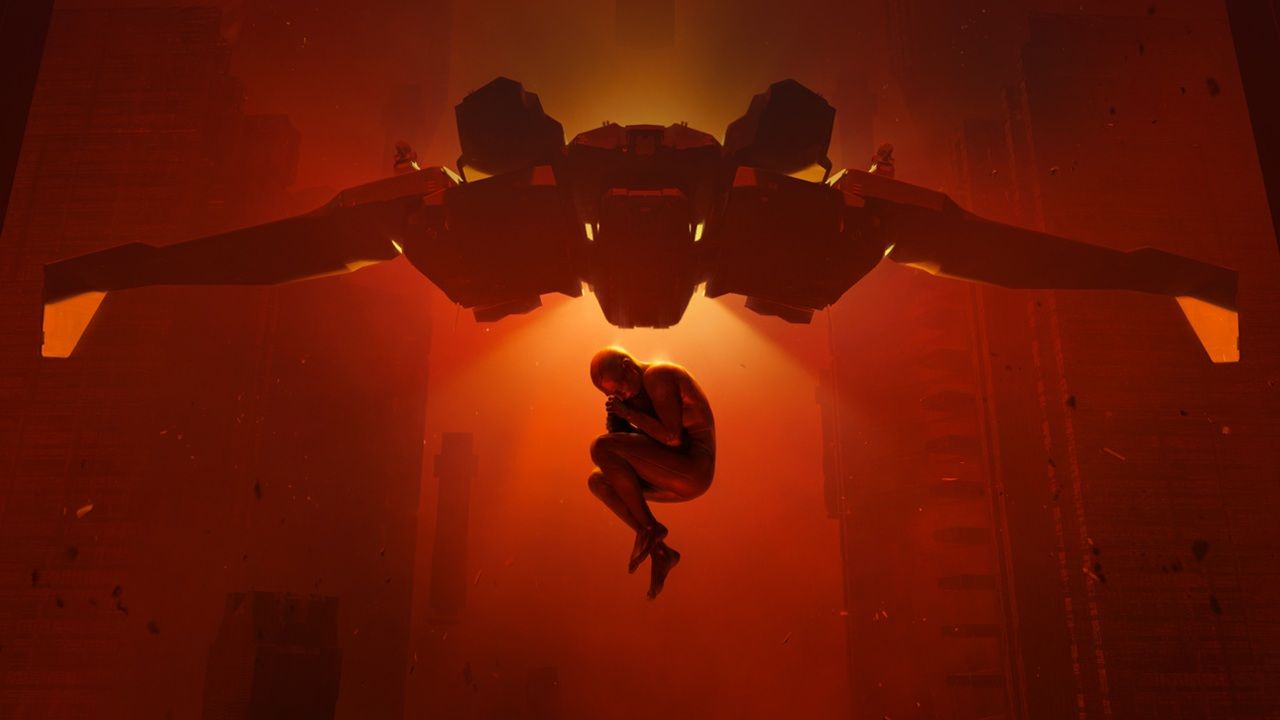
Meanwhile, there's been so much focus on Frontier's tech backend and emergent possibilities that it's easy to overlook the game's striking look. It's the sleek cyberpunk of EVE Online crossed with something ancient and unknowable: Ziggurats in space and disturbing, mega-scale statuary emerging out of nebulae like the dusty ruins of Las Vegas in Blade Runner: 2049. Even the UI is memorable, boasting a minimalist, retro computing vibe that reminds me of Bungie's Marathon.
In a major departure from EVE Online, Frontier now offers both manual aiming and auto-targeting weapon systems, with the choice between the two being a balance and player preference question: Big, meaty skillshots, or reliable slow-burn auto targeting? I had one weapon system of each type in the demo, but I relied more on the skillshots. "This is a pretty huge departure, obviously, from EVE Online," said Fenris community developer Ben Sisson. "EVE Online is much more like a MOBA in that way, where you just sort of select the target, you press the button, and it'll auto-target."
There was this great tension to chasing down opposing players, missing a shot as they banked and flew behind me, then having to slowly bring my ship around for another volley. Sisson described what they were going for as "like World of Warships in space."
At this stage, the main thing I found missing was feedback: The UI was still very much a fit for a mouse, keyboard, and desktop monitor that I found hard to parse on a big TV, and my FPS-loving brain yearned for clearer indications of weapon cooldowns, enemy health, and when I'd successfully scored a hit—even the vulgar pft pft of CoD hit markers would have been welcome. But I very much got the vision of tense, ponderous submarine duels in space, I'd gladly play again, and Frontier's devs say it's just the beginning.
Future perfect
(Image credit: Fenris Creations)
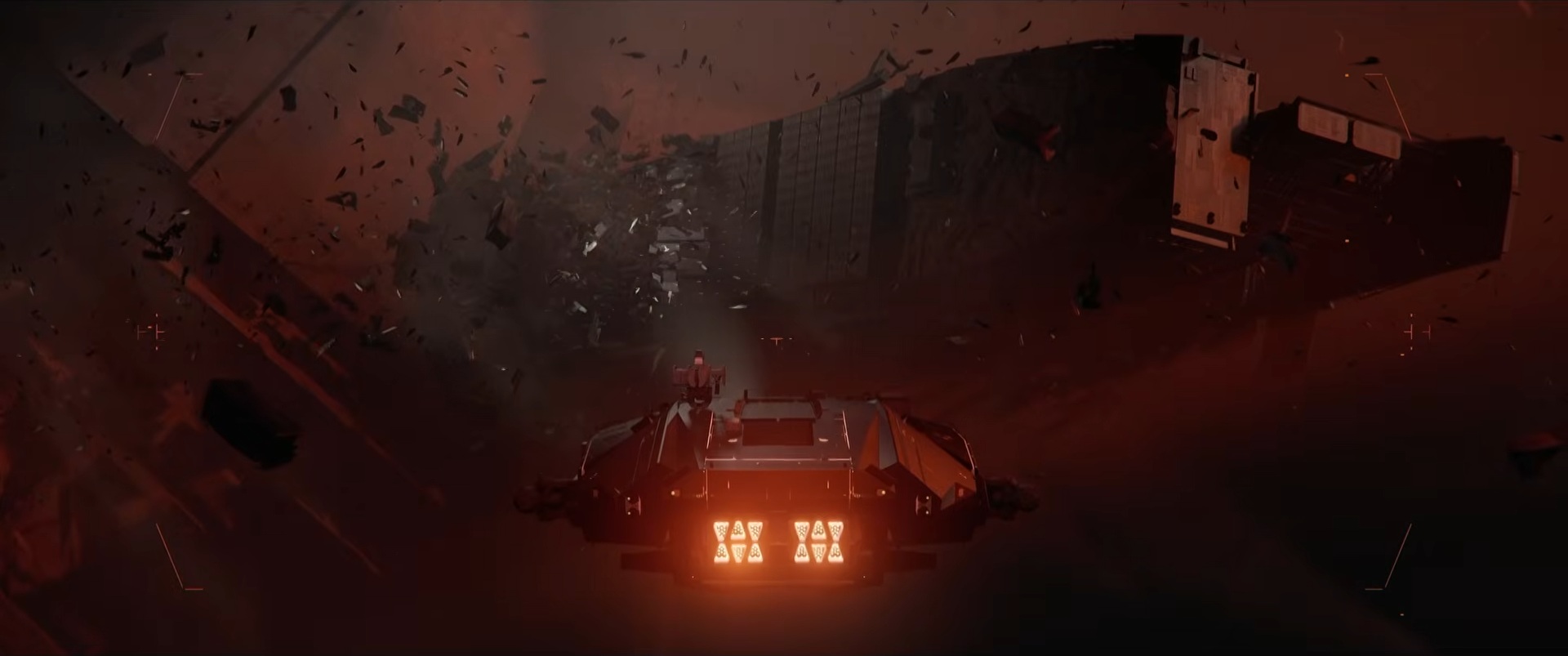
One thing that really intrigues me is where Frontier is going with those megastructures, the ziggurats in space. The team is treating them less like the highly-crafted dungeons in other MMOs, and more like the ones in the Elder Scrolls: They're desolate points of interest that can surprise you while you're scanning a system or on your way from one place to another. In a hands-off demo, I was shown gameplay exploring one such megastructure, turning Frontier into something more resembling a six degrees of freedom shooter like Descent.
"Environments have to be the focus," said Sisson, "And have had to be the focus for a while, especially interior spaces. It's cool just to go through space, and that's awesome, but a lot of games do that." He explained that very few space games do the same sort of seamless interior/exterior transitions as Frontier because the scale is so daunting.
"A lot of the things that are going on, though, are about the camera and not the ship," Frontier development director David Bowman explained regarding refinement of the driving controls. "We can easily get the ship to be physics-accurate and modeled, but the camera is your way of perceiving that. We want to make sure that you stay comfortable, that you stay in control, and that you don't get the 360 blur of which way is up. It's more about the camera than it is about the ship."
50px;">